
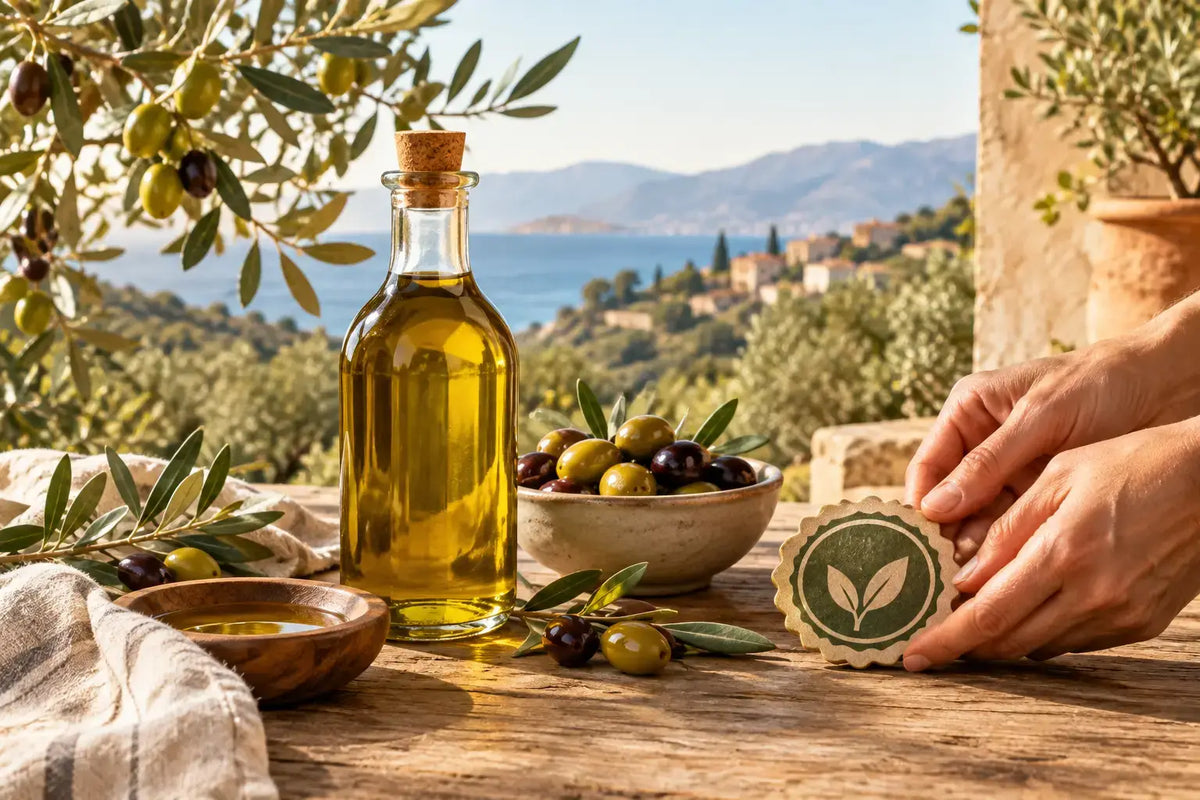
An organic seal on olive oil is a clear sign against mindlessly grabbing an anonymous bottle. It says: The olives were grown and inspected according to binding organic rules. But anyone looking for truly good olive oil should not stop at the seal. Because organic answers a central question about agriculture—but not automatically the questions of freshness, origin, taste, and artisanal processing.
The honest answer is therefore: Organic is a strong foundation. It is not a quality judgment of every detail of the oil. Anyone who cooks consciously can demand both: certified cultivation and uncompromising quality in the glass or bottle.
What the organic seal on olive oil guarantees
The green EU organic logo may only appear on foods that meet the requirements of the European organic regulation. For olive oil, this primarily concerns olive cultivation. Synthetically produced chemical pesticides, highly soluble mineral nitrogen fertilizers, and genetically modified organisms are generally excluded from organic farming.
Instead, organic farms use methods intended to keep the soil fertile in the long term: cover crops between the trees, organic fertilization, mechanical care, and a close eye on natural cycles. This sounds obvious, but it is by no means the standard in conventional intensive farming. An olive grove is not a sterile production space. Good agriculture must work with it, not against it.
The organic seal also includes inspection by approved control bodies. In addition to the EU organic logo, the packaging must display a control body code, such as DE-ÖKO-XXX. Below or next to it, it is stated whether the agricultural raw materials come from the EU, from non-EU countries, or from a combination. This information is mandatory, but often very general. “EU agriculture” does not yet reveal which grove the olives come from or who harvested them.
With pure olive oil, the matter is relatively clear: It consists of olives. Unlike with a composite organic product, it is not about achieving a minimum proportion of organic ingredients. The crucial point is that the olives used come from certified organic cultivation and that the processing is transparently controlled.
Organic does not automatically mean exceptionally good
An organic seal protects against certain practices in cultivation. However, it neither guarantees that the olives were harvested early nor that they were pressed on the same day. It does not promise a specific variety, low acidity, a high concentration of polyphenols, or a vibrant taste.
This is exactly the difference between organic oil and great organic olive oil. Olives are extremely sensitive after harvest. If they lie in sacks or piles for too long, their quality begins to suffer. The oil can taste flat, dull, or flawed, even though the olives were grown organically. Industrial processing under time and price pressure also does not turn good agriculture into a top product.
Organic does not automatically mean “extra virgin” either. This highest statutory quality class requires its own chemical and sensory criteria. An oil may only call itself extra virgin olive oil if it meets, among other things, very low limits for free fatty acids and shows no flaws during sensory testing. Organic and extra virgin are two different statements. Only together do they form a meaningful quality standard.
Anyone who buys oil with an organic seal is therefore not blindly buying quality. But they are making a conscious preliminary selection. This is more than a marketing detail—and yet only the first look at the label.
This information is crucial in addition to the seal
Good olive oil has nothing to hide. The more concrete a producer speaks about origin and production, the better its quality can be assessed. Vague formulations such as “from the Mediterranean region” or “a blend of olive oils from the European Union” may be legally correct. For people who want to know what they eat, they remain unsatisfying.
Therefore, pay attention to the origin of the olives, not just the bottling location. Were they harvested in Greece, Italy, or Spain? Is a region, village, grove, or even variety mentioned? Koroneiki olives, for example, stand for Greece and can—if properly harvested and processed—produce an intensely fruity oil with a pleasantly bitter and peppery note. The variety alone is not proof of quality. But it makes the taste predictable.
At least as important is the harvest year. Olive oil is not like wine, which improves with long storage. It thrives on freshness. A current harvest date shows that a manufacturer takes this point seriously. If it is missing, only the best-before date remains. That is better than nothing, but no substitute: It says how long an oil should last, not when the olives were harvested.
Information about the mill also deserves attention. An in-house harvest and an in-house or closely affiliated mill shorten distances and create accountability. Are the olives processed quickly after harvest? Is the extraction gentle and under controlled conditions? Such questions are not academic. They determine whether the aromas of the fresh olive are preserved or whether you end up with an arbitrary oil in a nice package.
Correctly interpreting laboratory values
Laboratory analyses can create transparency if they are communicated clearly. Free fatty acids are mentioned particularly frequently. For extra virgin olive oil, the statutory upper limit is 0.8 percent. A significantly lower value can indicate carefully harvested and quickly processed olives. However, it is not a free pass: An oil can have low acidity and still disappoint in taste.
Polyphenols are also exciting. These natural plant compounds contribute to the bitterness and pungency of a fresh olive oil and protect the oil from oxidation. High values are a quality marker for many people, but not an end in themselves. Not every dish requires maximum intensity. For a tomato salad, roasted vegetables, beans, or simply good bread, an oil can show character. For fine desserts or very subtle dishes, a milder oil sometimes fits better.
The crucial point is whether laboratory values are part of an honest overall information. Anyone who only advertises with a number, but leaves harvest, origin, and taste vague, is selling statistics instead of conviction. Good producers explain what their values mean—and how the oil tastes.
Organic farming is not a pesticide-free myth
The term “organic” is often confused with “completely untreated.” This is not true. Certain substances can also be used in organic farming if they are approved under organic rules. The difference lies in the system: Organic relies on preventive measures, soil care, and significantly stricter limitations on available inputs.
This is no small thing. But it is also no reason for romantic simplifications. An organic seal does not replace a look at the farm. How are the trees cared for? How is water used? How fair and long-term are the relationships with the people on site? Is the origin openly stated? Sustainability is not shown by a logo alone, but by traceable decisions throughout the entire harvest.
This is especially true for imported olive oil. Long supply chains, changing batches, and anonymous bulk blends can dilute trust, even if organic certification is present. Direct relationships with the producer and full traceability make the difference between a claim and a reliable promise.
How to buy organic olive oil with standards
Start with the organic seal and the control body code. Then look for a clear origin, a stated olive variety, and the harvest year. Check whether extra virgin olive oil is explicitly declared and whether the supplier provides information about the mill, laboratory values, and the taste profile.
After that, the palate decides. A fresh, high-quality oil may smell of green olives, freshly cut grass, tomato leaves, almonds, or herbs. Bitterness and a slight pungency in the throat are not flaws in fresh oils, but often a sign of vibrant ingredients. Rancid, musty, vinegary, or greasy-waxy notes, on the other hand, are not part of the character of a good oil.
This is why organic is not the only thing on the label at O.E.L. Berlin. Koroneiki olives from our own harvest and our own mill combine certified cultivation with an origin that does not remain vague. No industry. No anonymous blends. No oil that is only supposed to look good.
In the end, a simple attitude pays off: Do not buy organic olive oil just to check off a symbol. Buy it from people who can show you where their olives grow, when they are harvested, and why their oil tastes the way it does. Then an ingredient becomes something that makes every meal clearer, more vibrant, and more honest.


Leave a comment
All comments are moderated before being published.
This site is protected by hCaptcha and the hCaptcha Privacy Policy and Terms of Service apply.