
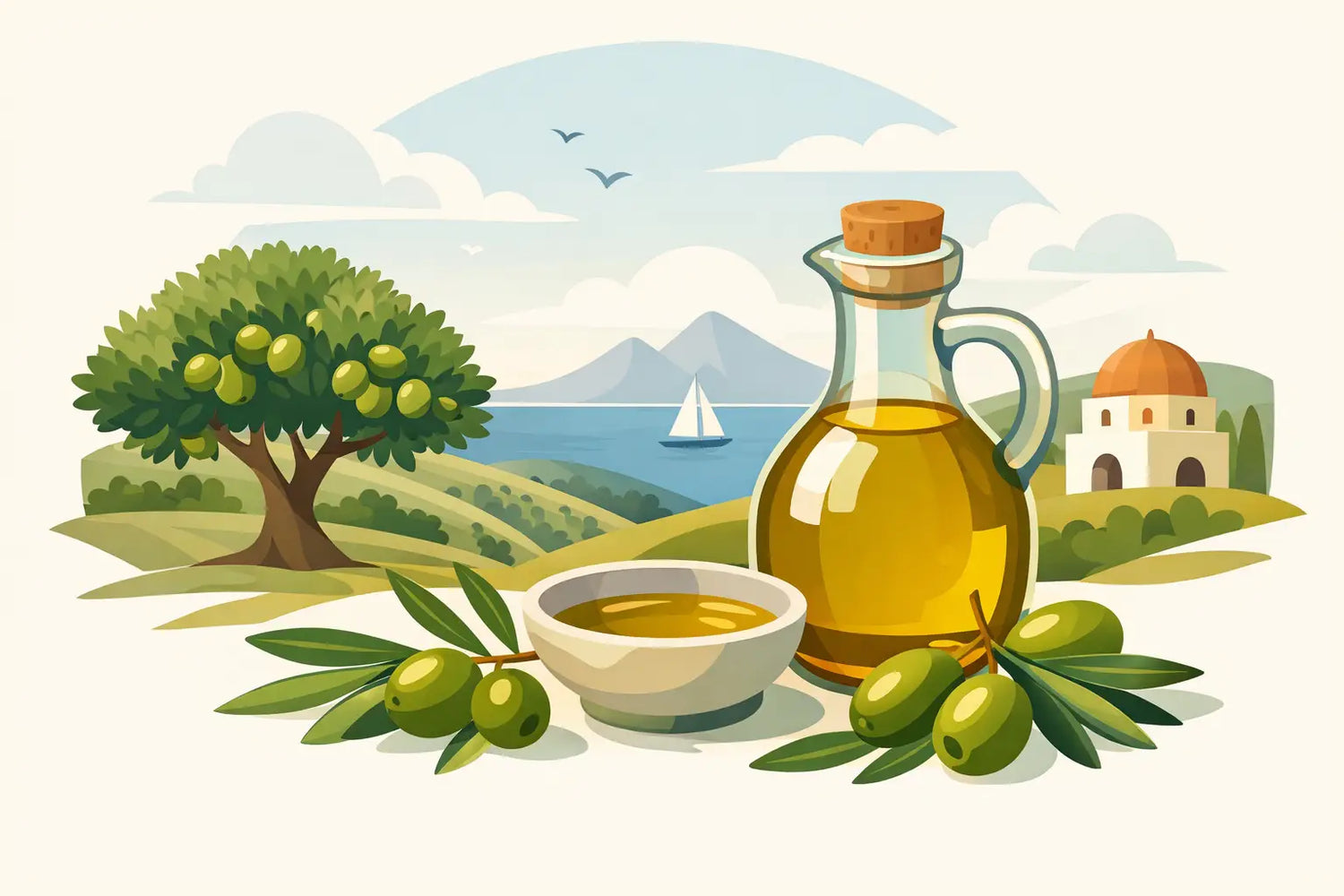
Anyone who has tried a truly fresh Koroneiki olive oil quickly realizes: this is not just "olive oil" as stated on countless supermarket bottles. The question "what is Koroneiki olive oil" therefore aims at more than just an olive variety. It leads directly to origin, harvest time, mill, freshness, and the very simple question of whether the product still has character – or just fat.
Koroneiki Olive Oil – What Exactly Is It?
Koroneiki is a Greek olive variety. It is considered one of the most important varieties for high-quality extra virgin olive oil and is particularly widespread in the Peloponnese, Crete, and other regions of Greece. So, when people talk about Koroneiki olive oil, they mean an oil obtained from Koroneiki olives.
This sounds simple at first. However, what this variety can achieve sensorially and qualitatively is crucial. Koroneiki olives are small, aromatically concentrated, and known for producing oils with a distinct aroma, fresh bitterness, and noticeable pungency. These very characteristics are not a flaw but often a sign of freshness and a high content of natural plant compounds, especially polyphenols.
Those accustomed to mild, flat, and almost tasteless oils often experience Koroneiki as a counterpoint. Herbaceous. Green. Peppery. Sometimes with notes of tomato leaf, artichoke, green almond kernel, or freshly cut grass. No industry. No watered-down arbitrariness. But an oil with attitude.
Why the Variety Alone Does Not Guarantee Quality
This is the point that many labels prefer to omit. Koroneiki is a strong variety, but it is not a quality guarantee per se. Even an excellent olive can yield mediocre oil if harvested too late, poorly stored, or uncleanly processed.
Good Koroneiki olive oil results from the interplay of several factors. The harvest time influences aroma and polyphenol content. The time between harvest and pressing determines freshness. The milling technique plays a role in how cleanly and precisely the work is done. Light, oxygen, and heat after bottling also make a noticeable difference.
Therefore, the statement "from Koroneiki olives" is not sufficient if everything else remains unclear. Those seriously seeking quality look for traceable origin, harvest year, processing, and ideally analytical values such as free fatty acid and polyphenol content. Anything else is often just pretty packaging.
What Makes Koroneiki So Special in Taste
Koroneiki oils are rarely neutral. And that's a good thing. A high-quality example brings freshness and excitement to food, rather than just laying a fatty layer over it. This is particularly crucial in Mediterranean cuisine, where olive oil is not just cooking fat but a seasoning.
Typical characteristics are green, vibrant aromas. Additionally, bitterness and pungency are present in a balanced ratio. These two properties initially deter some buyers, although they are desirable in fresh extra virgin olive oil. Bitterness can resemble chicory or artichoke, and pungency can be like white pepper in the throat. Both often indicate phenolic freshness.
Of course, here too: it depends. Not every Koroneiki oil tastes equally intense. Region, climate, ripeness, and processing significantly alter the profile. An early-harvested oil often appears greener, more distinctive, and sharper. Later-harvested batches can be rounder and softer. Those who enjoy bold cooking usually prefer the expressive style. Those seeking a milder oil for fish or delicate vegetable dishes are more likely to choose a more balanced harvest.
Origin Beats Marketing
Labels quickly say "Greek," "premium," or "extra virgin." That sounds good but often says surprisingly little. A truly good Koroneiki olive oil tells you more precisely where it comes from. Not just the country, but the region, harvest, mill, and ideally even the specific farm should be traceable.
Why is this so important? Because transparency is the simplest protection against anonymous mass-produced goods. Many commercially available oils are blends from different origins, harvests, or qualities. They are trimmed to an agreeable average taste. The result is stable but interchangeable. Those interested in single-varietal Koroneiki usually seek the exact opposite: clarity instead of compromise.
When a producer discloses that the olives come from their own harvest, were processed in their own or clearly named mill, and the oil is fully traceable, that is not a romantic detail. It is a quality proof. O.E.L. Berlin focuses precisely on this: origin not as decoration, but as a verifiable statement.
How to Recognize Good Koroneiki Olive Oil
You don't recognize good oil by golden colors or Mediterranean pictures on the bottle. Color is hardly meaningful. Smell, taste, and reliable information are crucial.
When you open the bottle, the oil should smell fresh, not stale. Aromas of green herbs, leaves, tomato, or fresh olive are a good sign. In the mouth, it may be bitter and slightly pungent, but not dull, rancid, or flat. Rancidity resembles old nuts, stale fat, or wax. Such notes have no place in a high-quality oil.
In addition, a look at hard facts helps. A low acid value is relevant, even if it alone does not guarantee top-notch sensory qualities. High polyphenol values can indicate freshness and stability. A specific harvest year is better than vague formulations. Dark or light-protected packaging is more sensible than transparent decorative bottles. And if an oil tastes the same in large batches for years, one should be skeptical.
Is Koroneiki Olive Oil Healthier?
The honest answer is: it depends, but often yes. Koroneiki is known for producing oils with a high polyphenol content, especially when harvested early and processed cleanly. These natural antioxidants are one reason why high-quality extra virgin olive oil is so nutritionally valued.
Nevertheless, one should not blindly believe every health claim. Not every Koroneiki oil is automatically rich in polyphenols, and not every mild oil is bad. The real quality of the batch is decisive. Those who buy olive oil only as "healthy fat" often opt for generic products and miss out on its best aspects: taste plus ingredients.
A strong oil can deliver both. It brings character to the plate and, if well-produced, has a convincing natural composition. That's precisely why it's worth paying attention not only to the variety but also to freshness and transparency.
What Dishes Is Koroneiki Suitable For?
Very well, in fact – if the oil is used appropriately. Robust Koroneiki oils shine raw over tomato salad, beans, grilled vegetables, burrata, feta, hummus, or on a slice of toasted sourdough bread with a little salt. The difference is immediately apparent there.
Koroneiki also works excellently for warm cooking. For oven vegetables, pasta, legumes, stews, or Mediterranean pan dishes, it brings depth and flavor. However, those looking for a very delicate dessert oil or a completely subtle finish for tender fish should choose more carefully. Not every intense Koroneiki suits every dish. Quality doesn't always mean maximum volume, but precision.
Why Koroneiki Is Often More Expensive – and When It's Worth It
A price difference has reasons. Early harvesting usually means lower yield, but more aroma and often more polyphenols. Careful processing in a short time also costs money. Small, traceable structures are not as cheap as industrial blends from anonymous sources.
The question is therefore not only what a bottle costs, but what it can do. If an oil tastes almost like nothing, you need more of it and still get less enjoyment. A characterful Koroneiki is used more sparingly and visibly elevates even simple ingredients. Good tomatoes, bread, beans, potatoes – suddenly the food feels more complete.
Those who cook often quickly notice this difference. Not as a luxury gesture, but in everyday life. Especially then, it's worth not settling for the cheapest common denominator when it comes to origin and freshness.
The Short Answer to "What Is Koroneiki Olive Oil?"
Koroneiki olive oil is oil from a top Greek variety known for aromatic, fresh, and often polyphenol-rich extra virgin olive oils. But it only becomes an oil worthy of its name with transparent origin, clean processing, and genuine freshness.
So, the next time you stand in front of a bottle, don't just ask about the variety. Ask about the harvest, the mill, the batch, and the taste. Good olive oil doesn't need to gloss over anything. It just needs to be honest – and deliver on the plate.

Leave a comment
All comments are moderated before being published.
This site is protected by hCaptcha and the hCaptcha Privacy Policy and Terms of Service apply.