
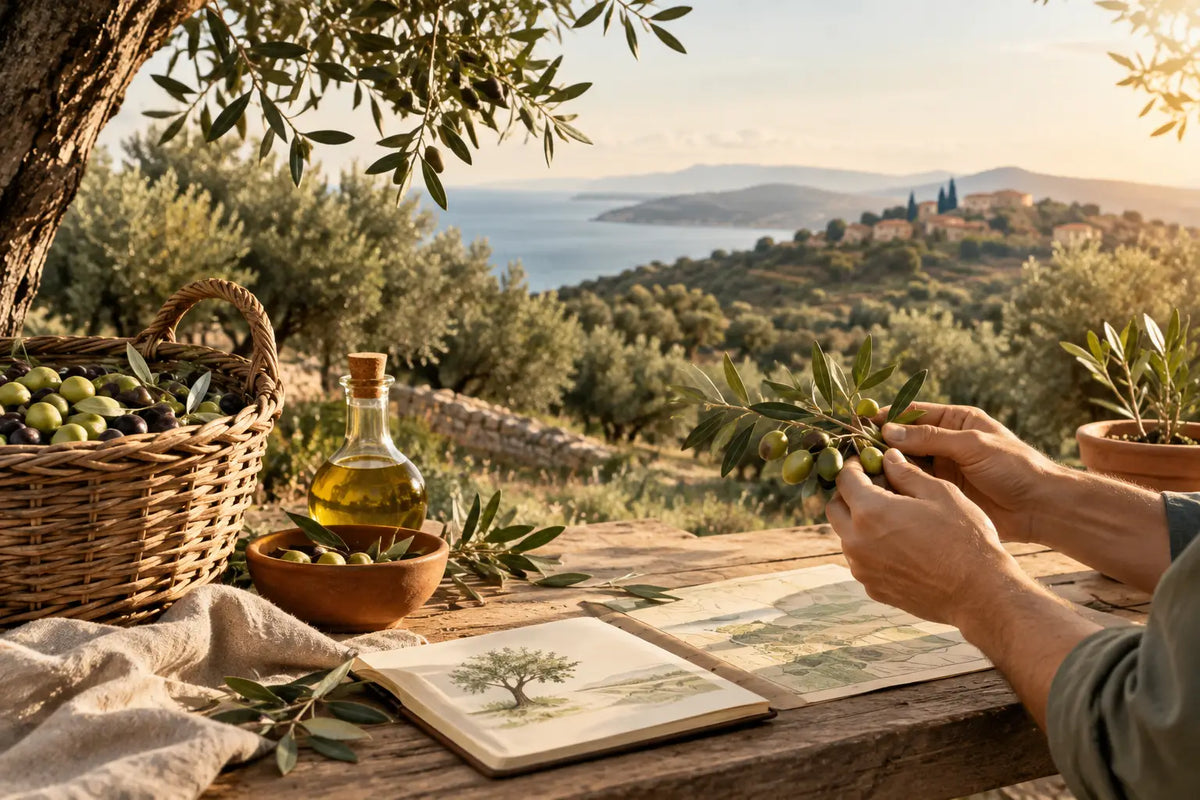
An olive grove is not automatically sustainable just because it is located in the Greek sun and a branch of olive is depicted on the bottle. This is exactly where the orientation for sustainable olive cultivation begins: with questions that go beyond organic labels, beautiful labels, and general origin promises. Anyone who buys good olive oil also decides how soils are cared for, water is used, harvests are processed, and people along the supply chain are treated.
Sustainability is not a single value on a certificate. It arises from the interplay of agriculture, artisanal processing, short distances, and honesty that can be verified. This makes the selection more demanding. But also clearly more rewarding—for the taste on the plate and for the landscape it comes from.
Orientation for sustainable olive cultivation begins in the soil
The soil is the foundation of every olive oil. A sustainably managed grove does not treat it as a mere area for maximum yields, but as a living system. Between the trees, herbs, grasses, or targeted cover crops often grow. They protect against erosion, promote insects, and help the soil retain moisture.
This is especially crucial in dry regions. When heavy rain hits bare, compacted earth, it takes valuable topsoil with it. What may look like a neatly maintained grove in the short term is a long-term loss of fertility. Soil care therefore also means tolerating disorder: some vegetation between the rows, organic material, and an agriculture that does not want to control every square meter.
Organic farming is an important point of reference for this, but not a free pass. It limits synthetic pesticides and chemical fertilizers. Whether a farm really works in a soil-friendly way beyond that, however, shows in concrete practices: Is organic fertilizer used? Do pruning residues stay in the cycle? Are monocultures supplemented by natural vegetation and habitats? These questions are more uncomfortable than a label. But they lead closer to reality.
Saving water does not mean letting trees thirst
Olive trees are considered hardy. This is true—up to a certain point. Increasing heat, long periods of drought, and irregular rainfall affect even deep-rooted trees. Sustainable olive cultivation therefore needs smart water management instead of big words about Mediterranean resilience.
Rain-fed groves can be very sensible if the location, variety, and age of the trees are suitable. However, in particularly dry years, targeted drip irrigation can be a better solution than a crop failure or weakened trees. The deciding factor is not the dogma of "no irrigation at all," but the responsible use of a scarce resource: precisely dosed, adapted to the actual need, and without wasteful systems.
Here too, it pays to look for transparency. Anyone who openly declares water as part of their cultivation practice takes the reality of the climate seriously. Anyone who only works with idyllic images leaves a central question unanswered.
Freshness is also a question of the mill
An ecologically managed grove alone does not make a high-quality olive oil. Between harvest and pressing, it is decided whether healthy olives will become a fresh, aromatic extra virgin olive oil—or a product that loses its best qualities before bottling.
Olives are not shelf-stable nuts. After harvest, they begin to oxidize and ferment, especially if they lie in sacks, on trailers, or in large piles for a long time. Sustainable quality therefore requires short distances to the mill and processing without avoidable waiting time. An in-house mill or a closely affiliated mill is not a romantic detail. It creates control over temperature, hygiene, time, and the clean separation of individual batches.
An early harvest can also produce particularly aromatic oils with high polyphenol levels. This usually means less oil per olive, but more freshness, bitterness, pungency, and complex green notes in the finished oil. This is exactly where a real conflict of interest lies: maximum yield and maximum sensory quality rarely go hand in hand. Sustainability must not become an excuse to sell mediocre quality. Good agriculture and good craftsmanship must show themselves in the bottle.
Traceability instead of origin fog
"From the EU" is not an origin story. It is a large area on a bottle. Just as little does a Greek-sounding brand name automatically say anything about where the olives grew, who harvested them, or when they were processed.
Credible providers state the growing area, olive variety, harvest period, and ideally the mill. They can explain whether the oil comes from their own harvest, how batches are separated, and why acidity, polyphenols, or sensory values are relevant. Low acidity is a quality indicator, but not a taste promise in itself. It must come together with freshness, clean processing, and a lively aroma.
For buyers, this is the most practical orientation: Do not look for vague terms, but for verifiable information. An oil that does not precisely state its origin demands trust without providing a basis for it. No transparency, no good reason for a premium price.
Fair work belongs in every bottle
Olive cultivation is manual labor, even where machines provide support. Trees are pruned, nets are laid out, fruits are sorted, facilities are cleaned, and batches are monitored. Sustainability therefore does not end with soil and water. It also includes the people whose work often disappears behind an anonymous supply chain.
Fair relationships are not created by a single advertising statement. They show themselves in long-term cooperation, direct sourcing, and clear responsibilities. If several anonymous trading stages lie between the grove and the bottle, it becomes difficult to trace who receives what share of the value. Direct structures are not automatically perfect. But they make responsibility more visible—and give producers more planning security than the daily price pressure of the raw materials market.
What you can specifically check when buying
A good bottle answers more than the question of whether it is "extra virgin." First, look at the harvest year. Olive oil is a fresh food, not a collector's item. A clearly stated harvest date is significantly more meaningful than a long best-before date.
Also pay attention to the variety and the precise region. Koroneiki olives from Greece, for example, can develop an intensely green, peppery profile if they are freshly and carefully processed. However, the concrete farm remains the deciding factor, not just the name of the variety. Dark glass or light-protected packaging helps protect the oil from quality loss. Refill sizes can be sensible if they save packaging and you store the oil at home cool, dark, and well sealed.
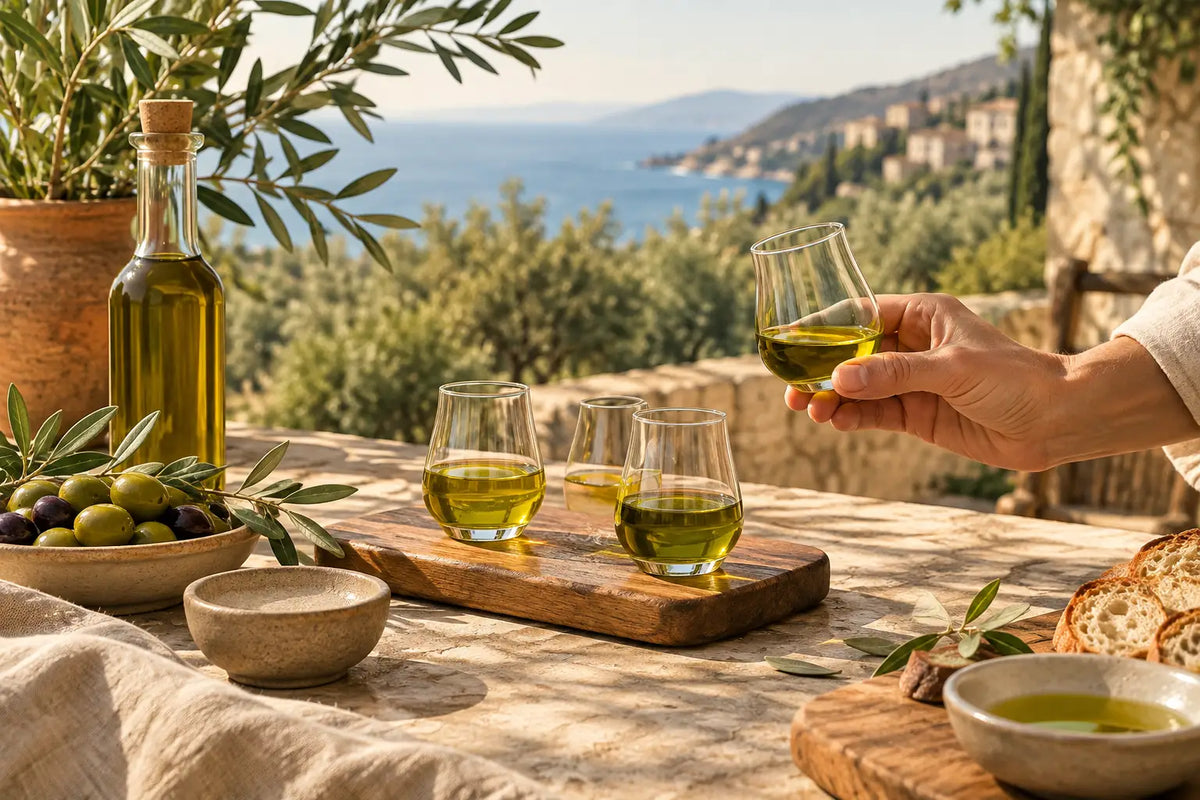
Sensorially, a fresh oil may be demanding. Bitterness and a pleasant pungency in the throat are not flaws in high-quality, polyphenol-rich oils. They are often a sign of fresh olives and careful processing. Rancid, waxy, or dull notes, on the other hand, have nothing to do with maturity. Anyone who only knows mild, almost neutral oil has often experienced only one thing: long storage and little character.
Sustainability must be tasteable and verifiable
A sustainable olive oil is not a product of compromise. It is supposed to taste better because the olives were treated better, because the distances to the mill were short, and because quality did not have to take a backseat to industrial quantity. The calculation is simple: What grows carefully in the grove and is processed quickly brings more clarity to the aroma.
At O.E.L. Berlin, exactly this connection is at the center: traceable Koroneiki olives from their own harvest, processing in their own mill, and an oil that does not use origin as decoration. This is not a substitute for critical questions. It is the standard by which every premium product should be measured.
At the next purchase, a small shift in perspective is enough: Do not just buy a bottle of oil, but a traceable decision for soil, craftsmanship, and freshness. If the producer can tell this story concretely and fulfill it in the taste, enjoyment with conviction begins.

Leave a comment
All comments are moderated before being published.
This site is protected by hCaptcha and the hCaptcha Privacy Policy and Terms of Service apply.