


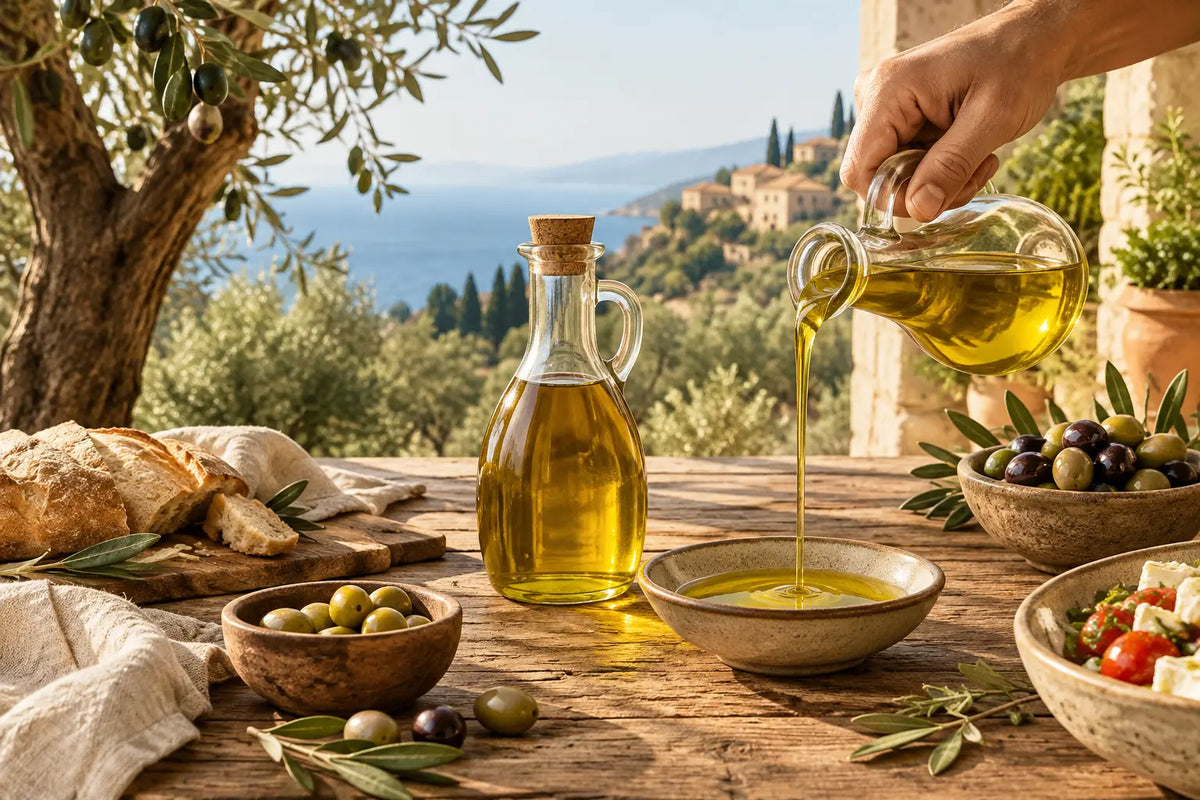
Olive oil that looks good on the shelf can be made from olives grown in many different countries, old stock, and anonymous batches. It may meet a category on the label—but it tells you nothing about the people, the harvest, or the mill behind it. Five reasons why producer olive oil shows why this gap matters in everyday cooking: Not every bottle of oil deserves your trust just because it is green and sounds Italian or Greek.
Producer olive oil is not merely a marketing term. It refers to oil for which the journey from the olive groves, through the harvest and processing, to bottling can be traced. This changes what ends up in the bottle—and how it tastes on tomatoes, bread, vegetables, or fish.
1. Origin is specific rather than decorative
With good producer olive oil, origin is not just a romantic landscape name on the label. It can be specified: region, variety, harvest, producer, and ideally the mill as well. For fine food enthusiasts, this information is not an afterthought. It is the foundation for being able to assess quality in the first place.
Olive oil is a natural product. Soil, climate, olive variety, and harvest time shape its character. Koroneiki olives from Greece, for example, can produce an oil with green, fresh notes reminiscent of herbs, green tomatoes, or artichokes. A blend from changing, unspecified sources can also be perfectly fine. However, its origin often remains as vague as its flavor profile.
When you buy directly from the producer, therefore, you do not have to buy folklore. You are buying the opportunity to ask questions and receive verifiable answers. Where are the olives grown? When were they harvested? Where were they pressed? What exactly is in the bottle? Transparency begins where such information is not avoided.
2. Freshness becomes a matter of taste
Olive oil does not get better with age. From the moment it is pressed, its aromas and valuable compounds react to light, heat, and oxygen. A fresh extra virgin olive oil can taste lively, grassy, and clean. In contrast, an aged oil often tastes flat, waxy, or dull—even if the best-before date is still far off.
The direct route from the producer does not automatically shorten every supply chain. But it creates the conditions for planning the harvest and bottling effectively, rather than trading goods for years as an interchangeable raw material. What matters is not whether a bottle has traveled a long distance. What matters is how long the oil has been in transit, stored, and unnecessarily transferred after harvest.
You cannot tell freshness by scent alone. Look for a clearly stated harvest year and packaging that protects against light. Dark glass, a tightly sealed tin, or an opaque squeeze bottle are not minor details. However, if you buy a high-quality oil and leave it open next to the stove, you lose part of that quality. Stored cool, in the dark, and sealed, it stays the way it should taste for longer.
3. An in-house mill means more control at the critical moment
Between picking and pressing lies one of the most important differences in olive oil. If olives are stored for too long, they begin to lose quality. They must therefore be processed quickly, cleanly, and under controlled conditions. This is exactly where artisanal care diverges from a supply chain in which no one is truly responsible anymore.
An in-house harvest and mill, which O.E.L. Berlin makes traceable for its oil, means control over the steps that shape the oil's character: fruit selection, timing of processing, temperature, and hygiene. This is no guarantee that every harvest will taste the same. On the contrary. Good producers do not treat natural variations as flaws, but describe them precisely.
The result can be an oil that feels slightly peppery in the throat. This pleasant sharpness is not a flaw, nor is it a sign that something has gone "too strong." It can indicate phenolic compounds, which are particularly common in early-harvested, carefully processed oils. Bitterness and sharpness are often part of the profile of a fresh extra virgin olive oil—provided they are clean, balanced, and not harsh or rancid.
4. Quality is measurable, not just claimed
Gold medals, Mediterranean labels, and words like "premium" can make a good first impression. They are no substitute for reliable data. For producer olive oil, a willingness to disclose quality values is a strong signal. This includes, for example, acidity, polyphenol levels, and independent laboratory analyses.
Low acidity is an important quality indicator, but it does not explain everything. It says something about the condition of the olives and the processing, but not yet whether the oil is aromatically convincing. Polyphenols, on the other hand, are natural plant compounds that can contribute to a bitter and peppery taste. High levels are interesting, but even here: a laboratory value alone does not make an oil a culinary experience.
Quality arises from the interplay of factors. The oil should be chemically flawless and sensorially enjoyable. It should taste of fresh olives, not cardboard, old nuts, vinegar, or a damp cellar. If you use oil regularly, you will quickly develop a feel for it. A small sip on its own is enough: smell first, then taste, swirl it briefly in your mouth, and pay attention to its freshness.
5. The price supports a different kind of food culture
Producer olive oil often costs more than a promotional offer. That is the honest part of the story. An early harvest yields less oil per olive, careful processing requires time and technology, and transparent analyses cost money. Fair, long-term relationships with the people on site cannot be financed by price wars either.
The higher price is not worth it for every application in the same way. For high-heat frying, a good, everyday oil can be the sensible choice. But for salad, roasted vegetables, pasta, dips, soups, or simply warm bread, a distinctive extra virgin olive oil makes the difference immediately noticeable. It is not an ingredient you hide. It is the final, decisive touch.
When you buy consciously, you can also plan differently: larger containers for regular consumption, smaller bottles for the table, and refill solutions, provided they are stored properly away from light. This way, premium oil does not become a precious bottle waiting for guests, but a permanent part of your own kitchen.
How to recognize producer olive oil
Not every oil with a small farm on the label comes directly from a producer. Therefore, check more carefully whether the information is reliable. A specific variety and region are better than general terms of origin. A clearly stated harvest year is more helpful than a vague story about sunshine and tradition. Statements about the mill, processing, and laboratory values show whether a brand is willing to make its quality verifiable.
The language also reveals a lot. If a supplier clearly explains what their oil can and cannot do, that is more credible than unsubstantiated superlatives. Olive oil may vary seasonally. It may be bitter and peppery. It may cost more, provided you can trace why. No industrial production. No tricks. No compromises—but also no empty promises.
The best decision is ultimately made not in front of the shelf, but at the dinner table. Give a good producer olive oil room to shine: over beans with lemon, on toasted sourdough bread, with ripe tomatoes, or at the end of a simple lentil soup. When origin suddenly becomes something you can taste, a bottle of oil becomes a daily attitude toward food.

Leave a comment
All comments are moderated before being published.
This site is protected by hCaptcha and the hCaptcha Privacy Policy and Terms of Service apply.