
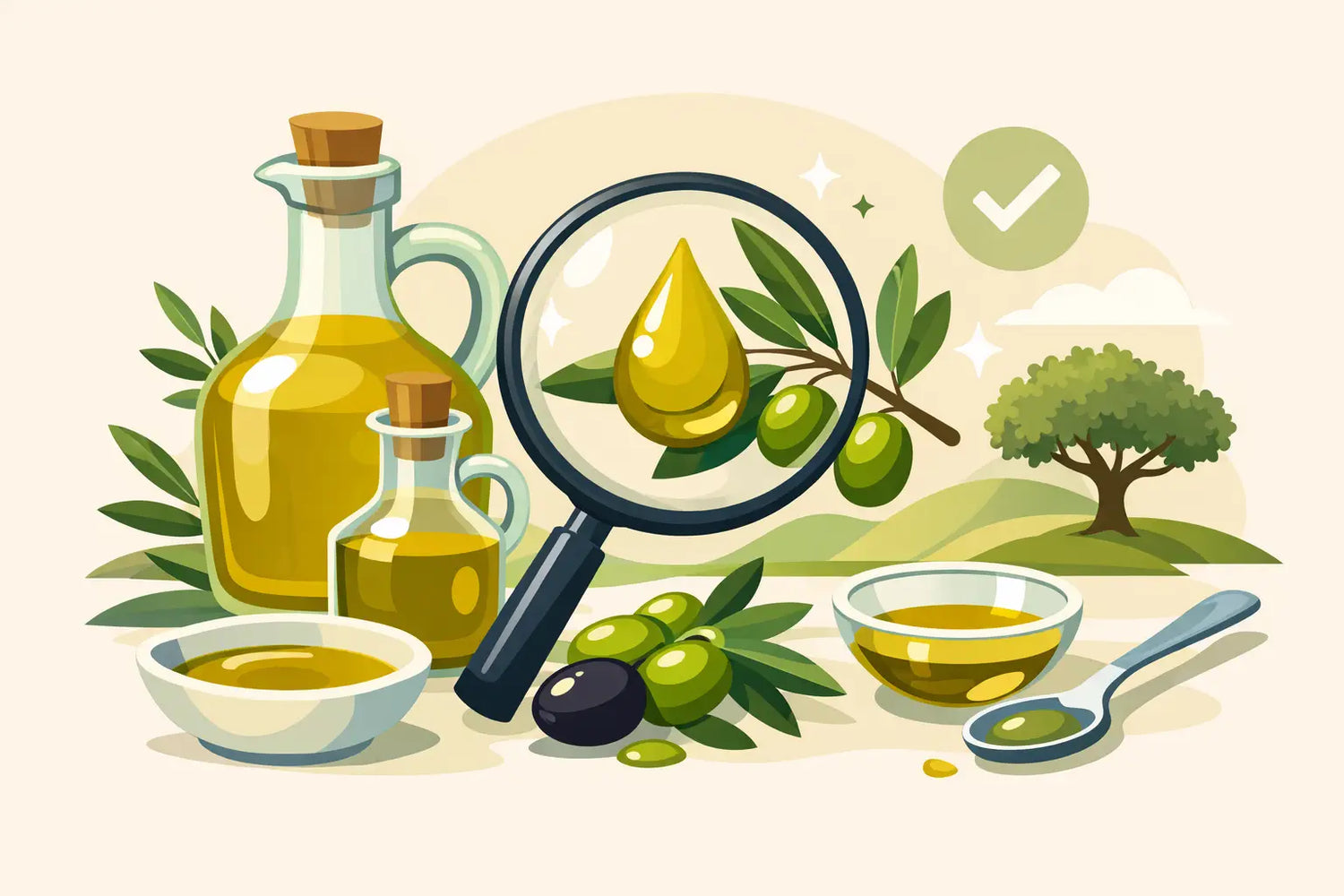
Anyone who has tried truly fresh, cleanly produced olive oil will immediately recognize the difference. The question of how to identify good olive oil is not decided by a pretty label or price alone, but by origin, harvest, processing, and the taste in the glass.
The problem is well-known: dozens of bottles on the shelf, often with Tuscan landscapes, golden color, and alluring promises. Many of them are still interchangeable. Some are overaged, others industrially blended, still others sensorially flat. Good olive oil is not a lifestyle accessory. It is a handcrafted product that can be tested.
How can you identify good olive oil in everyday life?
The first test begins long before tasting. A good extra virgin olive oil specifies its origin concretely. Not "from the EU," not "blend of olive oils from various countries," but a clearly named region, producer, ideally even variety, harvest, and mill. The more precise the information, the better. Transparency is not a bonus. It is the foundation.
Therefore, anyone who takes olive oil seriously looks not only at the front but at the entire label. This shows whether a manufacturer truly has something to say or if they are just selling design. If origin, harvest time, and bottling details are missing, it is rarely a good sign. Good producers do not hide behind generalities.
Equally important is the category. The bottle should state "native extra" or "extra vergine." This is the highest quality class. But here too, the designation alone is not enough. It is a minimum requirement, not a proof of quality. Between an anonymous mass product and a traceable oil from one's own harvest, there are worlds of difference in taste, even though both may formally bear the same category.
Origin beats marketing
With olive oil, origin is more than romance. It determines fruitiness, stability, freshness, and character. An oil from a clearly defined region, from a specific olive variety, and from a traceable harvest is generally more reliable than a blend whose contents have been purchased through many stages.
This doesn't mean that a blend is automatically bad. It just means: if no one explains exactly what's in the oil, why should you trust it? Quality doesn't need a smoke screen. Good oils can tell you where the olives come from, when they were harvested, and how quickly they were processed.
Especially crucial is the time between harvest and pressing. Fresh olives must quickly go to the mill. If they lie too long, the quality suffers. Then off-notes increase, freshness is lost, and the oil becomes tired even before it reaches the customer. Those who disclose this process chain usually also demonstrate a different understanding of quality.
The harvest date is often more important than the best-before date
Many consumers only look at the best-before date. Understandable, but shortsighted. The harvest year, or even better, the specific harvest window, is truly informative. Because olive oil is not wine, which improves with long storage. It thrives on freshness.
A fresh oil tastes lively. It has tension, aroma, structure, and often a peppery sharpness on the finish. An old oil may still be usable, but it loses exactly what makes good olive oil. Those who buy only for long shelf life often buy a convenient, not necessarily a good product.
Ideally, an oil from the current or very recent harvest, properly stored, bottled to protect from light, and not left warm on the shelf for months. Dark glass bottles or suitable metal canisters are therefore sensible. Clear designer bottles look good on the table but protect the contents less effectively.
How to identify good olive oil by taste?
Here's where it gets specific. Good olive oil doesn't taste neutral. Neutrality in olive oil isn't a sign of quality; it often indicates age, blandness, or a very late harvest with little character. A good oil is allowed and expected to express something.
Typical positive notes are green, fresh, and herbaceous: freshly cut grass, tomato leaf, green almond, artichoke, herbs, or green banana. Additionally, bitterness and pungency are present. Many are initially startled by this. They needn't be. These two characteristics are often a sign of freshness and a higher polyphenol content.
Balance is important. An excellent oil isn't simply sharp. It's fruity, bitter, and pungent in balance. It has pull, but no harshness. It remains present on the palate without feeling dull. If an oil tastes completely flat, fatty, or waxy, it usually lacks quality.
Defects can also be recognized. Rancidity makes it taste old, reminiscent of old nuts or stale fat. Musty tones indicate poor storage or inadequate processing. A winy or vinegary impression is also problematic. Such aromas have no place in good olive oil.
Acidity is important - but not in the way many think
The statement "the lower the acidity, the better" is only partially true. Free fatty acid is a relevant quality parameter, but it doesn't immediately tell the average consumer anything about taste. You can't simply taste acidity in olive oil like you can in lemon juice.
Nevertheless, it's worth looking at the value if it's voluntarily provided. For extra virgin olive oil, the legal upper limit is 0.8 percent. Truly high-quality oils are often significantly lower. A very low acidity value generally indicates healthy fruits and clean processing. But here too, a good oil is never identified by a single number alone.
Those who delve deeper also pay attention to peroxide value and polyphenols. These are not marketing gimmicks, but rather indicators of freshness, stability, and antioxidant properties. High polyphenol levels often go hand in hand with bitterness and pungency. That's precisely why many outstanding oils taste more distinctive than the smooth standard oils from the supermarket.
Price: expensive is not automatically good, cheap almost never
A high price can mean quality. But it can also only finance expensive packaging, trade margins, and good storytelling. Conversely, extremely cheap olive oil is almost always suspicious. Olive cultivation, early harvest, quick pressing, clean bottling, and fair labor cost money. Those who promise all this and then sell at dumping prices are counting on something, just not on real top quality.
Therefore, price should always be seen in proportion. How precisely is the origin specified? Is there information on the variety, the harvest, the mill, laboratory values, or awards? Is the oil in packaging that protects quality? Those who work cleanly here usually also deliver in taste.
The color is almost irrelevant
Golden-green, deep green, sunny yellow – much is discussed about color, and surprisingly little is understood. It is not a reliable indicator of quality. An oil can be excellent and appear rather yellow. Another can look intensely green and still be sensorially weak.
Professionals do not taste olive oil in colored glasses for no reason. This keeps the perception focused on the nose and palate. If you let yourself be swayed by the color when buying, you are often evaluating the wrong criterion.
Good labels are concrete, not poetic
A strong label doesn't have to be loud. It has to be precise. Good information includes the olive variety, harvest year, region, producer, bottler, possibly the mill, and analysis values. Statements like "first cold pressing" sound good, but are of limited help today because they say little about the actual quality of the final product.
Caution is also advised with watered-down advertising phrases. "Mild," "fine," "Mediterranean," or "for everyday" can mean anything and nothing. If an oil doesn't show character, it often also shows little character in taste.
How to test it yourself at home
Pour some olive oil into a small glass, warm it with your hand, and first smell it. Do you detect anything fresh? Green, herbaceous, perhaps slightly tomato-like or almondy? Then take a small sip, draw in some air, and pay attention to the development.
A good oil starts fruity, then develops bitterness, and often shows a delicate to distinct pungency in the throat. This pungency is not a defect. It is often a sign of quality. The crucial thing is whether the oil appears lively and clear, or if it runs broadly, dully, and tiredly over the palate.
If you cook regularly, you'll quickly notice the difference in everyday life anyway. Good olive oil complements tomatoes, vegetables, fish, legumes, or simply bread with salt. It makes dishes more precise. It doesn't overpower everything, but adds depth. That's precisely why it's worth not buying it arbitrarily.
At O.E.L. Berlin, this attitude is simple: no anonymous blends, no industry, no compromises on origin and freshness. Because good olive oil doesn't need complicated explanations - it needs to be traceable and convince on the first spoonful.
In the end, it's not about how luxuriously an oil is presented, but how honestly it's made. If origin, harvest, processing, and taste align, you no longer need a marketing promise - just good bread, ripe tomatoes, and a little trust in your own palate.


Leave a comment
All comments are moderated before being published.
This site is protected by hCaptcha and the hCaptcha Privacy Policy and Terms of Service apply.