

Anyone looking to buy olive oil from Greece today faces a strange contradiction: never before has the selection been so vast, and never before has good quality been so difficult to discern. Many things sound convincing on the label. But often, what ends up in the bottle is an anonymous blend, technically clean but sensorially flat, without clear origin, without character, without trust.
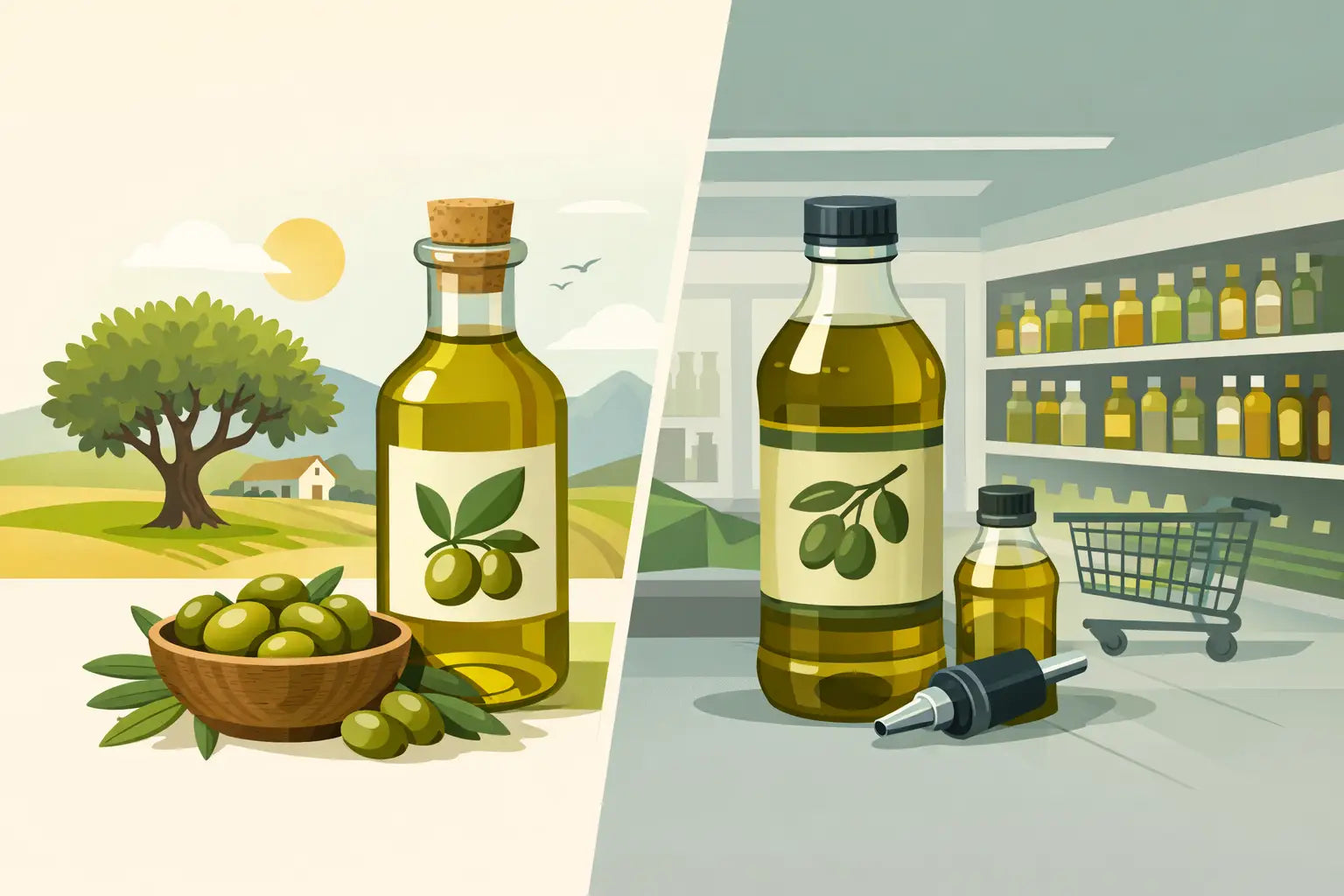
That is precisely where the real dividing line lies. Not between cheap and expensive. But between oil as an arbitrary kitchen commodity and oil as an honest foodstuff with origin, harvest, mill, and taste.
Buying olive oil from Greece means buying origin
Greek olive oil has an excellent reputation, and for good reason. The climate, soils, and long olive cultivation tradition create the best conditions for expressive oils. The Koroneiki olive, in particular, is known for intense fruitiness, pleasant pungency, and high natural polyphenol levels. But origin as a country is not enough.
If a bottle only states Greece, that is not yet proof of quality. The crucial question is how precisely the origin is named. Does the oil come from a specific region, from a clearly defined grove, from its own harvest, or from changing purchased supplies? Are there verifiable details about the mill, processing, and batch? The more precise this information, the less room there is for marketing fog.
A good olive oil does not hide behind generalities. It shows its true colors. Those who shop consciously should therefore not only pay attention to the country of origin but to the complete story behind the oil.
How to recognize good Greek olive oil
Extra virgin is a start, but not an end point. The designation indicates minimum chemical and sensory standards, not automatically top quality. There are worlds between acceptable and exceptional.
Truly good Greek olive oil can be recognized by several factors that must align. First, freshness. Olive oil is not wine; it does not gain depth over years on the shelf. It thrives on a fresh harvest, clean processing, and a quick journey into the bottle. Second, sensory clarity. Good oils smell vibrant - of green olive, herbs, sometimes tomato leaf, almond, or artichoke. Bitterness and a slight pungency are permissible in the mouth. These are not flaws but often signs of freshness and polyphenols.
Third, transparency. If a producer openly discusses harvest time, olive variety, mill, and analysis values, that is a strong signal. Those who do good work do not need to obscure it. Fourth, packaging. Dark glass or suitable light-protected containers are not a design gimmick but a matter of quality logic. Light, heat, and oxygen are the natural enemies of good oil.
A low acidity value is often mentioned, and yes, it is important. But here too: viewed in isolation, it says little. An oil can be analytically sound and yet taste aromatically lifeless. Therefore, never buy just numbers. Buy the whole picture.
Why polyphenols are more than just a buzzword
Polyphenols are often used as a health argument. This is not wrong, but often abbreviated. For discerning buyers, they are also taste-relevant. They contribute to bitterness and pungency and often make an oil more stable. A high polyphenol content is therefore not just laboratory prose but is tangible in everyday life.
The important thing is to understand the balance. Very polyphenol-rich oils can be brilliant for some applications - such as on salads, legumes, or toasted bread - but too dominant for every dish. There is no single perfect oil for everything. There are suitable oils for different culinary moments.
The most common mistakes when buying
Many people first look at the price per liter. This is understandable, but often the wrong starting point for olive oil. When harvest, quick processing, clean mill technology, controlled storage, and direct bottling come together, it costs money. Extremely cheap olive oil is rarely a miracle. Mostly, it is the result of compromises that one tastes - or no longer tastes.
Another mistake is confusing mild with high quality. Many supermarket oils are popular because they offer little resistance. No bite, no pungency, hardly any bitterness. For some palates, this seems pleasing. In reality, it is often just neutralized characterlessness. A good oil can have edges. Not aggressive, not flawed, but clear and present.
Awards are also overestimated. Prizes can be helpful, but they do not replace true transparency. If an oil carries medals but provides little information about its origin, a gap remains. Trust is not created by gold stickers but by verifiable quality.
Buying Greek olive oil online - is it risk-free?
Yes, if you ask the right questions. Online shopping is not a disadvantage, as long as the information is correct. In fact, good quality can often be better assessed through direct sales than on a shelf, because online producers can explain more about harvest, variety, processing, and philosophy.
Pay attention to concrete details instead of grand promises. Is the olive variety named? Is there information about the harvest and mill? Is it clear whether the oil comes from their own production or from anonymous purchases? Are analysis values explained, rather than just buzzwords listed? And practically: How is it shipped, how fresh is it delivered, in what containers is the oil available?
Especially for households that cook regularly, larger formats or refill solutions are sensible. They do not automatically lower the quality standard but can, on the contrary, be more reasonable - provided the oil is stored cool, dark, and well-sealed at home. Those who cook daily with good olive oil should not shop as if it were a rare luxury ritual. Quality belongs in everyday life.
What makes Greek olive oil particularly special in taste
Greece does not produce tasteless uniform goods. Region, variety, harvest time, and processing strongly shape the aroma profile. Koroneiki oils are often green, fresh, peppery, and dense. This is precisely what makes them so exciting in the kitchen. They provide not just fat but structure. On tomatoes, beans, fish, yogurt, feta, or grilled vegetables, they show what good olive oil can achieve.
The difference from industrial mass-produced goods is often immediately noticeable. A characterful oil enhances a dish. It connects, lifts, brings length. An arbitrary oil merely lubricates the surface. This may sound exaggerated, but on the plate, it is surprisingly concrete.
Once you have tasted a truly fresh, single-varietal oil, you quickly understand why origin is not a minor matter. Taste is not a coincidence. It is the result of decisions - in the grove, in the mill, and during bottling.
For which cuisine is premium olive oil worthwhile?
The honest answer: not equally strong for every application. If you sear something very hot or cook a complexly spiced stew, fine nuances are partly lost. For that, an excellent oil would almost be a shame. Its strength is particularly evident where it remains directly perceptible - on salads, vegetables, soups, bread, fish, pasta, legumes, or as a finish on warm dishes.
This is not a counter-argument but a question of intelligent use. Those who appreciate quality use good oil consciously. Not sparingly out of fear, but precisely, so that aroma lands where it makes sense.
Why traceability is no longer a luxury today
Food trust begins not with the label, but long before. For olive oil, traceability is particularly relevant because the market has been working with blends, vague declarations, and interchangeable commercial goods for years. This is precisely why clarity becomes a quality feature.
If a producer can show where the olives were harvested, when they were processed, and under what conditions the oil is produced, it changes the purchasing decision. Not only emotionally, but factually. Suddenly, a promise becomes a verifiable connection.
Brands like O.E.L. Berlin start precisely there: no anonymous blended goods, but clearly named origin, own harvest, own mill, and an oil that not only sounds good but also shows character in the glass and on the palate. This is not a luxury for specialists. This is the difference between assertion and proof.
The better benchmark when buying
When you buy olive oil from Greece, don't ask first which oil advertises loudest. Ask which oil has the least to hide. Good origin is precise. Good processing is explainable. Good taste needs no excuses.
In the end, it's not about how Mediterranean a label looks, but whether the oil convinces in everyday life - on the plate, in the aroma, in its freshness, and in the trust it evokes. If a bottle delivers exactly that, shopping becomes not a compromise, but a clear decision for more taste and less industry.


Leave a comment
All comments are moderated before being published.
This site is protected by hCaptcha and the hCaptcha Privacy Policy and Terms of Service apply.