
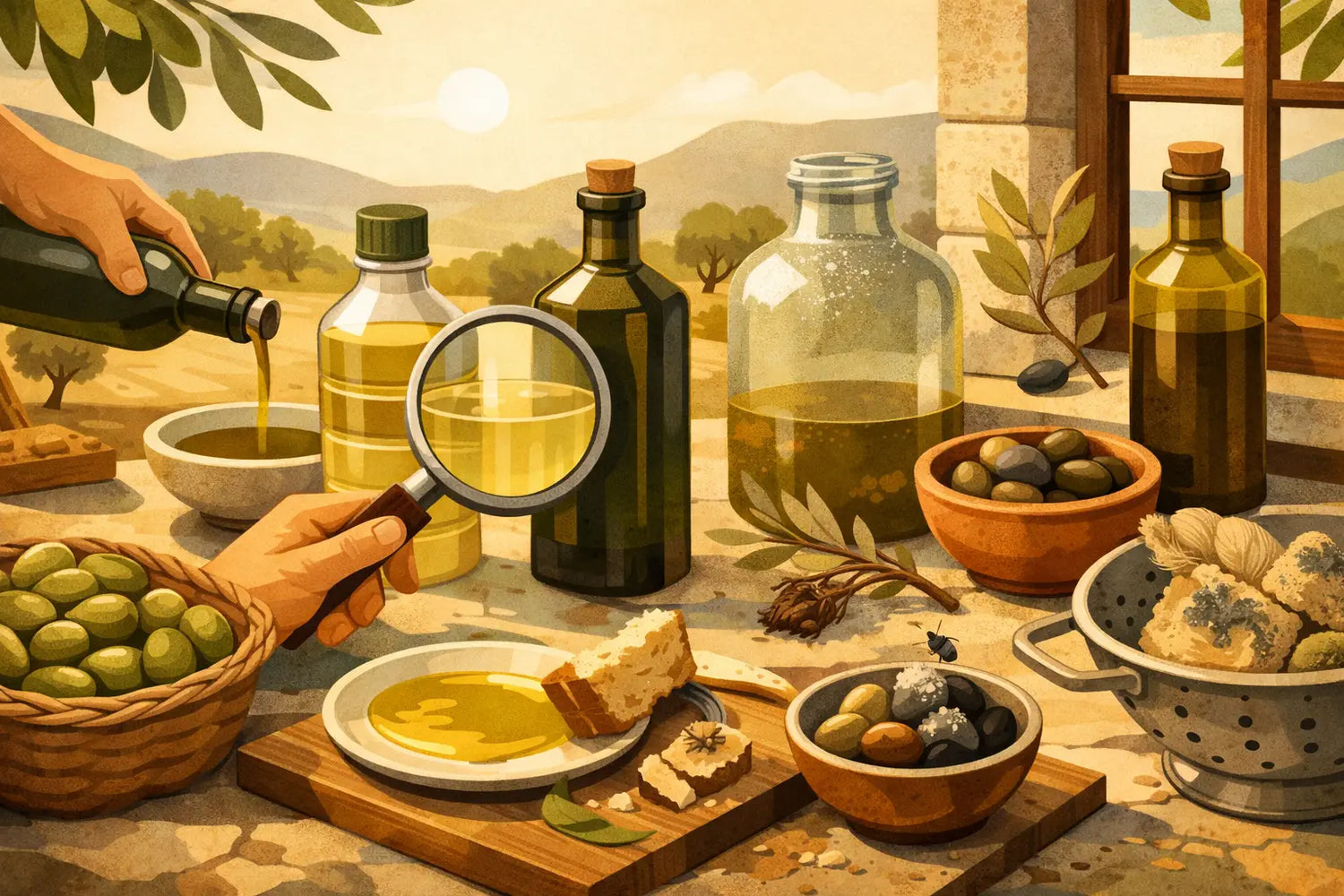
A dark bottle, an Italian-sounding name, a golden spout - suddenly, an oil appears high-quality. This is often what retailers rely on. The eight mistakes made when buying olive oil don't happen because people lack taste, but because crucial information is missing or cleverly concealed. Good olive oil is not just any cooking fat. It is fresh olive juice: you can taste its origin, harvest, mill, and storage.
Those who cook consciously should not reach for the prettiest label when choosing oil, but rather look for reliable answers. No industry. No tricks. No compromises. Here are the mistakes that can turn a good meal into an average one.
Avoid these eight mistakes when buying olive oil
1. Relying solely on "Native Extra" (Extra Virgin)
"Native Extra" is the highest legal quality class. This is a sensible starting point, but not a quality promise in itself. An oil can meet the minimum values and still be old, bland, or sensorially flawed. The category states that certain chemical and sensory requirements were met at the time of testing. It does not automatically say how freshly the olives were processed, how transparent the manufacturer works, or how the oil tastes today.
Therefore, look beyond the front label. Is there information about the variety, harvest year, region, and mill? Are the acidity and, ideally, other laboratory values openly stated? A producer who knows their oil doesn't need to hide behind general formulations.
2. Generously interpreting origin information
"Olive oil from the European Union" is not an origin in the culinary sense. It only means that the oils may come from a large, anonymous area. Such blends can be composed of olives from several countries, regions, and harvests. This is legal, but it doesn't answer the question of which olives are in your bottle.
A traceable origin is more specific: country, growing region, olive variety, producer or cooperative, ideally also their own mill. For Koroneiki olives from Greece, for example, a clear flavor profile can be expected - often fresh, green, slightly peppery, and with a delicate bitterness. Origin does not guarantee automatic perfection. But it does create responsibility. Those who are named can vouch for quality.
3. Ignoring the harvest year
Olive oil does not improve with age. It is not wine. Immediately after production, a good Extra Virgin Olive Oil has its most intense aromas and valuable accompanying substances. It degrades with light, heat, oxygen, and time. A best-before date alone is only of limited help, as it doesn't reveal whether the oil is sold at the beginning or end of its useful life.
Look for the harvest year or a clear harvest date. An oil from the current or most recent available harvest is usually the better choice. There are exceptions: a carefully stored oil can still be convincing later. But without harvest information, you are buying blind.
4. Confusing low acidity with taste
Low free fatty acid is a good sign. It indicates that the olives were processed healthily and not stored unnecessarily long before milling. Nevertheless, you don't taste acidity in olive oil like you do in lemon juice. The indication describes a laboratory value, not the acidity on the tongue.
Those who look exclusively at an extremely low value miss the bigger picture. The crucial factor is the interplay of clean processing, freshness, sensory testing, and transparent analysis. An oil with low acidity must still not taste musty, waxy, rancid, or flat. Chemistry and sensory perception belong together.
5. Mistaking bitterness and pungency for a defect
Many only know olive oil as soft, mild, and almost neutral. This is understandable, but not necessarily a quality ideal. Fresh oil from early harvested, green olives can taste bitter and create a pleasant scratchiness in the throat. This peppery note is often associated with polyphenols - natural plant compounds that also characterize a fresh oil.
Bitterness and pungency must be balanced. A high-quality oil should not be aggressive or overpower every dish. However, with tomatoes, beans, roasted vegetables, fish, yogurt, or a simple slice of sourdough bread, they bring exactly the tension that a bland oil can never provide. Mild is not bad. But neutral is not a quality goal.
6. Considering packaging as a minor detail
Light and heat are enemies of olive oil. A clear glass bottle on a sunny kitchen shelf looks decorative but poorly protects the content. Light-opaque containers, dark glass, or well-suited tins are better. It is also crucial how long the oil is in contact with oxygen after opening.
For households that cook a lot, larger containers can be useful - provided the oil is consumed quickly and transferred into smaller, tightly sealable bottles. Those who only use oil occasionally are often better off with a smaller quantity. The cheaper liter price of a large can is useless if the second half oxidizes. Buy according to your consumption, not based on a supposed bargain.
7. Considering the price in isolation
Very cheap olive oil has to finance many stages: cultivation, harvest, transport, storage, bottling, trade, and often elaborate marketing. If the price is strikingly low, a simple question is worth asking: Where were savings made here? Not every cheap oil is bad, and not every expensive bottle is excellent. But genuine craftsmanship, early harvest, quick processing, analyses, and traceable supply chains do not come for free.
The fair comparison is therefore not just euros per liter. Also ask: How fresh is the oil? Who produced it? Is the variety named? Can the supplier prove quality? And most importantly: How much flavor does a tablespoon bring to the plate? A characterful oil is used more consciously and can significantly enhance a simple ingredient.
8. Storing olive oil like any other cooking oil
The last mistake often happens only at home. Even an excellent oil loses its quality if it stands next to the stove, remains open, or is stored in a warm pantry. The best environment is cool, dark, and odorless. The refrigerator is not strictly necessary and can temporarily make the oil cloudy. This is usually unproblematic, but not particularly pleasant for daily use.
Close the bottle after each use and do not leave it permanently in bright light. It is better to buy fresher and replenish as needed than to maintain a supply for years. Taste is fleeting. This is especially true for a natural product that should be as minimally processed as good olive oil.
What good olive oil must specifically deliver
A convincing oil doesn't need an overloaded story. It needs a verifiable one. You should be able to know where the olives grew, when they were harvested, and how quickly they went to the mill. You should be able to expect a clear aroma: green notes, herbs, tomato leaf, almond, fresh olive, or a delicate pungency - depending on the variety and ripeness.
Its use in the kitchen also counts. A high-quality Extra Virgin Olive Oil does not belong in a display case. It makes roasted vegetables livelier, carries a vinaigrette, gives pasta depth, and adds the final, decisive accent to hummus, soup, or burrata. It is also suitable for frying, as long as the pan is not overheated empty until it smokes. For very high temperatures or deep-frying, depending on the dish and budget, another fat may be the more practical choice.
O.E.L. Berlin stands precisely for this approach: traceable Koroneiki olives, their own harvest, and their own mill instead of anonymous commercial blends. Not because origin is a nice story for the label, but because it creates the prerequisite for making quality verifiable.
For your next purchase, a brief change of perspective is sufficient: Don't just buy oil. Buy freshness, craftsmanship, and a taste that turns a few ingredients into a meal to remember.

Leave a comment
All comments are moderated before being published.
This site is protected by hCaptcha and the hCaptcha Privacy Policy and Terms of Service apply.