
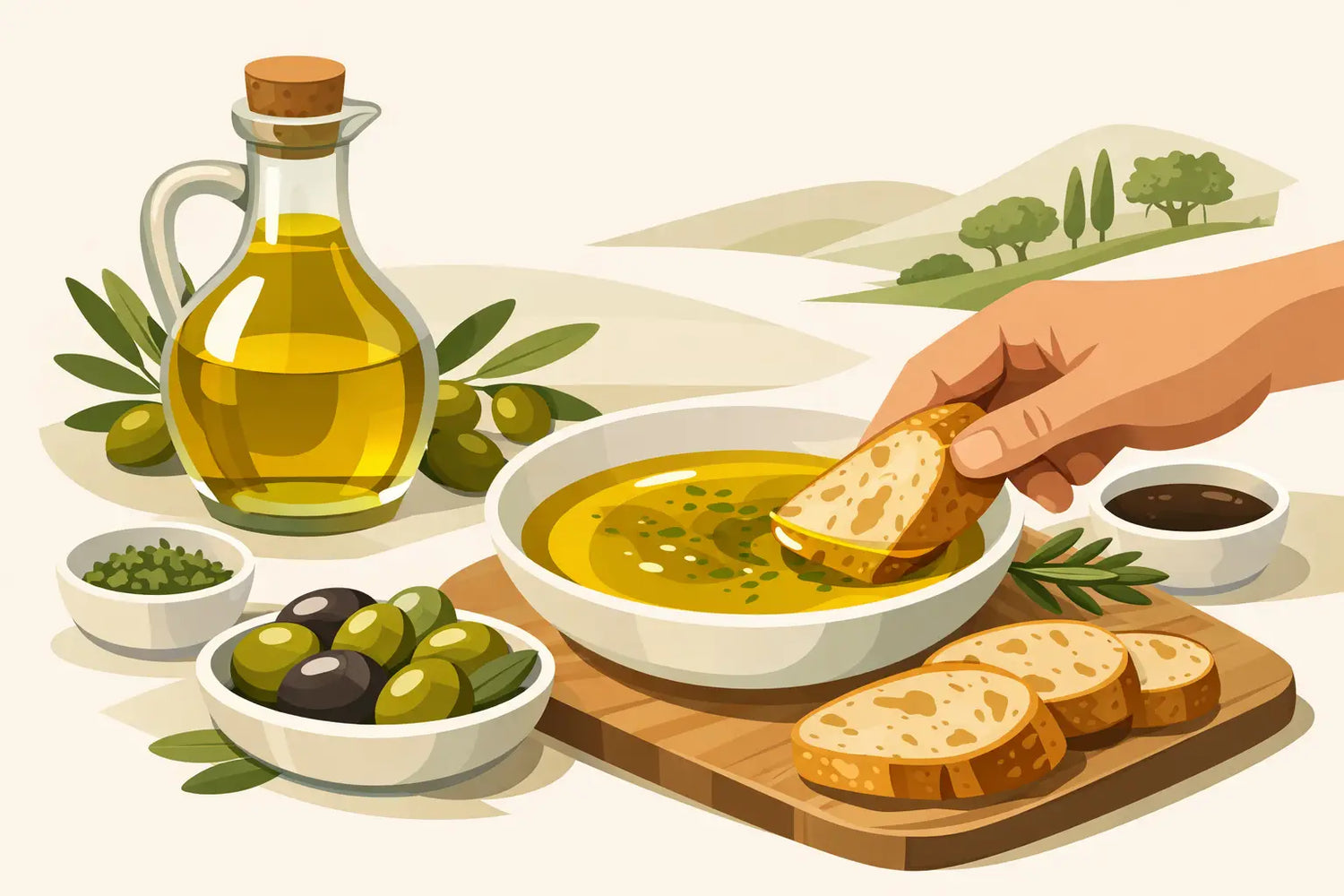
Bread, a little salt, maybe a few warm olives - and suddenly, you discover how good an olive oil truly is. When cooking, many things can be hidden. In the bowl, they cannot. Therefore, those looking for the best olive oil for dipping don't need a fancy label, but an oil with character, freshness, and a clean origin.
What truly makes the best olive oil for dipping
Dipping is the most honest test for extra virgin olive oil. There's no sauce, no heat, no other fat to hide flaws. What lands in the glass or on the plate is tasted directly. This is precisely why mild, flat, or old oils rarely work well here. They quickly come across as arbitrary, greasy, or dull.
A truly good dipping oil has tension. It smells fresh, green, lively. In the mouth, it brings fruitiness, then a pleasant bitterness, and finally often a slight to distinct pungency in the throat. This pungency is not a flaw, but usually a sign of freshness and phenolic substance. Those who only know soft, neutral oils sometimes find this too intense at first. After the second or third taste, you usually realize: that's exactly what makes the difference.
So, the best olive oil for dipping isn't simply the softest. It's the oil that tastes clear, shows its origin, and makes you crave the next bite. This includes balance. An oil can be peppery, but not scratchy. It can be bitter, but not dull. It can appear green and expressive, but not unbalanced.
Fruity, bitter, pungent - and why that's good
For years, many consumers have been conditioned to prefer the most neutral olive oil possible. The problem: neutrality is not a quality characteristic in high-quality, fresh olive oil. It is often the result of age, poor raw materials, or an intentionally bland blend.
For dipping, three sensory elements are crucial. First, the fruitiness on the nose and palate. Depending on the variety and harvest, it can evoke freshly cut grass, green almond, tomato leaf, artichoke, or herbs. Second, the bitterness. It sits more on the tongue and pairs excellently with bread, vegetables, or white beans. Third, the pungency in the throat. This often indicates that the oil has been freshly processed and is still rich in polyphenols.
Of course, here too: it depends. If you're serving an oil with mild focaccia or burrata, you might be happier with a harmonious, medium-intensity oil than with an extremely early, very aggressive pressing. However, with robust sourdough bread, grilled bell peppers, or ripe tomatoes, the oil can certainly have more edge.
Origin beats marketing
When an oil is intended for dipping, origin matters more than grand words on the label. Terms like "Mediterranean," "from the EU," or "first-class" say little about how the oil actually tastes. More specific questions are crucial: What region does it come from? Which olive variety was used? When was it harvested? Where was it milled? Is the oil traceable or just an anonymous blend from various tanks?
Especially when dipping, the difference between single-varietal, cleanly processed oil and industrial mass-produced goods is immediately apparent. A transparently produced oil has character. A standardized blend is often designed primarily not to offend anyone. This is logical for the industry. For true taste, it is unsatisfactory.
Variety also plays a big role. Koroneiki, for example, is known for aromatic, dense, and often pleasantly peppery oils that are very suitable for dipping. Other varieties can be softer, butterier, or nuttier. So there isn't one perfect style for everyone. But there are clear quality characteristics - and they start with traceable origin, not with golden medals without context.
Freshness is not a detail, but the point
Olive oil is not wine. It doesn't get better with age. This is especially true for dipping. What you want is freshness in the aroma and precision on the palate. Old oils lose exactly that first. They become duller, flatter, and in the worst case, waxy or rancid.
That's why it's worth looking at the harvest time and bottling date. Many labels only state the best-before date. That's convenient, but not very informative. An oil can formally still be edible and sensorially no longer deliver what you're looking for for dipping. If you're serious about choosing, pay attention to the current harvest, good storage, and containers that protect the oil.
The packaging is also not irrelevant. Dark glass or light-protected containers are significantly better than transparent bottles that are exposed to light for weeks on the shelf. After opening, everyday habits and discipline matter: seal well, do not store next to the stove, consume quickly. A top-quality oil loses its appeal if left warm and bright for months.
How to instantly recognize bad dipping oils
Some off-notes are immediately apparent. Others become clear with a little practice. Rancidity often reminds one of old nuts, wax, cardboard, or stale fat. Musty notes can evoke a damp cellar, fermented olives, or stale hay. Such oils have no place in a dipping bowl.