
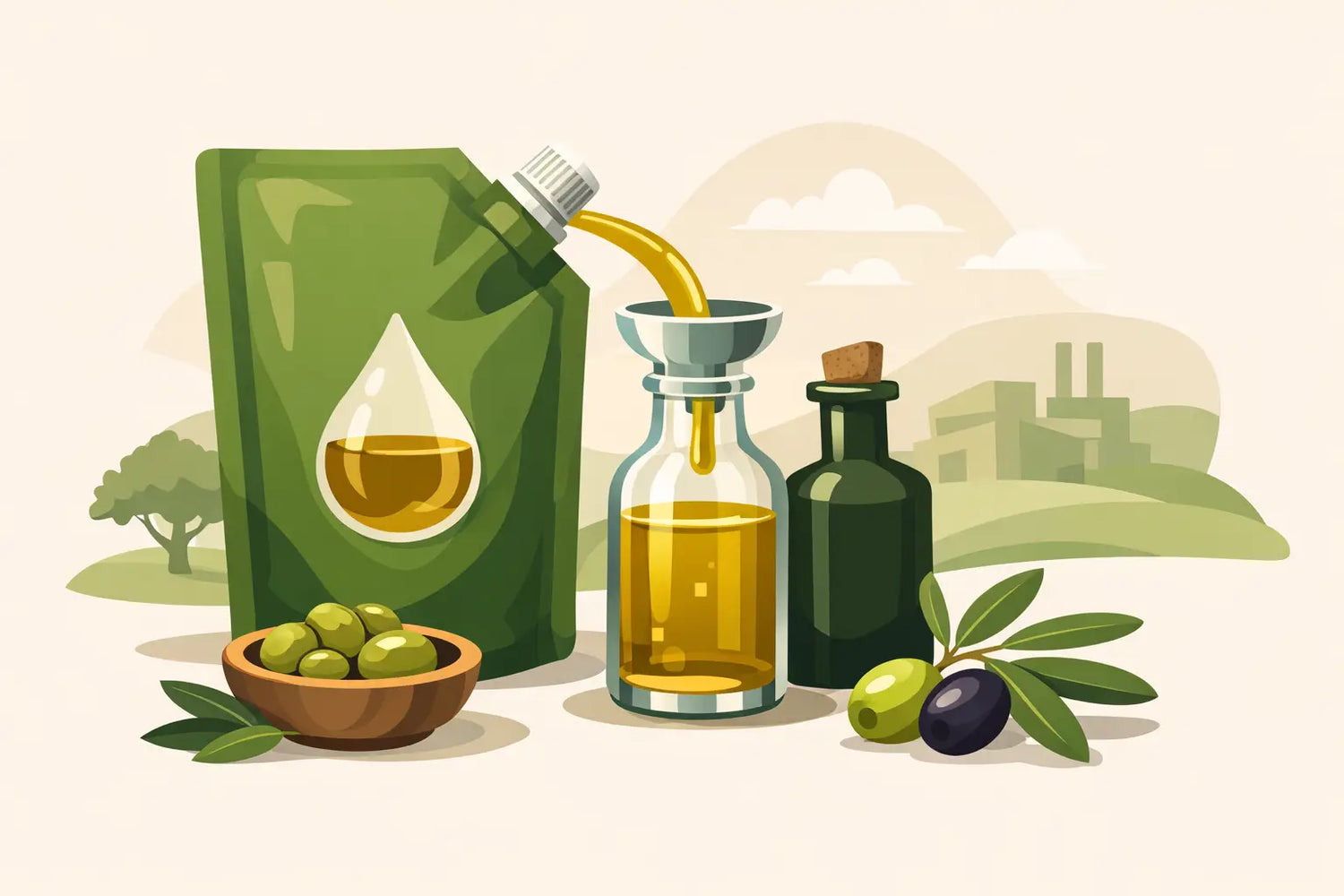
Anyone who regularly cooks with good olive oil knows the moment: The bottle is almost empty, the oil was expensive, and the next question is not just how much, but also which format really makes sense. This is exactly where the topic of buying an olive oil refill pack becomes interesting - not as a money-saving trick, but as a quality decision for people who consider taste, origin, and everyday life together.
Why an Olive Oil Refill Pack Can Be More Than Just a Larger Supply
Many people still buy olive oil like a standard product. Bottle empty, new bottle, nice label, price somehow plausible. But with truly good extra virgin olive oil, this logic only applies to a limited extent. Because quality doesn't just depend on the content, but also on how the oil is stored, bottled, and used in everyday life.
A refill pack makes sense, especially if it supports a good system. That means: the fresh oil remains in the larger, light-protected container, while you transfer smaller amounts into a handy bottle. This way, less oxygen gets to the main supply, and the oil you use daily remains better controlled. This is not only more practical. It protects aroma, fruitiness, and that peppery bitterness that makes a fresh, polyphenol-rich oil what it is.
Those who simply buy as much oil as possible for the lowest possible price often end up with exactly what discerning households want to avoid: anonymous goods, old harvests, flat aromatics, interchangeable taste. A refill solution is therefore only smart if the product itself is good.
Buying Olive Oil Refill Packs: These Quality Questions Are Crucial
When buying a refill pack, origin is paramount. Not the country on the front, but the concrete story behind it. What region does the oil come from? Which olive variety was processed? Are there details about harvest, mill, batch, or analyses? If you don't get a clear answer to these questions, you're buying trust on speculation.
Especially with premium olive oil, it should be clear whether it is a single-varietal oil or a blend from different sources. Both can be legitimate, but only if openly communicated. It becomes problematic where origin is sold as a mood. Mediterranean images do not replace transparency.
Equally important is freshness. Olive oil is not a wine that gets better with age. A good extra virgin olive oil thrives on its vibrancy - grassy notes, herbs, green almond, sometimes tomato leaf, plus bitter notes and a noticeable scratch in the throat. These are not flaws, but characteristics of freshness and phenolic quality. If a refill pack is large but already old, you're buying bulk instead of character.
Also pay attention to the packaging itself. Light, heat, and oxygen are the silent enemies of good oils. A refill pack should therefore be stable, sealed, and as light-protected as possible. Thin, transparent containers may look uncomplicated, but they are rarely the best solution for high-quality olive oil.
Which Format Suits Your Daily Routine?
Not every refill pack is automatically the right one. It depends on how often you use olive oil and how consciously you handle it. Those who cook daily, make salads, roast vegetables, and want to eat bread not with arbitrary fatness but with real oil, often get along better with larger containers. The price per liter can be more sensible, and refilling saves packaging compared to constantly buying new small bottles.
For smaller households or people who use several oils in parallel, too large a quantity can also be impractical. If an oil stands open for months, even good quality loses its edge. Then a smaller refill size is the better choice. Buying premium doesn't automatically mean always taking the largest unit. It means buying realistically for your own rhythm.
Especially useful is the interplay between storage container and everyday bottle. In the kitchen, you want to dose precisely, work cleanly, and have the oil ready to hand. The supply itself, however, should be stored in a dark, cool, and closed place. This exact difference is often overlooked when buying.
Price that Seems Cheap, and Price that is Fair
Anyone who wants to buy an olive oil refill pack naturally looks at the price. That is reasonable. But with olive oil, it's worth reading the price more closely. A conspicuously cheap organic olive oil in a large quantity can work - but it's more likely that savings were made somewhere: in the selection of fruits, the harvest time, the processing, or the transparency.
Good olive oil is not created in a brochure. It is created in the grove, at harvest, in the mill, and in a supply chain that does not dilute quality along the way. If an oil comes from its own harvest, its own mill, and fully traceable production, it has a price. But it also has a value: more freshness, more expressiveness in taste, more reliability with every reorder.
Cheap olive oil is often only inexpensive at first glance. If you consume more because the oil has no aromatic contribution, or if you only use it for frying because it's not enjoyable on its own, the price quickly relativizes itself. A truly good oil often needs less because it can do more.
How to Immediately Recognize Good Refill Solutions
Reputable suppliers don't just talk about a Mediterranean lifestyle, but about concrete facts. This includes harvest year, olive variety, origin, acidity, and ideally also information on polyphenols or laboratory analyses. Not every customer needs every metric. But anyone who discloses nothing deprives you of the opportunity to assess quality yourself.
A good sign is also if the product is not sold as a mere bulk pack, but as part of a well-thought-out usage system. That means with clear instructions on how to properly decant, store, and consume. This shows that the brand doesn't just want the initial purchase, but has understood how good oil should be handled in everyday life.
This is exactly the difference between merchandise and attitude. O.E.L. Berlin takes a clear counter-position to anonymous supermarket blends with this claim: no decorative origin, but traceable origin; no interchangeable filling, but award-winning organic olive oil from Koroneiki olives, from our own harvest and our own mill.
For Whom the Purchase Is Particularly Worthwhile
A refill pack is particularly worthwhile for households where olive oil is not just an accessory. If you cook almost daily, treat vegetables in the oven with good oil, finish fish or burrata with a few precise drops, or eat honest bread with oil and salt in the morning, then a good refill solution will noticeably change your everyday life.
The format is also interesting for people who are more conscious about packaging and consumption. Not because every refill pack is automatically sustainable, but because fewer single-use bottles can simply make more sense with regular consumption. The prerequisite remains that the oil is consumed quickly enough and stored correctly.
A large refill pack is less sensible if olive oil is only used sporadically in your kitchen. Then even the highest quality brings little if the product stands for too long. With olive oil, it's not the largest supply that wins, but the best balance of freshness, consumption, and enjoyment.
The Most Common Bad Buys of Olive Oil
The first mistake is to confuse size with advantage. A lot of oil is only a good purchase if you use it within a reasonable period. The second mistake is to confuse origin with design. A beautiful label, Italian-sounding name, or Greek color scheme prove nothing.
The third mistake is to misunderstand pungency and bitterness as defects. Many consumers have been conditioned over the years to soft, harmless oils. However, these intense, green, and slightly pungent notes are often a sign of freshness and quality. Once you understand what lively olive oil should taste like, you are much less likely to fall for bland industrial oils.
And then there's the storage error after purchase. The best refill pack is of little use if it stands next to the stove, remains open, or is poured into an unsuitable bottle. Good purchasing decisions don't end at the checkout, but in the kitchen.
How to Make a Good Decision When Repurchasing
If you want to buy an olive oil refill pack, ask yourself three simple questions before buying: Is the origin clearly traceable? Is the format suitable for my consumption? And is the packaging designed to protect quality until the last refill?
If all three answers are convincing, you're not just buying more oil. You're buying more control over taste, freshness, and daily routine. That's what good olive oil is all about: not decoration, not empty promises, but a product that you use every day and recognize every time.
Ultimately, the best refill pack is the one that doesn't dilute your standards. It makes good cooking easier, not more arbitrary - and reminds you that quality begins in everyday life, long before something lands on your plate.


Leave a comment
All comments are moderated before being published.
This site is protected by hCaptcha and the hCaptcha Privacy Policy and Terms of Service apply.