
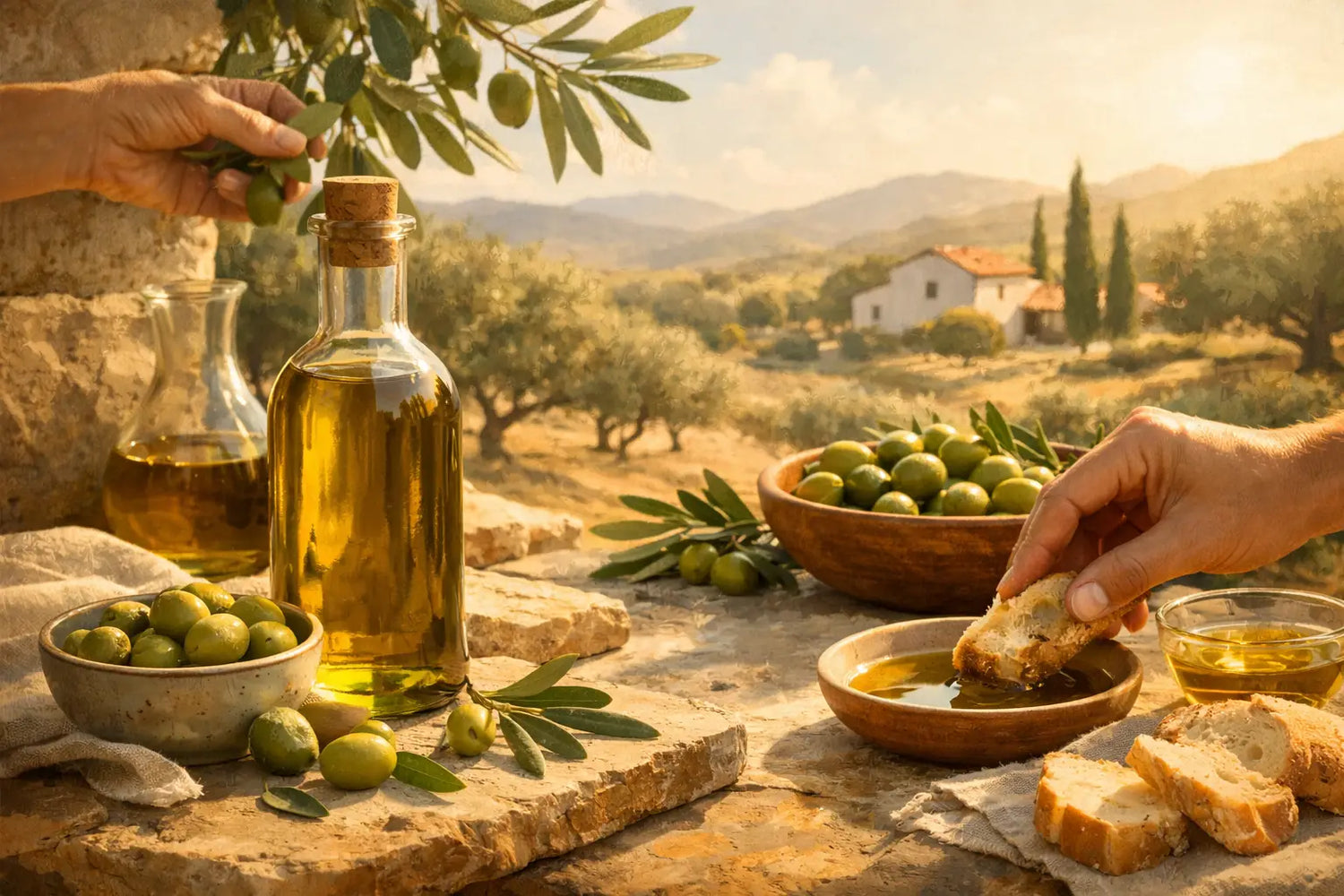
You can tell a good oil not by its golden label, an Italian-sounding brand, or the color in the bottle. You can tell it when tomatoes suddenly taste better, a soup gains depth, and fresh bread no longer needs accompaniment. Organic olive oil can do exactly that. But only if genuine origin, freshness, and clean processing stand behind the organic seal.
Because organic is not a free pass for taste. It says something crucial about cultivation – not automatically about harvest time, mill, storage, or the people behind the product. Those who shop consciously should therefore look more closely. No industry. No anonymous blends. No bottle whose story ends on the shelf.
What Organic Olive Oil Actually Means
Organic olive oil comes from olive groves managed according to the rules of organic farming. Synthetic pesticides and mineral nitrogen fertilizers have no place there. Instead, it's about soil health, natural cycles, and cultivation that doesn't short-term extract everything the grove has to offer.
This is relevant, but it's only the first level. An organic seal doesn't answer from which region the olives come, whether they were milled immediately after harvest, or how long the oil has been exposed to light and heat. It also doesn't reveal whether a single variety was bottled or if several batches and countries disappear in a blend.
The honest question is therefore not just: Is this olive oil organic? But: Who grew the olives, when were they harvested, where were they processed, and how does the result taste? Transparency is not a marketing detail. It is the prerequisite for being able to check quality.
Origin Is More Than a Dot on the Label
Olive oil is an agricultural product. Soil, climate, olive variety, ripeness, and harvest determine its character. The Koroneiki olive from Greece does not coincidentally taste different from an Arbequina from Spain or a Frantoio from Italy. It often brings green, herbaceous, slightly peppery notes – provided it is processed early and carefully.
A specific indication of origin is therefore more valuable than the vague statement "from the EU" or "blend of olive oils from EU countries." Such statements are legally possible, but tell almost nothing about the actual quality. They leave open which olives were processed in which season, under what conditions, and in what proportion.
For high-quality oil, the supply chain must not be shrouded in fog. Ideally, the journey can be traced: from the grove through harvesting and the own or clearly named mill to bottling. This creates trust, but more importantly: It protects the taste. Anyone who takes responsibility for every station cannot simply hide mediocre goods behind beautiful packaging.
The Harvest Determines Freshness and Character
Green, early harvested olives usually yield less oil than fully ripe fruits. For industrial calculations, this is inconvenient. For aroma and structure, it is often exactly right. Early harvested olive oils can taste significantly fresher, livelier, and more complex – with notes of grass, green almond, artichoke, or wild herbs.
A slightly bitter impression and a scratch in the throat are not automatically flaws. On the contrary: In fresh extra virgin olive oil, they can indicate natural polyphenols. These secondary plant compounds characterize the distinctive taste. Those who only know mild, completely neutral oils sometimes have to get used to it. But precisely this tension makes good olive oil a spice, not just a fat.
However, it depends on personal use. For a hearty bean ragout, roasted vegetables, or a thick slice of sourdough, the oil can have edges and corners. For a fine fish dish or vanilla ice cream, a milder, ripe oil may be more suitable. Quality does not mean that every oil must taste equally sharp. Quality means that its taste is clear, fresh, and free from defects.
How to Recognize Good Organic Olive Oil
Start with the harvest date. A best-before date alone is not enough, because it doesn't say how long the oil has been on its way before purchase. Olive oil is not like wine, which benefits from years of storage. It thrives on freshness. Buy from the current or most recent available harvest if possible and consume opened bottles within a few months.
Then pay attention to the processing. "Extra virgin" is the highest legal quality class, but even that is only the beginning. Crucial are gentle, rapid processing after harvest and measurable values such as low free fatty acids. A single laboratory value does not replace a tasting, but it shows whether a producer is willing to make their quality verifiable.
Packaging also plays a practical role. Light and oxygen are enemies of olive oil. Dark glass, an opaque can, or a sensibly designed refill system protect the oil better than decorative clear glass bottles. Large containers can be useful if a lot of cooking is done and the oil is consumed quickly. For a small household, a smaller bottle is often the smarter choice, because freshness is more important than the price per liter.
And then: smell and taste. Good oil smells clean and vibrant. It can remind you of freshly cut grass, tomato leaves, herbs, almonds, or citrus zest. It does not smell musty, waxy, rancid, or dull. Defects are often confused with "mild." An oil can be mild. It must not be dull.
Why Supermarket Oil So Often Remains Interchangeable
The low price of many standard oils does not come from magic. Large quantities, anonymous supply chains, blends from different origins, and long storage times make a product predictably cheap. This can work for the masses. But it rarely leads to an oil that you consciously taste or pour over a warm bowl of lentils because it carries the dish.
The difference is particularly evident where nothing can be hidden: on burrata, over roasted pumpkin, in a vinaigrette, or on a warm potato. A bland oil makes the dish greasier. A good oil makes it more complete. It balances fruitiness, bitterness, and pungency and connects ingredients without masking them.
This is also why a higher price does not just have to be a luxury. With carefully produced organic olive oil, you are not paying for an origin romanticism. You are paying for hand labor in the grove, an early harvest with lower yields, rapid processing, controlled storage, and a supply chain that deserves its name.
How to Use Good Oil Not Just for Special Occasions
Many save high-quality olive oil for the final drop. This is understandable, but a shame. Of course, an expressive oil can finish a dish. But it also belongs in everyday cooking: in beans, on yogurt with salt and lemon, in a simple pasta, over steamed vegetables, or on toasted bread.
Extra virgin olive oil is also suitable for frying – especially at medium temperatures and for everyday pan dishes. The key is not to let the oil smoke. For very high heat or long deep-frying, another fat may be the more suitable choice depending on the dish. Good cooking is not dogmatic. It begins with consciously using the right product.
At O.E.L. Berlin, this very attitude is central: traceable organic olive oil from Koroneiki olives, our own harvest and our own mill instead of anonymous commercial goods. Not because origin looks good on the label, but because you can taste it.
Don't put the bottle in the cupboard for "special days." Put it where you cook. Because a truly good organic olive oil doesn't change a kitchen with one big moment, but with many small, damn good meals.

Leave a comment
All comments are moderated before being published.
This site is protected by hCaptcha and the hCaptcha Privacy Policy and Terms of Service apply.