
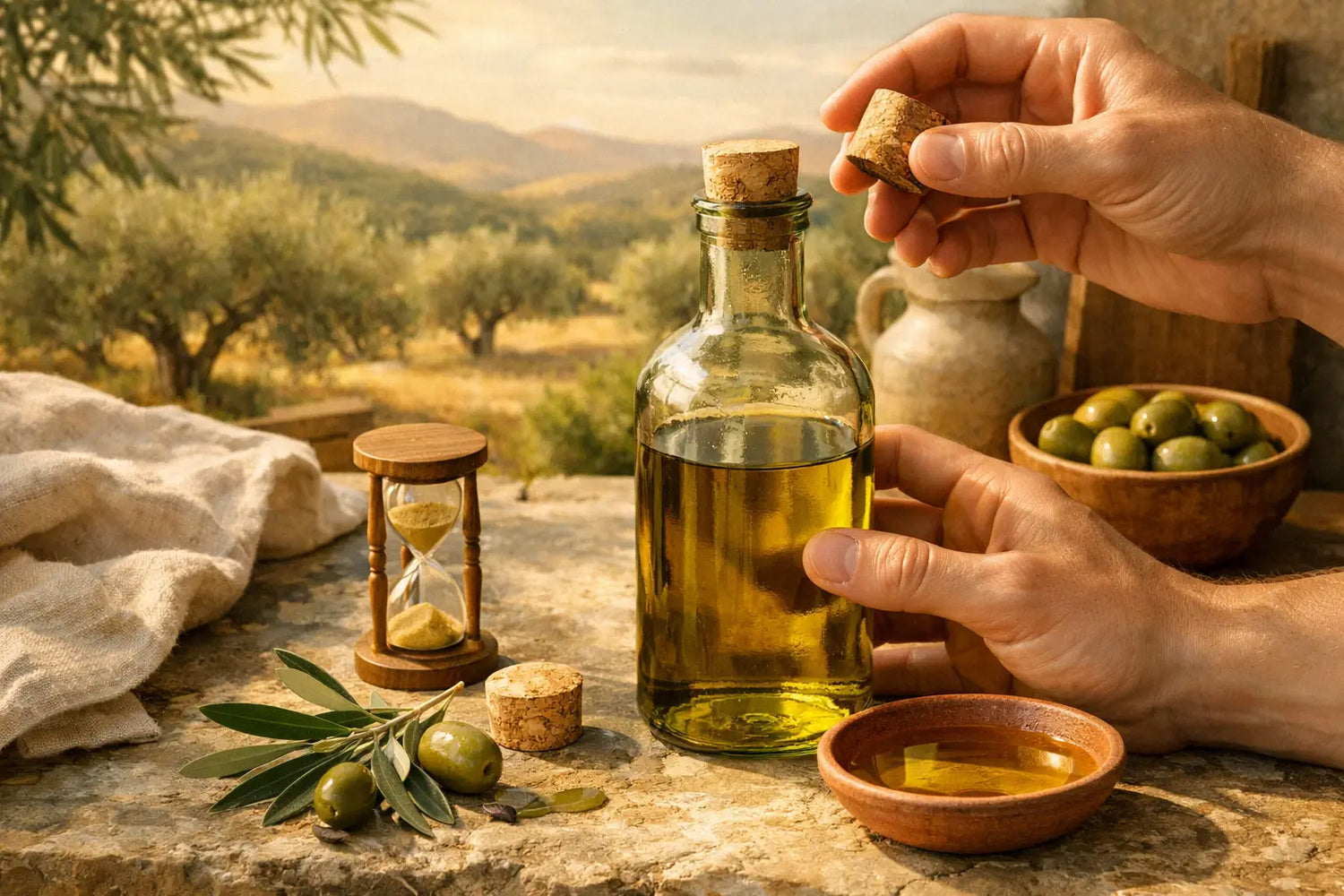
The bottle sits next to the stove, the lid is loosely placed after cooking, and a few weeks later the salad suddenly tastes bland. How long does opened olive oil last? The honest answer is: it depends on how fresh it was when you bought it and what happens to it afterward. For full flavor, you should generally use an opened bottle within three to six months. Well protected, it can remain edible longer. But edible and truly good are two different things.
Extra virgin olive oil is not a perishable luxury product, but it is not an indestructible kitchen fat either. It thrives on fruity aromas, a pleasant bitterness, and the peppery sharpness in the finish. Exactly these qualities are lost when light, air, and heat work on it for too long. No industry. No tricks. The quality of an oil is only maintained if it is taken seriously at home.
How long does opened olive oil last with proper storage?
As a practical rule of thumb: After opening, high-quality olive oil usually tastes most vibrant in the first three months. Up to about six months, with consistently good storage, it generally remains very good. After that, a critical taste test is worthwhile. An oil may not seem spoiled even after nine or twelve months, but it has often lost its freshness, complexity, and precision.
The initial quality is crucial. A freshly harvested, carefully milled olive oil with low acidity and stable natural antioxidants has better prerequisites than an anonymous blend that was bottled long before purchase. This is not a carte blanche for poor storage. But it explains why harvest date, origin, and processing say more than a distant best-before date.
The best-before date applies to the unopened, correctly stored bottle. It does not answer the question of how long the oil remains aromatic after the first opening. With each pouring, oxygen enters the bottle. Oxidation does not only begin when the oil smells clearly bad. It begins gradually and slowly deprives the oil of its character.
Light, air, and heat: the three enemies of oil
Olive oil doesn't need complicated treatment, just a good spot in the kitchen. The best one is dark, dry, and rather cool – ideally at about 14 to 18 degrees Celsius. A closed kitchen cabinet, not directly on an outer wall and not above the heating, usually works excellently.
Light accelerates quality loss. Therefore, transparent decanters belong on a beautifully set table, but not as permanent storage for the entire supply. Dark glass and opaque metal canisters are not a design whim, but protection. If you refill oil from a larger container, you should use a small dark bottle for this and keep the rest consistently sealed.
Heat is the second major mistake in everyday kitchen life. The spot directly next to the stove, oven, or window looks practical, but exposes the oil to daily temperature fluctuations. Steam rises during frying, it gets hot during cooking, the sun might even hit the bottle. Exactly this combination makes a good oil age faster.
The third enemy is air. Screw the lid back on immediately after each use. An open pourer is convenient for quick access but does not reliably protect. Especially with bottles that are rarely used, this makes a noticeable difference. It's better to buy a container size that suits your consumption instead of leaving a liter half-full for a year.
How do you know when opened olive oil is deteriorating?
Rancid oil isn't always dramatically bad. Often, what's missing is the first thing noticed: freshness. A good olive oil can smell of green grass, tomato leaf, almond, artichoke, or ripe olive. It may be bitter and gently scratch the throat. This scratching is not a defect, but often a sign of fresh phenolic compounds.
If the oil has passed its prime, it smells dull, waxy, or fatty. Some people find the smell reminiscent of old nuts, cardboard, candle wax, playdough, or long-stored chips. On the palate, it seems dull and heavy, sometimes almost sickly sweet. Then it no longer belongs on burrata, roasted vegetables, or in a simple vinaigrette where the oil plays the main role.
A small test is enough: put some oil in a glass, warm it briefly with your hand, and smell it. Then try a small sip. If it smells and tastes clear, fresh, and lively, all is well. If it seems musty, oily-old, or empty, you should replace it. Don't rely solely on color. Green doesn't automatically mean fresh, and yellow doesn't automatically mean bad.
How to keep olive oil fresh longer after opening
The right routine is simpler than any loss of quality. Keep the bottle in a dark place, close it immediately after use, and keep it away from the stove. If you rarely cook with olive oil, smaller bottles are sensible. If you cook a lot, a larger container might be the better choice – provided you regularly refill a small, well-sealed bottle.
Four things make a difference in everyday life:
- Store oil in a dark cabinet instead of on the countertop.
- Buy quantities you will use within a few months.
- Only refill small amounts from canisters and immediately seal the main container.
- Keep bottles, lids, and pourers clean and dry to prevent residues from entering the oil.
Buy fresh instead of managing shelf life
If you really want good olive oil on your plate, you shouldn't just ask how long it lasts after opening. The more important question is: How old was it when it arrived? The harvest date is more valuable than a best-before date without context. Olive oil is a natural product from a specific harvest. It does not get better with storage.
Look for traceable origin, a clearly named olive variety, transparent information on the harvest, and packaging that blocks light. At O.E.L. Berlin, Koroneiki olives, their own harvest, and their own mill stand for this very claim: quality must not be a black box. Whoever knows when and where their oil was produced can buy, store, and enjoy it more consciously.
The intended use also plays a role. A fresh, aromatic Extra Virgin Olive Oil is particularly worthwhile raw: on tomatoes, beans, fish, bread, soups, or just before serving over pasta. For searing, it can also be suitable, but the delicate aromas recede into the background. Use your best oil where its flavor remains noticeable. This is not a luxury ritual, but respect for a handcrafted food.
An opened bottle does not need to be anxiously monitored. Simply use it generously and consciously. A good oil does not belong in the pantry for the perfect occasion. It belongs on the plate today – as long as it still tastes of olive, not of the past.

Leave a comment
All comments are moderated before being published.
This site is protected by hCaptcha and the hCaptcha Privacy Policy and Terms of Service apply.