
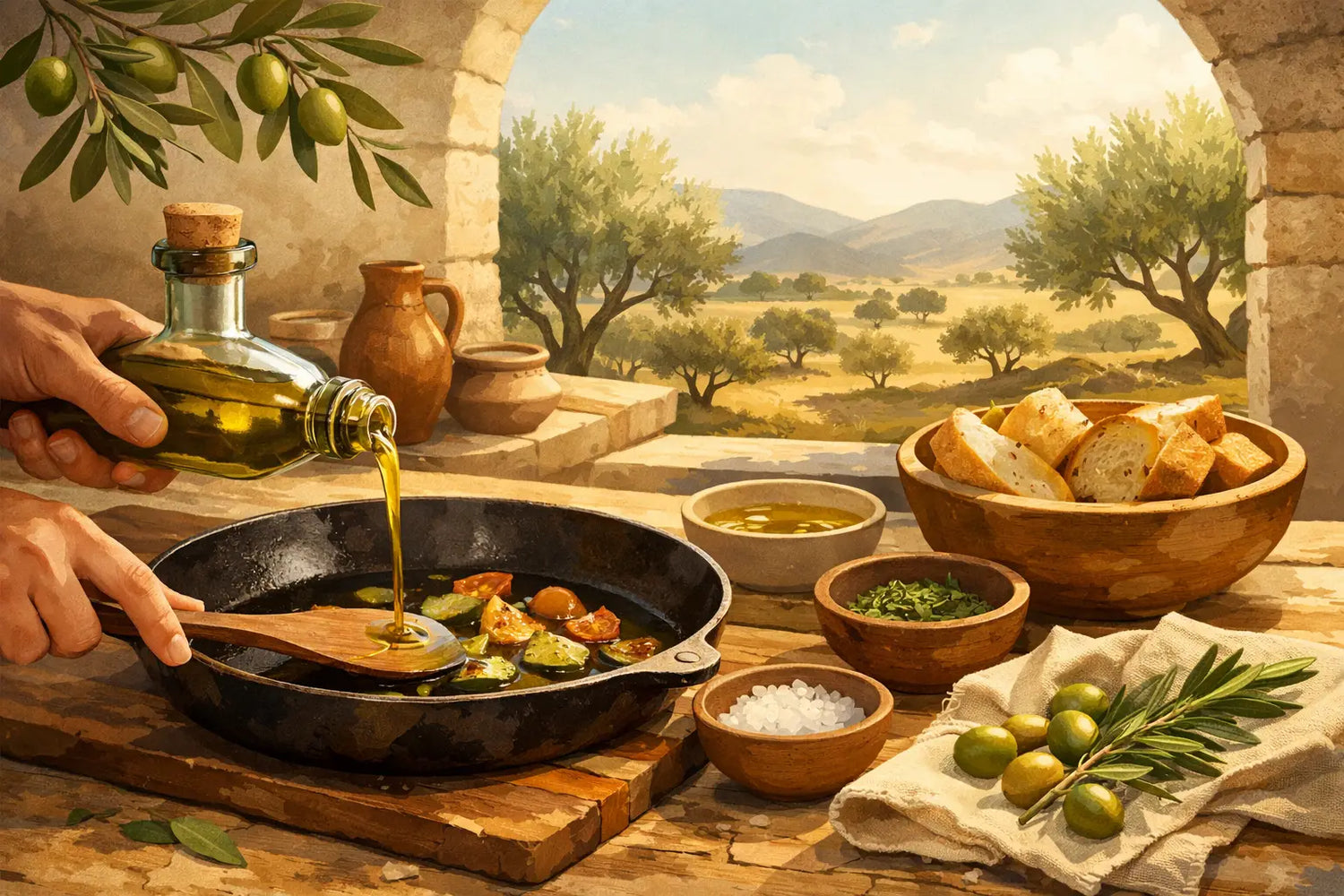
The pan is hot, the vegetables are ready, and then comes the age-old kitchen question: Can you use organic olive oil for frying without sacrificing flavor, quality, or health benefits? The short answer is yes. The honest answer is: it depends on the oil. Not every organic olive oil is automatically good. And not every olive oil that tastes good is the best choice for every high-heat situation.
Especially with olive oil, an astonishing number of myths circulate. One says it should only be used cold. Another has been frying everything with it for years. Both fall short. Those who take quality seriously should not think in kitchen legends, but in terms of origin, freshness, processing, and temperature.
Using organic olive oil for frying – is it really possible?
Yes, it is. The crucial point is that we are not talking about just any industrially blended supermarket oil, but about a truly good organic extra virgin olive oil. That is, an oil that has been cleanly processed, is fresh, and has a stable fatty acid structure.
Olive oil largely consists of monounsaturated fatty acids. This is precisely what makes it so interesting in the kitchen. These fatty acids are significantly more heat-stable than many people assume. In addition, there are natural accompanying substances like polyphenols, which can make a high-quality virgin olive oil more resistant. If you have a fresh, cleanly produced oil from an early harvest and your own mill, you are working with a different product than with anonymous mass-produced goods in a decorative bottle.
However, this does not mean that every frying scenario is automatically sensible. Gently sautéing vegetables, fish, eggs, or chicken is different from deep-frying at consistently very high temperatures. Good cooking recognizes distinctions.
Why quality matters more than just the organic label
Organic is an important signal. It says something about cultivation. But it doesn't say enough about freshness, sensory quality, or clean processing after harvest. This is precisely where good olive oil distinguishes itself from interchangeable commercial goods.
If you want to use organic olive oil for frying, don't just look at the green label. Look at the entire chain. Where do the olives come from? How quickly were they processed after harvest? Is there information about the harvest, the mill, the variety? Is the oil traceable, or does it remain an anonymous blend from changing origins?
A high-quality organic extra virgin olive oil usually has a low free fatty acid content, clear freshness on the nose, and a noticeable liveliness on the palate. This is not just a topic for gourmets. It is also relevant in the pan. Because a cleanly produced oil behaves differently when heated than an old, flat, or oxidized one.
In other words: Organic is good. Freshness, transparency, and artisanal processing are better. Only together do they create an oil that convinces in everyday life.
What temperatures are appropriate?
For most everyday cooking applications, olive oil is a strong choice. Sautéing vegetables, caramelizing onions, sautéing mushrooms, pan-frying fish, browning potatoes, or moderately roasting meat – good organic olive oil is very well suited for all of these.
It becomes less sensible when the pan is preheated empty on the highest setting, the oil smokes for minutes, or you maintain consistently extreme temperatures. As soon as oil visibly smokes, something is going wrong. This is not a sign of professional cooking, but of loss of control.
Those who cook with olive oil should consciously control the heat. Medium to medium-high temperatures are completely sufficient in most cases. Good pans, a little patience, and stovetops that are not overheated achieve more than brute force. Flavor is not created by burnt fat.
Does good olive oil lose its character when fried?
Partially yes – and that's normal. Fine green notes, fruitiness, and the peppery pungency of an excellent virgin oil change under heat. However, this does not mean that the oil becomes worthless. It merely means that cold application and warm cooking highlight different strengths.
For a vinaigrette or as a finish over burrata, beans, or grilled bread, a particularly expressive oil would be used neat to capture every nuance. In the pan, the focus shifts. There, stability, clean behavior when heated, and a good, rounded basic flavor count.
Those who like to cook with differentiation approach it pragmatically: a very good olive oil for frying and the same or an even more expressive oil for seasoning at the table. This is not a contradiction, but culinary respect for the product.
How to recognize a suitable organic olive oil
A good frying oil made from olives doesn't have to be boring. But it should be clear, fresh, and clean. If an oil smells dull, appears waxy, or tastes old, it does not belong in good cooking – whether organic or not.
Specific details are helpful instead of advertising language. Variety name, harvest time, origin, bottling, and ideally also information on polyphenols or acidity levels show that a producer has substance. Those who work transparently need to impress less.
The packaging also plays a role. Dark glass or light-protected containers are sensible because light damages the oil. After opening: do not store next to the stove, do not keep indefinitely, do not let it age for months in half-empty bottles. A fresh premium oil is not a decorative object, but a living food.
Typical mistakes when frying with olive oil
The biggest mistake is not the olive oil itself, but how it is handled. Many blame the oil, although in reality, temperature, pan, or timing are the problem.
If the pan gets too hot, every oil suffers. If ingredients are added to the pan wet, cooking water is created rather than a crust. If the oil was stored openly, warm, and bright, it is already compromised before frying. And if only the cheapest purchase applies to a fine oil, you shouldn't be surprised by a flat taste.
Another misconception is the reflex to automatically switch to refined standard oil for everyday use and high heat. Of course, there are applications where a neutral oil can be useful. But those who cook Mediterranean and do not treat flavor as an afterthought often gain significantly more depth, character, and balance with good olive oil.
For which dishes is it particularly worthwhile?
Organic olive oil shows its strength wherever roasting aromas and product flavor work together. With zucchini, eggplant, fennel, or bell peppers, it adds warmth and contour. With eggs, it makes the difference between merely fried and truly good. Fish benefits from the gentle fruitiness, potatoes from the aromatic depth, and even a simple piece of sourdough bread with tomatoes fried in olive oil becomes a serious meal.
It is less ideal when absolute neutrality is required. For some baking recipes or very specific flavor profiles, another fat may be more suitable. Good cooking is not a religion. It is a sequence of conscious decisions.
The real question is not whether, but with what
Those who want to use organic olive oil for frying should therefore focus less on blanket prohibitions and more on the specific product. A fresh, single-varietal, traceable organic extra virgin olive oil from clean processing is not only suitable for many frying applications but is culinarily the better decision.
Because this is not just about heat tables. It's about what should end up in your kitchen: an anonymous industrial oil without a face or a food with origin, character, and artisanal integrity. Precisely at this point, the difference becomes palpable. No tricks. No blend romance. Just honest quality that shows character even in the pan.
O.E.L. Berlin stands precisely for this type of olive oil – transparent, award-winning, and made for people who don't want to compromise when cooking.
Next time you put the pan on, don't ask first if olive oil can handle it. Rather ask if the oil in your hand truly deserves that name.

Leave a comment
All comments are moderated before being published.
This site is protected by hCaptcha and the hCaptcha Privacy Policy and Terms of Service apply.