
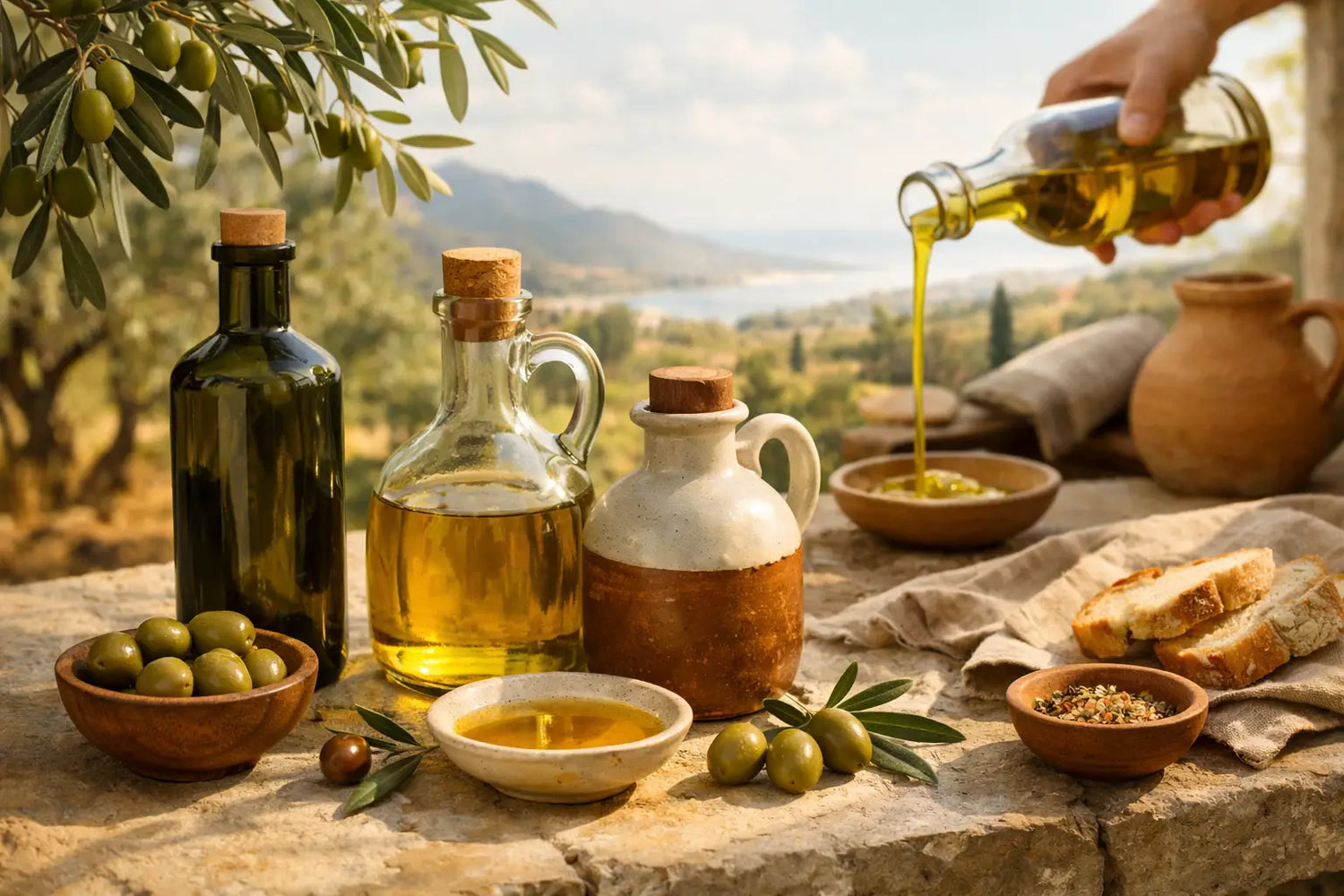
Tomato, good salt, a piece of bread – and suddenly, it's not the recipe but the oil that makes the difference. That's why the question of the best olive oils for cold dishes is no trivial matter. In cold applications, there's no searing, no sauce, no hiding behind heat. What's in the oil is immediately tasted.
If you reach for just any "mild" supermarket blend here, you often get exactly what makes industrial products so convenient: little character, little freshness, little origin. For cold dishes, this is the wrong approach. What's needed here is an extra virgin olive oil that is cleanly processed, smells clearly of olives, and doesn't feel flat in the mouth, but lively.
What really makes the best olive oils for cold dishes
Cold dishes are unforgiving. On burrata, fennel, beans, fish, or simply over warm potatoes, the oil lies openly on the plate. Therefore, it's not just "extra virgin" on the label that counts, but the actual quality behind it.
The first test is freshness. A good olive oil for cold applications doesn't smell old, waxy, or dull. It smells green, clear, sometimes of freshly cut grass, tomato leaf, artichoke, or almond – depending on the variety and origin. These aromas are not a marketing detail but the core of the experience.
The second point is sensory balance. Many people have been conditioned to "mild = high quality." The opposite is often closer to the truth. A high-quality oil can be bitter and slightly pungent. These characteristics come from polyphenols and cleanly harvested, early processed olives. For cold dishes, this is precisely what's interesting because it gives the oil tension and depth. Pungency in the throat is not a defect. Rancidity is.
Then comes the origin. If the bottle only states a vague mixture from several EU and non-EU countries, that's rarely a good sign. Those who take cold dishes seriously should know where the olives grew, when they were harvested, and ideally, who pressed them. Transparency is not a luxury. It is the prerequisite for a premium product to be more than just a pretty label.
Why supermarket oil often loses out in cold dishes
Many commercially available oils are built for mass production. They are meant to appeal to as many people as possible, be as inoffensive as possible, and remain stable on the shelf for a long time. The result is often a standardized profile without true freshness. For frying, some may not care. For salads, dips, or the finishing touch of a dish, it's wasted potential.
In addition, there's a psychological error when shopping: consumers check grape variety, vintage, and origin for wine, but often only the price for olive oil. Yet, olive oil in cold dishes is not a neutral fat but an ingredient with its own voice. If you buy it silently, you get silent taste.
Anonymous blends are particularly problematic. They can be technically correct but culinarily arbitrary. An oil for cold dishes shouldn't just "not interfere." It should make a dish more precise, fresher, and more characterful.
How to recognize high-quality olive oils for cold dishes when buying
Looking at the label isn't enough, but it helps. The category is crucial first: extra virgin olive oil. Below that, you wouldn't even start for cold dishes. It gets more interesting with the details. Is there a clearly named region, a variety like Koroneiki, Picual, or Hojiblanca, a harvest year, or even information about the mill? The more precise this information, the more likely there is a true origin behind it.
Packaging also plays a role. Dark glass or light-protected containers are sensible because light degrades aromas and quality. Those who regularly use good oil often fare better with larger, well-sealed formats than with small designer bottles that sit open for months. What matters is not how elegant a bottle looks, but how well it protects the oil.
If lab values are openly communicated, that's a strong signal. Low free acidity, high polyphenol values, and verifiable analyses show that quality is not just talked about. It is proven. Brands with their own harvest and mill, in particular, have a real advantage here, because fewer intermediate steps also mean less ambiguity.
Which styles work best in cold dishes
Not every good olive oil suits every dish. This is not a weakness, but precisely the point. Those who only look for one oil for everything often end up with mediocrity again.