
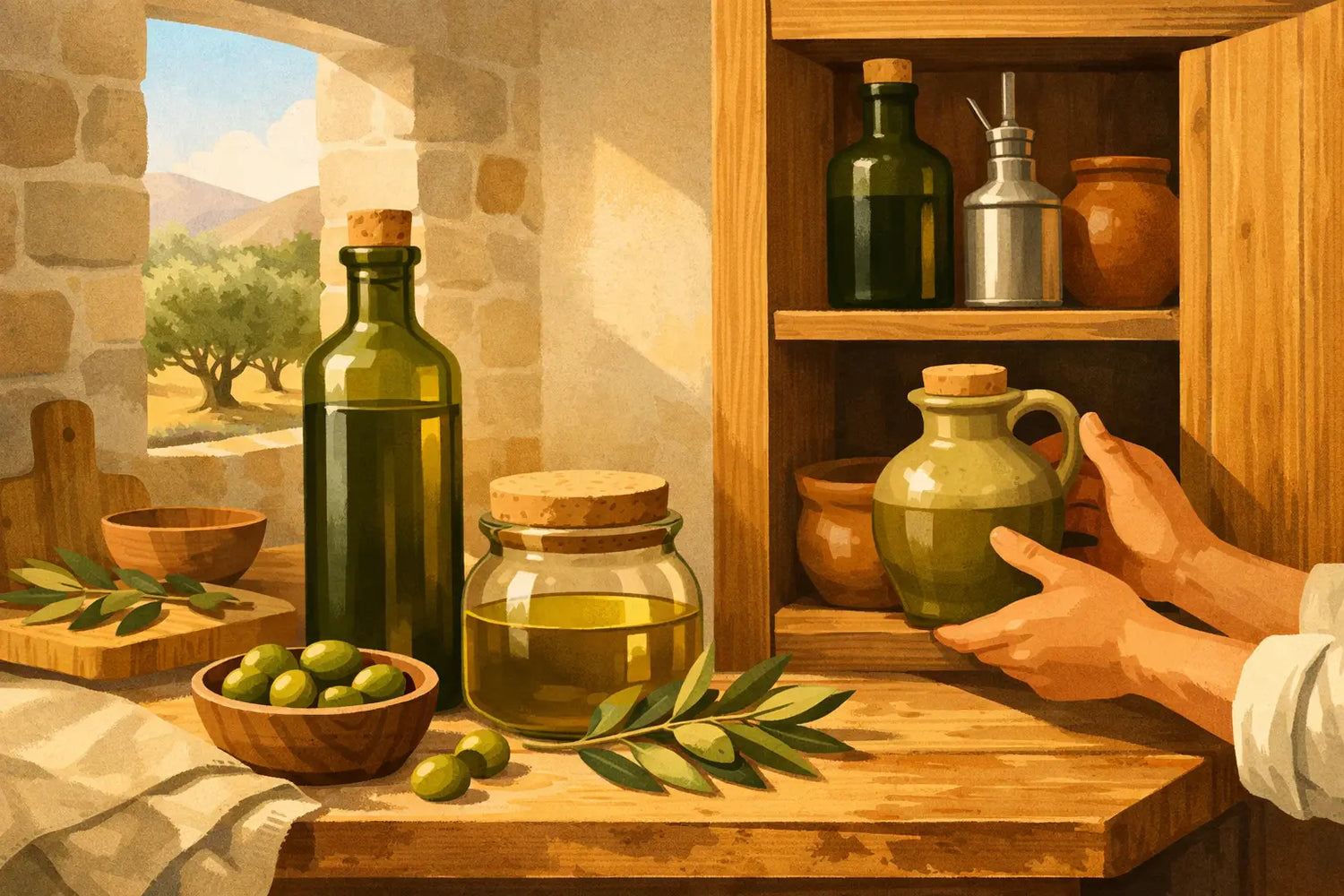
The bottle stands next to the stove, decorative, within reach, always in use - and that's exactly where good oil ages fastest. Those who want to store olive oil correctly at home are not just protecting any kitchen product, but a fresh natural product with character. A truly good extra virgin olive oil thrives on aromas, bitterness, a slight pungency, and its freshness. This quality is there - but it doesn't maintain itself.
Why incorrect storage spoils good olive oil
Olive oil is not a shelf-stable industrial product that should remain unchanged on the shelf for years. It is a juice from fresh olives. The better the initial quality, the more noticeable it becomes when it is lost due to improper storage.
The three biggest enemies are light, heat, and oxygen. Light accelerates oxidation. Heat does too, often even more drastically than many people think. Oxygen comes into play as soon as a bottle is opened and air reaches the oil with each use. The result is rarely spectacular, but rather gradual: the oil smells flatter, tastes duller, loses fruitiness, and eventually appears waxy, tired, or old.
This is particularly a shame with high-quality organic extra virgin olive oil. Because here you're not paying for neutral fattiness, but for origin, harvest freshness, artisanal processing, and sensory precision. If you then store it incorrectly, you're taking away exactly what makes the product valuable.
Storing olive oil correctly at home - the best place
The best storage place is cool, dark, and with as constant a temperature as possible. Not cold in the sense of requiring refrigeration, but rather stably between about 14 and 18 degrees Celsius, if that is realistically possible in the household. A pantry, a closed kitchen cabinet away from the oven, or a cool utility room are often better than any open kitchen shelf.
Consistency is paramount. A place that gets warm during the day and cools down again at night stresses the oil more than a consistently somewhat cooler place. Olive oil has no business being directly next to the stove, oven, dishwasher, or in the sun on the windowsill. It may be practical. It is not good.
If you use the oil daily, a smaller working bottle can of course be in the kitchen - but not permanently in the heat center. Better briefly within reach than decoratively sacrificed.
Is the refrigerator a good idea?
Mostly not as a standard solution. In the refrigerator, olive oil becomes cloudy or flaky because natural components change at low temperatures. This is not a quality defect and is reversible, but it makes application impractical. Furthermore, constant putting in and taking out brings about temperature fluctuations.
The refrigerator can only be useful in exceptional situations - for example, during extreme summer heat in attic apartments when rooms become permanently too warm. In that case, cool storage is better than heat. The important thing is to then let the oil slowly return to serving temperature.
The right bottle is also crucial
Not only the location matters. The container also plays a big role. Dark glass protects better than clear glass, tinplate canisters or high-quality metal containers protect even more consistently from light. Transparent designer bottles look good, but for serious olive oil, they are often the wrong priority.
Equally important is the opening. The larger the contact surface with air, the faster the oil degrades. Therefore, bottles with a tightly closing cap are better than open pourers that remain permanently on the bottle. These classic restaurant pourers look professional, but at home, they are often simply an invitation letter for oxygen.
Those who buy larger containers often do everything right for quality and price reasons - but only if the oil is then properly decanted. A large storage container should remain dark and cool. For everyday use, it's better to transfer smaller amounts into a handy bottle that will be consumed quickly.
Large containers or small bottles?
That depends on your consumption. Those who cook almost daily, prepare salads, roast vegetables, and truly use good oil often do very well with larger containers. Those who rarely use it, however, should buy smaller. Because the best bottle is not the largest, but the one that empties while fresh.
Quality is always also a question of timing. An excellent oil that has been open for a year is often the worse choice in everyday life than a smaller container that is consumed in a few weeks.
What often goes wrong at home
The typical mistakes are surprisingly trivial. The bottle stands next to the hob because it is pretty and practical there. It remains open after use or only loosely closed. Oil is decanted into transparent carafes because it looks nicer on the table. Or a good premium oil is saved for "special occasions" and hardly used for months.
This is precisely the misconception. Fresh olive oil is not a museum piece. It belongs in the kitchen and on the plate - but under reasonable conditions. Those who use it too rarely are not storing carefully, but for too long.
Heat from everyday life is also underestimated. Even the cupboard above the stove is often too warm. The same applies to shelves next to radiators or sunny countertops. The problem is not the single hour, but the daily repetition.
How to tell if your olive oil has suffered
A good extra virgin olive oil smells vibrant. Depending on the variety and harvest, it can smell of fresh grass, tomato leaf, artichoke, green almond, or herbs. In the mouth, it can be bitter and slightly pungent in the throat. This is not a defect, but often a sign of freshness and phenolic quality.
If, on the other hand, the oil smells of old fat, wax, cardboard, nuts in a negative sense, or simply almost nothing, it has usually lost its quality. Rancidity rarely comes suddenly. Often the fruitiness goes away first. Then a tired, flat impression remains, which many mistakenly consider "mild."
This is less noticeable with supermarket products, as they often have little character from the start. With artisanally produced oil, the difference is clearer. Good storage therefore not only preserves quality - it makes it perceptible until the very last drop.
Storing olive oil correctly at home - after opening
From the first opening, the clock ticks faster. This doesn't mean the oil immediately goes bad. It just means: now your handling of it matters more than before. Close the bottle immediately after use. Don't leave it open for long, especially not when cooking, when steam and heat are added.
Use opened bottles consistently. Don't hoard, don't collect, don't leave three different open oils standing in parallel for months if you only use one regularly. If you love variety, you should at least keep the quantities small.
If you like to switch between a strong oil for salads and a softer one for warm dishes, that's perfectly legitimate. But then it requires discipline in storage and consumption. Enjoyment has to do with awareness, not accumulation.
What role does the best-before date play?
The best-before date is a framework, not a guarantee of quality until the last day. It also says little about how fresh the oil really was when purchased. More crucial are the harvest time, bottling, transport, and your storage at home.
A freshly harvested and cleanly processed oil can be sensorially excellent - if handled correctly. An older oil with a long remaining best-before date can still appear tired. Those who take origin seriously therefore not only look at numbers, but at the overall picture: harvest, producer, processing, and storage.
Brands like O.E.L. Berlin therefore emphasize freshness, traceability, and direct control over harvest and mill. This doesn't end with shipping. At home, the customer then takes over the last, crucial part.
The simple practice for every day
You don't need specialized knowledge or laboratory equipment. A dark, cool place. A tightly sealed bottle. No permanent place by the stove. Larger containers only if your consumption matches. And most importantly: don't save good oil, but use it consciously.
This sounds simple, but it makes the difference between an oil that still tastes of green olive, herbs, and freshness after weeks, and one that is just fatty. Those who value quality should not lose it on the last stretch in their own kitchen.
Good olive oil is not an accessory. It is a living food - and at home, it shows whether you have only bought it or truly understood it.

Leave a comment
All comments are moderated before being published.
This site is protected by hCaptcha and the hCaptcha Privacy Policy and Terms of Service apply.