
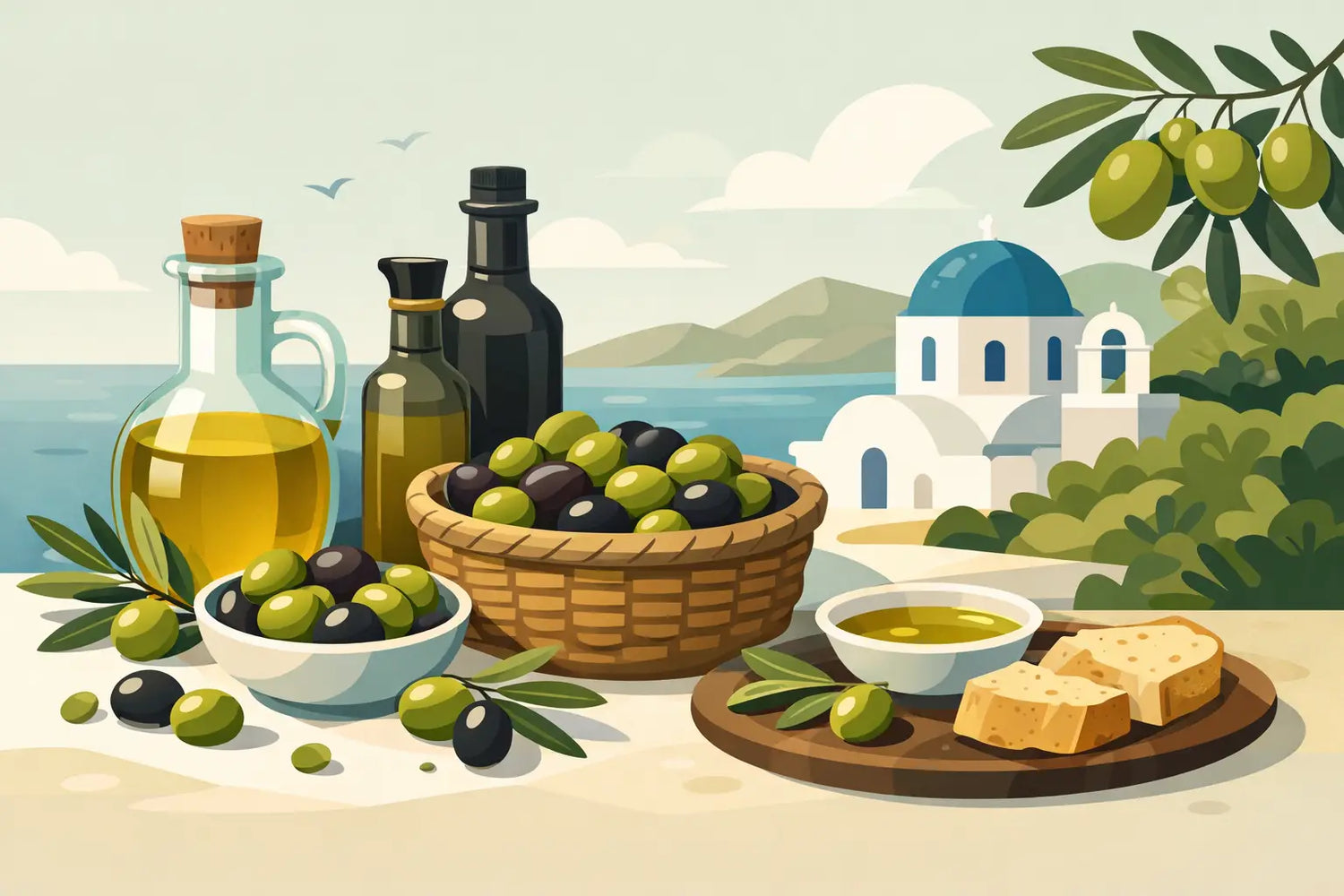
Anyone who wants to buy Greek premium olives isn't just buying a snack in a jar. They are choosing an attitude towards food. For origin over commodity. For pulp over brine with indifference. And for a product that immediately shows on the plate whether it was handcrafted or just prettily labelled.
The difference begins long before the first bite. Premium olives are not recognized by Mediterranean pictures on the packaging, but by variety, harvest time, processing, and transparency. This is precisely where honest quality separates itself from mass-produced goods.
Buying Greek Premium Olives - What Really Matters
Many people buy olives based on size, color, or because the label sounds "fine." This is understandable but often leads to disappointing results. Truly good Greek olives taste clear, lively, and true to their variety. They don't just taste salty but have structure, depth, and a clean finish.
If the origin is not explicitly stated, caution is advised. "From Greece" alone is not enough. It is crucial whether the region, variety, and processing method are traceable. Do the olives come from a clearly named growing region? Is it discernible whether they ripened naturally, were gently debittered, and processed without unnecessary additives? Anyone who doesn't answer these questions usually sells interchangeability.
Premium also doesn't automatically mean expensive at any cost. Premium means that the higher price is justified by taste and craftsmanship. An olive can cost more if it tastes like an olive and not like marinade, preservatives, and storage.
Origin is Not a Marketing Detail
Especially with olives, origin is often vaguely formulated. The problem: The less clear the origin, the greater the chance that it is standardized goods optimized primarily for shelf life and mass distribution. Many know the result: rubbery consistency, dominant saltiness, hardly any freshness.
Greece has an enormous culinary depth for olives. Depending on the region, microclimate, and variety, very different profiles emerge - from fleshy and mild to spicy, slightly bitter, and aromatically dense. These differences are not a side issue but the core of quality. Those who sell premium should therefore not only name the country but take the origin seriously.
This also applies to processing. Natural fermentation takes time. Industrial acceleration saves costs but sacrifices character. Not every fast method is automatically bad, but it changes texture and taste. Anyone who understands olives as a delicacy tastes this difference.
Which Greek Olives Can Be Considered Premium
Not every well-known variety is automatically the best for every purpose. Kalamata olives are deservedly popular because they are juicy, aromatic, and multifaceted. They often bring a pleasant balance of fruitiness, slight acidity, and spicy depth. For salads, mezze, and as a pure antipasto moment, they are often a very good choice.
Green Greek olives, on the other hand, often appear fresher, firmer, and more tart. They are an excellent match if you are looking for more bite and a slightly more astringent aroma. With fish, lemon, herbs, or young cheeses, they can even be the more exciting option.
Then there are refined variants - for example, with herbs, spices, or in high-quality marinades. This can be excellent if the olive itself is good. However, poor quality goods are often "spruced up." Therefore, the rule is: first the fruit, then the seasoning. Never the other way around.
How to Recognize Quality Before Buying
Anyone who wants to buy Greek premium olives should look more closely at the product description than at the design style of the jar. Good suppliers speak specifically. They name the variety, origin, net weight, ingredients, and ideally something about the processing. Vague formulations such as "Mediterranean style" or "from the best selection" say almost nothing.
A short list of ingredients is usually a good sign. Olives, water or brine, salt, perhaps vinegar or lemon juice, depending on the product, some oil or herbs - often nothing more is needed. If flavors, preservation details, and additives dominate, quality is often compensated for rather than delivered.
Texture is also a quality feature. Of course, you can't see it directly online, but descriptions like "fleshy," "firm," "juicy," and "true to variety" are more meaningful than mere lifestyle language. Good retailers sell taste, not scenery.
Why Many Supermarket Olives Disappoint
The supermarket wins through price, availability, and habit. Quality there is often just a byproduct. Many olives for the mass market are trimmed for uniformity: same size, same color, as little risk as possible in taste. What gets lost in the process is precisely what you actually buy olives for - character.
Added to this is long storage. Olives are durable, but not sensually arbitrary. An olive that has been designed for standardization for months or longer often tastes flatter. It fulfills its purpose, but it doesn't excite. For pizza nights, that may be enough. For a good salad, an appetizer platter, or simply bread, oil, and olives, that's too little.
It's not about demonizing every cheap olive. It's about honesty. If you're looking for pleasure, uncompromisingness pays off. No industry. No tricks. No compromises. That's where premium begins.
The Right Use in the Kitchen
Premium olives should not be treated as mere decoration. Their taste is precise enough to carry a dish. In a tomato salad with good onions, oregano, and olive oil, the olives decide between balance and arbitrariness. In pasta with capers and garlic, they set the rhythm. With bread and cheese, they immediately show whether there is substance.
The better the olive, the less you have to do with it. A good Kalamata olive doesn't need a heavy marinade. A few drops of high-quality olive oil, perhaps orange zest or a little thyme, are completely sufficient. Those who have excellent products do not need to disguise them.
For warm dishes, moderation is advisable. Cooking them for too long deprives many premium olives of tension and texture. It is often better to add them only at the end or serve them cold. This is not dogma, but a question of the desired result.
Buying Greek Premium Olives in the Online Shop
Buying online is not a disadvantage - on the contrary. Those who order directly from specialized delicatessens often get significantly more information than on the shelf. Good shops clearly explain origin, philosophy, taste, and product differences. Bad shops hide behind beautiful pictures.
Pay attention to three things. First, clear indications of origin. Second, a range with conviction instead of arbitrary breadth. And third, language that has substance. Anyone who formulates imprecisely about olives usually also works imprecisely in purchasing.
A curated assortment is often stronger than a hundred variants without a recognizable line. If a provider visibly distinguishes themselves from anonymous mass-produced goods and can explain why a product is in their assortment, trust increases. That's why specialized direct-to-consumer brands work so well when they truly live up to origin and quality.
Price, Brine, Organic - What Is Often Misunderstood
Organic is a strong signal, but not a free pass. An organic olive from poor processing remains mediocre in taste. Conversely, a non-certified olive is not automatically bad. Nevertheless, organic is often sensible, especially with Mediterranean products, when origin, producer relationship, and clean processing come together.
The brine is also underestimated. It is not only preservation but also influences texture and taste. Too aggressive brine pushes the olive's taste to the wall. Too little structure makes it flat. Good producers find a balance where the fruit remains the focus.
When it comes to price, a sober look is worthwhile. A cheap olive is often only cheap at the checkout. If consistency, aroma, and origin are not convincing, you are buying volume instead of pleasure. A smaller quantity of good olives ultimately puts more on the table than a large jar of mediocrity.
Who Really Benefits from Premium
Not everyone needs the best olive for every occasion. If twenty people need to be spontaneously catered for, pragmatism can play a role. But anyone who enjoys cooking, entertaining guests, or takes Mediterranean cuisine seriously will immediately taste the difference. Premium is particularly worthwhile where few ingredients matter.
This is precisely why the topic fits so well with brands like O.E.L. Berlin. Not because "Premium" sounds good, but because origin, craftsmanship, and sensory quality are only credible if they are precisely explained and consistently lived.
Ultimately, the standard is simple: buy olives that you don't just eat casually, but consciously serve. If a product arouses curiosity, sparks conversation, and makes a simple dish better, it wasn't an expensive snack. It was the right decision.

Leave a comment
All comments are moderated before being published.
This site is protected by hCaptcha and the hCaptcha Privacy Policy and Terms of Service apply.