
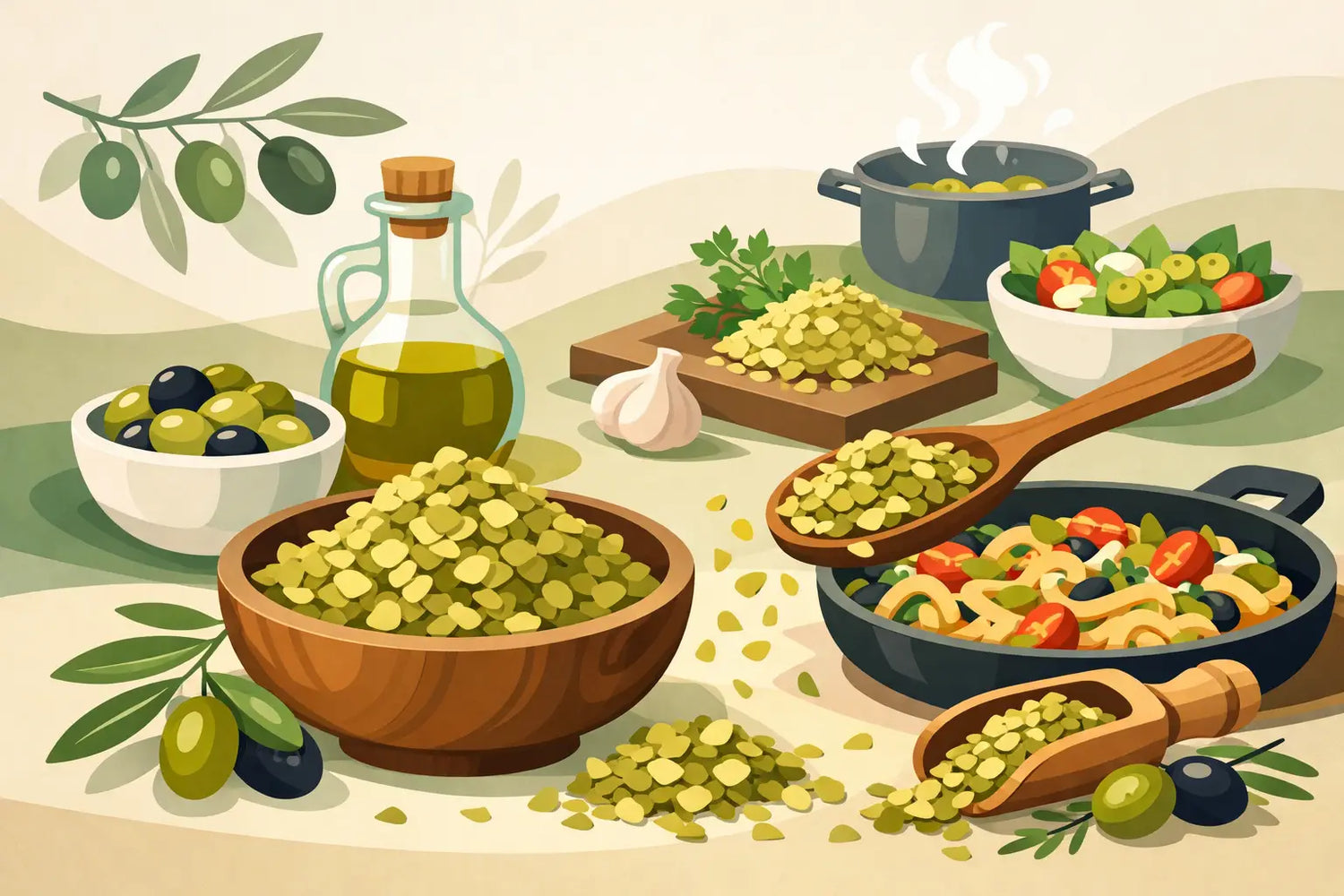
If you like olives, you know the problem: whole olives are great, but not always practical. Too dominant in salads, too bulky on a slice of bread, often requiring a cutting board and knife for quick dishes. This is where the use of olive flakes becomes exciting. They bring concentrated olive flavor to your plate - directly, precisely, and without detours.
Olive flakes are not a decorative gourmet gimmick. Used correctly, they function as a powerful seasoning with real depth. Salty, fruity, slightly tart, and depending on the variety, pleasantly spicy. They can round off dishes, create contrasts, or elevate a simple plate of bread, tomatoes, and good olive oil to another level. Don't cook more complicated. Season better.
What makes olive flakes so powerful in the kitchen
Olive flakes are made from olives from which water has been removed. This concentrates the aroma. What remains is not a watery snack, but an intense ingredient with character. The difference to chopped olives from a jar is clear: less liquid, more concentration, more control when seasoning.
That's why they are so versatile in the kitchen. They add flavor without watering down a sauce. They can be sprinkled, incorporated, baked with, or used as a finish. And they are best when a dish doesn't disappear under a list of ingredients, but rather a few strong components work together cleanly.
Those who buy high quality notice the difference immediately. Good olive flakes taste like olive - not just brine. They have substance, a clear fruitiness, and often the fine bitterness that makes good olive products interesting. Mass-produced goods, on the other hand, often taste flat, dull, or just salty. As with olive oil, origin and processing are decisive here.
Using olive flakes for everyday and gourmet cooking
The best use of olive flakes rarely starts with complicated recipes. It starts with the dishes that are regularly on the table anyway. Pasta, salad, roasted vegetables, eggs, sandwiches, dips. Wherever umami, salt, and Mediterranean depth are desired, olive flakes can work very precisely.
With pasta, restraint is worthwhile. A spoon of olive flakes in a sauce of tomatoes, garlic, and extra virgin olive oil can be enough to turn a simple everyday combination into something serious. This works particularly well with quick sauces where no long simmering time builds up the flavor. The flakes deliver character immediately.
In salads, they are often a more elegant alternative to olive rings. They distribute more evenly and add flavor with every bite. This is especially useful when other ingredients are meant to remain fine and fresh - for example, with fennel, orange, arugula, cucumber, or tomato. A heavy, salty block of whole olives would often be more disruptive than helpful here.
They also work well on roasted vegetables. Cauliflower, peppers, zucchini, eggplant, or potatoes gain more depth with olive flakes and a good oil, without the need for additional sauces. The result looks clearer and more mature than with ready-made spice blends. No industry. No artificial aromas. Just product, heat, and balance.
Where olive flakes are better than whole olives
Whole olives have their place. On antipasti platters, with bread, with cheese, in stews. But not every dish benefits from their shape and texture. This is exactly where the practical advantages of olive flakes lie.
Firstly, they can be dispensed evenly. Anyone who has tried to harmoniously distribute whole olives on a sandwich or on poached eggs knows how quickly that becomes messy. Flakes solve this problem.
Secondly, they are more texture-friendly. In creamy dips, fine spreads, or on crispy dishes, they add flavor without destroying the mouthfeel. This is a real advantage with hummus, labneh, cream cheese spreads, or on a focaccia.
Thirdly, they are often more suitable for everyday use. No pitting, no chopping, no brine running over the cutting board. Those who cook well don't always have to cook complicated. Efficiency is not a contradiction to quality.
How to use olive flakes correctly
The biggest mistake when using olive flakes is overdosing. Because they appear small, their intensity is often underestimated. In fact, they are more comparable to capers, sun-dried tomatoes, or good hard cheese than to a neutral sprinkling ingredient. Less is often more here.
Start with small amounts and work your way up. In cold dishes, olive flakes can be sprinkled directly on top. In warm dishes, it depends on what is desired. If the aroma should remain fresh and clear, they are added at the very end. If they are to combine with a sauce or filling, they can be added earlier.
Accompanying ingredients are important. Olive flakes don't need an overloaded environment. They work particularly well with tomato, lemon, yogurt, white beans, herbs, roasted vegetables, fish, eggs, and of course, good olive oil. It becomes more difficult with very sweet, very heavy, or heavily spiced dishes where their character gets lost.
The best combinations for olive flakes
Some ingredients bring out the best in them. Ripe tomatoes and olive flakes are such a combination, because sweetness, acidity, and salty depth meet cleanly. On burrata or mozzarella, they create more excitement, especially with a little lemon zest and peppery oil.
On bread, they are stronger than many expect. Not as a substitute for toppings, but as an accent. Try them on toasted sourdough bread with cream cheese, ricotta, or avocado. They also work well with butter - then rather sparingly, so that the whole thing doesn't tip over.
With eggs, they are almost always a good idea. Scrambled eggs, omelets, poached eggs, or soft-boiled eggs benefit from this small, salty-fruity contrast. If you want to eat quickly but not arbitrarily in the morning, this is a very rewarding area of application.
And then there are legumes. White beans, chickpeas, or lentils benefit enormously from an ingredient that brings both seasoning and a Mediterranean direction. A warm bean salad with olive flakes, lemon juice, parsley, and good oil doesn't need much more.
What to look for when buying
Not every olive automatically gets better through drying. If the raw material is weak, the result remains weak - just more concentrated. Therefore, pay attention to clear origin, traceable processing, and an ingredient list without unnecessary additives. Good olive flakes don't need flavors or tricks.
The texture also says a lot. They should be loose and pourable, but not dusty. Overly dry goods quickly lose their enjoyment and appear one-dimensional. Overly moist goods clump and often taste less clean.
Sensory, fruit before salt. Of course, olive flakes bring seasoning, but good quality shows more than just salt. It tastes like olive, like ripeness, sometimes slightly herbaceous, sometimes darker and more intense. Once you have tasted honestly produced goods, you quickly realize how great the difference to arbitrary commercial products can be. At O.E.L. Berlin, this exact product language is decisive: traceable origin, clean processing, and taste that doesn't need to be masked.
Storage and shelf life
Olive flakes should be stored dry, dark, and well-sealed. Not next to the stove, not open in the spice rack above the steam. Oxygen, heat, and moisture will gradually diminish their precision and aroma.
It's best to treat them like a high-quality seasoning ingredient and not just any pantry item. So it's better to use smaller amounts fresh than to forget a large jar for months. The better the product, the more worthwhile careful storage is.
Who olive flakes are really worth it for
Not every pantry needs ten specialty ingredients. But this one definitely deserves a place if you enjoy cooking Mediterranean food, value good products, and want to quickly add more flavor to your everyday meals. Olive flakes are not a show ingredient. They are for people who know that quality often lies in the details.
Above all, they are worthwhile if you want to season consciously, without immediately resorting to ready-made sauces, aroma mixes, or overly seasoned toppings. They bring clarity instead of noise. And that's exactly what good cooking is all about: a few strong ingredients, used cleanly.
The next time you're slicing tomatoes, roasting vegetables, or want to eat a piece of bread with something truly good, don't think bigger. Think more precisely. Often, that's all it takes.

Leave a comment
All comments are moderated before being published.
This site is protected by hCaptcha and the hCaptcha Privacy Policy and Terms of Service apply.