
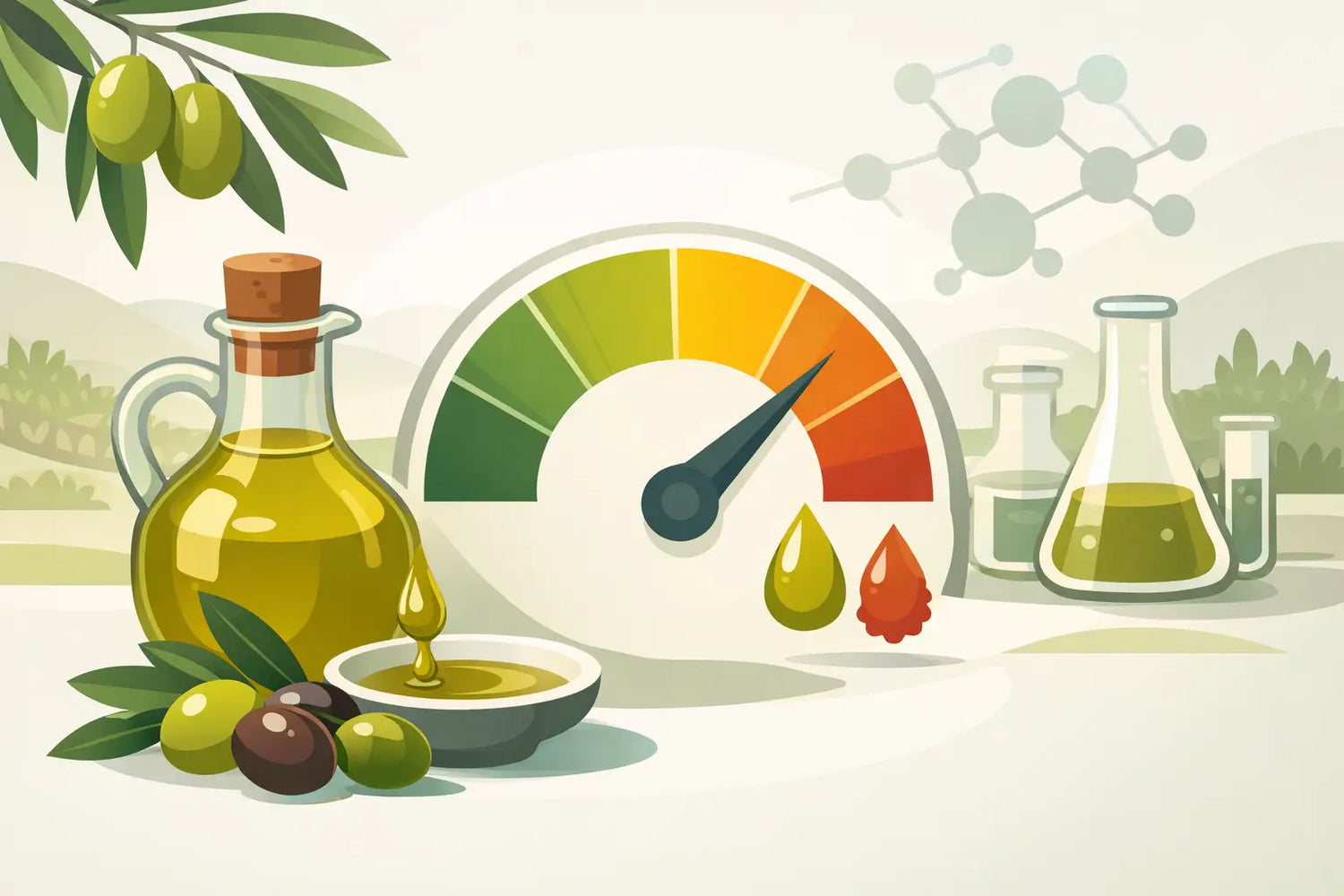
Anyone looking for quality on labels will sooner or later come across the term "extra virgin olive oil acidity". Many then read a number, breathe a sigh of relief and believe: the lower, the better. It's not that simple. Acidity is important - but on its own, it doesn't tell you whether an olive oil is fresh, characterful, and produced with clean craftsmanship.
This is precisely where genuine quality separates from marketing. Because industrial goods love simple key figures that are easy to print. However, truly good olive oil is never recognized by a single number. Anyone who only looks at the acidity will, in doubt, buy a technically correct oil that is nevertheless bland, old, or sensorially insignificant.
Extra virgin olive oil and acidity: What is it anyway?
The acidity indicates the content of free fatty acids, usually expressed as a percentage of oleic acid. For extra virgin olive oil, the legal limit in the EU is a maximum of 0.8 percent. Anything above that may no longer be sold as "extra virgin".
These free fatty acids are formed when olives are damaged, stored too long, or processed improperly. A low acidity is therefore a good sign. It indicates that the fruits were healthy and were processed quickly and carefully after harvesting.
But: Acidity does not measure taste. It also does not directly measure freshness on the plate. And it doesn't automatically tell you whether the oil is vibrant, green, peppery, and aromatic, or just well-behaved and boring.
Why low acidity is good - but not enough
Very low acidity speaks for carefulness. This is not a detail, but a core characteristic of quality. Those who harvest early, work cleanly, control the temperature, and quickly bring the olives to the mill often achieve significantly lower values than the legal maximum.
Nevertheless, the reverse conclusion is dangerous. An oil with 0.2 percent is not automatically better than one with 0.3 percent. Both values are at a very high level. The difference is not necessarily directly tasted in the mouth. Much more crucial is what else is right besides the acidity.
This includes fruitiness, bitterness, and pungency - precisely the sensory characteristics that distinguish fresh, polyphenol-rich olive oil. An oil can have good acidity and still appear sensorially tired if it has been stored incorrectly or was produced for mass rather than character from the outset.
What acidity in extra virgin olive oil does not show
The term "extra virgin olive oil acidity" is often treated as if it were the complete quality check. This is convenient, but short-sighted.
Acidity says nothing about whether the oil smells of green apple, artichoke, tomato leaf, or fresh herbs. It says nothing about whether you feel that pleasant pungency in the finish, which speaks for freshness and phenolic power. And it says nothing about whether the oil comes from a clearly named harvest or an anonymous blend where origin becomes secondary.
More importantly: Acidity is determined under laboratory conditions. You don't taste it directly. What you taste is the overall picture. A strong olive oil therefore needs more than good chemistry. It needs good fruits, timing, craftsmanship, and transparency.
What you should pay attention to besides acidity
Anyone who takes olive oil seriously always looks at the interplay of several factors. First, the origin. A specific growing region, a named variety, and a verifiable harvest say more than interchangeable Mediterranean romance on the label.
Second, harvest and processing freshness. Olive oil is not wine, which automatically improves with long storage. Freshness counts. An oil from the current harvest, processed quickly after picking, usually has significantly more expression.
Third, the sensory qualities. Good extra virgin olive oil can be bitter. It can slightly scratch the throat. This is not a defect, but often a sign of quality. Many consumers have been trained for years on mild, smooth supermarket oils and therefore confuse insignificance with quality.
Fourth, other analytical values. Peroxide value, K-values, and polyphenol content provide a much more complete picture. Not every label openly displays this data. If a producer makes them transparent, it is usually a good sign.
How low acidity is even created
Truly low acidity is no accident. It begins in the grove. Healthy olives must be harvested at the right stage of ripeness. After that, every hour counts. If fruits lie too long in bags, get bruised, or ferment warmly, the proportion of free fatty acids increases.
Much is also decided in the mill. Clean processing, short distances, controlled temperatures, and precise separation of phases are not a luxury, but a foundation. Those who work carelessly here lose quality before the oil is even in the bottle.
Therefore, acidity is also an indirect proof of discipline throughout the entire chain. Not as an isolated number, but as a result of harvesting practices, logistics, and processing. This is precisely what distinguishes artisan-produced oil from anonymous mass-produced goods, where in the end only standardization and blending take place.
Why supermarket oil often tastes different
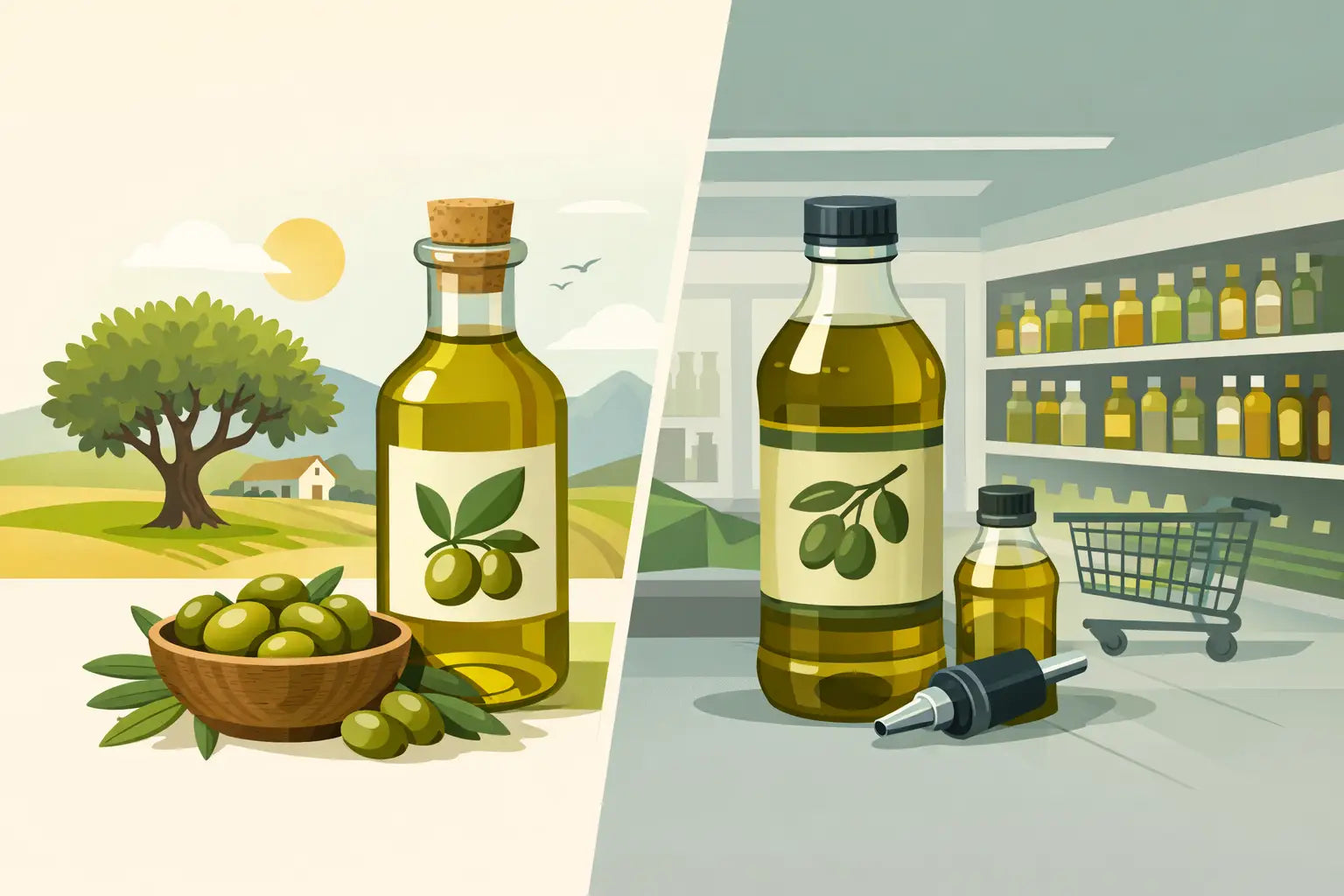
Many commercial oils formally meet the "extra virgin" category, yet fall far short of what olive oil can achieve in terms of taste. This is not always due to catastrophic acidity. Often it is due to the focus on price, consistency, and broad appeal.
Such oils are not meant to irritate anyone. So, little bitterness, little pungency, few edges. The result is an oil that can do almost anything but says little. For frying, this is enough for many. However, anyone who wants to refine bread, tomatoes, beans, fish, or simply cooked vegetables with olive oil quickly realizes how big the difference is.
A characterful oil not only elevates a dish. It brings structure, freshness, and depth. It turns ingredients into an attitude. No industry. No tricks. No compromises.
What acidity is really good for extra virgin olive oil?
Legally, anything up to 0.8 percent is permissible. Quality-oriented producers are often significantly below that, sometimes at 0.1 to 0.3 percent. That's strong. But here, too, applies: Don't fall into number fetishism.
If a manufacturer aggressively advertises extremely low acidity, the rest of the story should follow suit. Where do the olives come from? Which variety was processed? When was it harvested? Are there current analyses? How does the oil taste specifically? Anyone who remains silent on this may be using the number as a smokescreen.
A credible producer explains not only the acidity, but the entire quality profile. This is precisely the difference between assertion and evidence.
For whom acidity is particularly relevant
If you shop consciously, cook Mediterranean, and are not just looking for any fat, then acidity is a useful starting point. It is particularly relevant for people who take freshness, artisanal processing, and health-promoting ingredients seriously.
However, anyone who just wants to know if the oil is "still okay" falls short. Olive oil is not a technical basic product. It is an agricultural product with vintage, variety, origin, and style. Anyone who looks at wine in a differentiated way should not reduce olive oil to a laboratory number.
Especially in the premium segment, this is crucial. There you buy not just purity, but character. Not just compliance with standards, but expression. Not just fat, but culture on the plate.
How to read the label smarter
If the bottle shows good acidity, that's positive. Then immediately ask further questions. Is there a precise origin instead of a vague EU blend? Is the olive variety named? Is the harvest current? Is there transparent communication about the mill, processing, and analysis?
Anyone who discloses this information usually has nothing to hide. Anyone who hides behind pretty design and vague terms often sells atmosphere rather than substance. With a producer like O.E.L. Berlin, this very difference becomes visible: quality is not asserted, but made comprehensible - from the olive to the bottling.
Ultimately, what happens in the kitchen counts. A good extra virgin olive oil with low acidity should not only be formally correct, but also make you want to cook. It should make tomatoes seem sweeter, balance bitter leafy greens, and suddenly turn a piece of bread into a meal. If a number supports that, good. If only the number is there, the essential is usually missing.
So don't rely on label magic. Trust in origin, freshness, sensory qualities, and verifiable diligence. Then you won't buy an off-the-shelf olive oil, but one with character - and you can taste that every day.

Leave a comment
All comments are moderated before being published.
This site is protected by hCaptcha and the hCaptcha Privacy Policy and Terms of Service apply.