
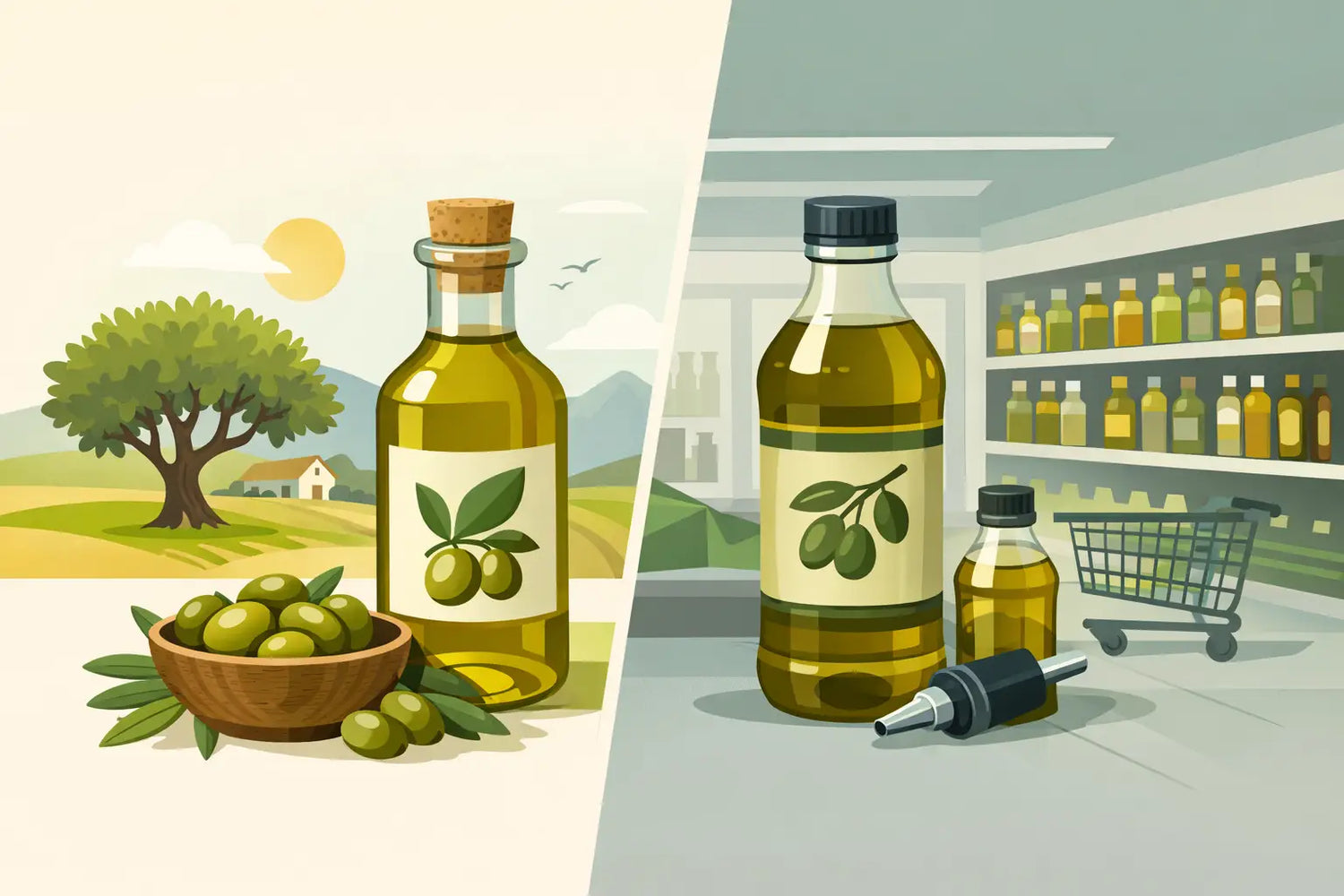
Between two green bottles on the supermarket shelf, there are often worlds apart - even if both are labeled organic, extra virgin, and cold-pressed. This is precisely what the topic of supermarket organic olive oil differences is about: not every organic olive oil is automatically fresh, single-varietal, transparent, or sensorially convincing. Organic is a start. Quality only begins after that.
What the Difference in Supermarket Organic Olive Oil Really Means
Many buyers expect three things from organic olive oil: less chemicals, better agriculture, a clearer conscience. This is legitimate. But the organic label alone says surprisingly little about what ends up on your plate. It primarily regulates cultivation and certain processing specifications. However, it guarantees neither an early harvest nor its own mill, neither short distances nor high freshness, neither varietal-typical taste nor low oxidation.
This is where the real difference begins. An organic olive oil from the supermarket can be cleanly produced and still taste flat. It can bear "extra virgin" on the label and still appear sensorially dull. And it can be attractively priced because it was blended from large, anonymous batches designed primarily to achieve one thing: constant availability on the shelf.
Anyone who cooks really well notices this quickly. The oil then doesn't carry the dish; it only accompanies it. It doesn't make salad more precise, vegetables more vibrant, or bread more exciting. It's fat with an olive note. Nothing more.
Organic Does Not Equal Origin
The most common misconception is: organic automatically means better origin. In reality, the origin of many supermarket oils remains surprisingly vague. Some bottles state a blend of olive oils from EU countries, sometimes supplemented by non-EU countries. This is legal. For people who want to know where their food comes from, it is nevertheless unsatisfactory.
Why is this relevant? Origin is not a minor detail for olive oil. Climate, variety, harvest time, mill, and storage massively shape the oil's character. An oil from a specific region and a specific olive variety can be clear, grassy, peppery, and bitter. A blend of changing origins is often built on balance. The goal is rarely character. The goal is stability in the mass market.
Anyone buying a real quality oil usually gets more than one country of origin mentioned. Ideally, the region, variety, harvest, and producer are traceable. Even better is full traceability. Then an interchangeable shelf product becomes a food with identity.
The Price Difference Usually Has a Reason
Supermarket organic olive oil often seems reasonably priced. This is understandable, as supermarkets sell volume. Large quantities, standardized procurement, mixed batches, and long supply chains drive down the price. For everyday use, this sounds practical at first glance.
The only question is: where were cuts made? Rarely on the label. Mostly on the raw material, harvest logistics, selection, and the speed between tree, mill, and bottling. A truly fresh, precisely processed extra virgin olive oil is not a random product. It results from early harvest, clean processing, controlled temperatures, good storage, and often from the conscious decision to accept less yield in favor of more quality.
That costs. And that's precisely why a very cheap organic olive oil is not automatically a bargain. It can end up being more expensive - in taste, culinary value, and one's own standards.
Supermarket Organic Olive Oil Difference: Freshness Trumps Label
Olive oil is not a long-lasting decorative product. It thrives on freshness. Polyphenols degrade, aromas lose their intensity, fruitiness becomes dull. Nevertheless, many bottles only state the best-before date, not the harvest year. For informed buyers, this is a problem.
An oil can still be officially edible and yet far from its best condition. Especially in supermarkets, long storage times, central distribution, and brightly lit shelves are not uncommon. This doesn't automatically mean it's bad, but it doesn't help the product.
Those seeking quality therefore look not only for organic and extra virgin, but also for indications of the harvest. A fresh oil often shows more green notes, more bitterness, more pepper in the finish. This is not a flaw, but a sign of quality. It shows that there is still something happening in the oil.
Extra Virgin is the Minimum Requirement, Not the Peak
Many consumers read "extra virgin" and think: it doesn't get any better than this. Formally, it is the highest quality grade. Practically, the range within this category is enormous. Between an industrially sourced standard oil and an artisanally produced top oil, there can be huge sensory and analytical differences - even though both are legally extra virgin.
Both values and taste are crucial. A low free fatty acid is good, but it alone does not make an outstanding oil. Polyphenols are interesting because they influence bitterness, pungency, and stability. Sensorially, a good oil should be fruity, show no off-notes, and ideally smell clearly of fresh olive, green leaf, herbs, or tomato.
If an organic olive oil in the supermarket tastes like almost nothing, that's not a sign of particular mildness. It's often a sign that there's little substance there.
What is Often Missing on the Shelf: Transparency
With genuine quality awareness, the question doesn't end with taste. It goes further: Who harvested? Where was it milled? How quickly after harvest? What variety? What analytical values are available? Is there a clear story or just pretty Mediterranean pictures?
Many supermarket products thrive on atmosphere. Sun, olive branch, rustic typography. This sells longing, but not yet quality. If you look closely, you often find little reliable information. Anonymous bottlers, unclear blends, no information on the variety, no indications of harvest window or mill.
Especially for a product as sensitive as olive oil, this is not enough. Transparency is not a luxury. It is the foundation of trust.
How to Recognize Good Organic Olive Oil
When standing in front of the shelf, a simple priority helps: first origin, then harvest, then processing, then price. A good oil doesn't have to be complicated to communicate. But the essential information should be discoverable.
Look for a clearly named origin instead of general EU blends. Look for a harvest year or at least concrete indications of freshness. Check if an olive variety is mentioned. Look for dark or light-protected packaging. And take seriously how the oil tastes later. Fruity, bitter, peppery - these are not warning signs for fresh organic olive oil, but often precisely the qualities that make it valuable in the kitchen.
For many dishes, a characterful oil is the difference between decent and truly good. Poured over tomato salad, on white beans, with fish, on hummus, or simply on warm bread, it quickly shows whether the oil is just there - or whether it sets the tone.
When Supermarket Organic Is Still Okay
Not every supermarket oil is automatically bad. That, too, must be said honestly. If you are looking for a solid everyday oil for large quantities, have little to compare with, and primarily value organic cultivation, you can certainly find something usable there. Especially if the bottle provides clear origin, harvest information, and a clean declaration.
But you should know what you are choosing. Supermarket organic is often the pragmatic solution. Not the most exciting. Not the most transparent. Not the freshest. For some kitchens, that's enough. For people who understand food as culture and take ingredients seriously, usually not in the long run.
Why Direct Sourcing is Often the Better Choice
The more direct the path from producer to bottle and from bottle to kitchen, the higher the chance of freshness, clarity, and character. This is precisely why direct sourcing is gaining importance for olive oil. Not as a lifestyle gesture, but because it has structural advantages: fewer intermediaries, more responsibility, more information.
When a manufacturer discloses their own harvest, their own mill, or close producer relationships, it's more than marketing. It shows that origin can be proven, not invented. Brands like O.E.L. Berlin focus precisely on this - with traceable organic extra virgin olive oil, clear origin, and an attitude that consciously doesn't sugarcoat supermarket blends.
This is not necessarily for everyone. But for anyone who wants more than a neutral fat carrier when cooking, it is usually the more consistent decision.
The Better Question When Buying
Next time you're shopping, don't just ask: Is it organic? Ask: Where exactly does it come from, how fresh is it, how transparent is the manufacturer, and does the oil taste like something that deserves the name? Then a casual purchasing decision becomes a conscious one.
And that's where good taste begins - not with the shelf price, but with the willingness to truly recognize quality.



Leave a comment
All comments are moderated before being published.
This site is protected by hCaptcha and the hCaptcha Privacy Policy and Terms of Service apply.