

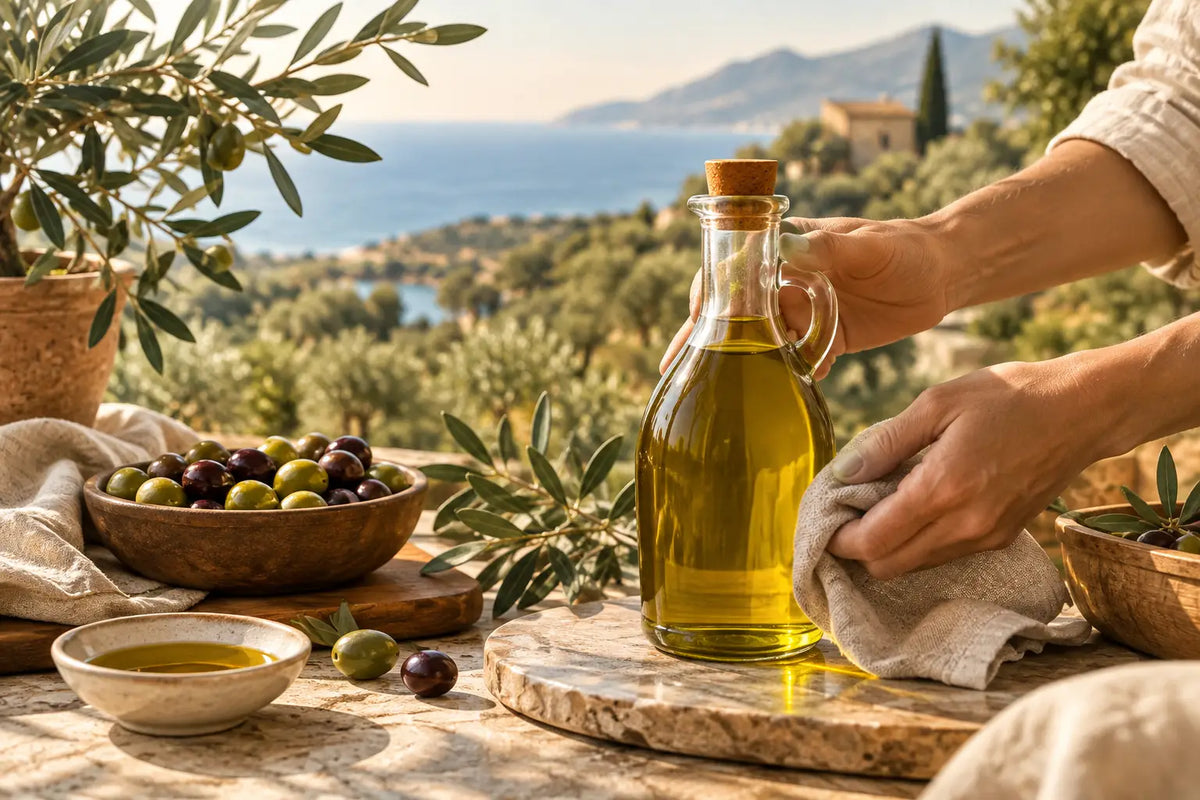
You can tell a good olive oil not just by its first opening. What matters is how it tastes weeks later on bread, over tomatoes, or in the pan. Anyone who wants to avoid olive oil oxidation is protecting exactly what they paid for: fresh green aromas, spicy heat, subtle bitterness, and natural polyphenols. The best-before date alone does not determine quality in everyday life. What matters are light, air, heat, and how you handle the bottle.
Oxidation is not a complicated laboratory problem. It begins as soon as oxygen, heat, or light affect the oil. It happens slowly but steadily. The result: The oil loses character, eventually smells flat or waxy, and instead of tasting of fresh grass, herbs, or green almonds, it becomes increasingly dull. No industry. No tricks. High-quality extra virgin olive oil deserves conditions that preserve its quality.
What happens with oxidized olive oil
Olive oil consists mainly of unsaturated fatty acids. They are culinarily valuable but react more sensitively to oxygen than highly saturated fats. When oxygen meets the oil, degradation products are gradually formed. Light and heat significantly accelerate this process.
At the same time, the oil gradually loses some of its protective compounds. Polyphenols are particularly relevant: They create the pleasant bitterness and scratch in the throat that many know from fresh, early olive oil. They also help the oil better defend itself against oxidation. That is why a polyphenol-rich oil usually remains stable longer under the same conditions than a very mild, polyphenol-poor oil. This is an advantage, not a free pass for poor storage.
Oxidation does not make an oil undrinkable overnight. That is exactly where the trap lies. The loss of quality is often gradual and overlooked in everyday life because many people are accustomed to oxidized, anonymous supermarket blends. Fresh olive oil should smell and taste lively. Rancid notes are more reminiscent of old nuts, wax, cardboard, or stale fats.
Avoiding olive oil oxidation: The four levers
Consistently exclude light
Direct sunlight is the fastest way to make a good oil age unnecessarily. A bright spot on the windowsill or directly next to the stove is also not a good idea. UV radiation and continuous ambient light promote oxidation processes, even if the kitchen otherwise seems cool.
Dark glass protects better than clear glass, and an opaque container even more so. But the packaging can only mitigate what happens afterward. Put the bottle in a closed kitchen cabinet or pantry. Being visible on the countertop is practical. Stored protected, the oil stays better.
Keep air contact to a minimum
Every opening brings oxygen into the bottle. This cannot be prevented, but it can be very well limited. Screw or snap the cap shut again immediately after pouring. Do not leave the bottle open while food is sizzling or guests are sitting at the table.
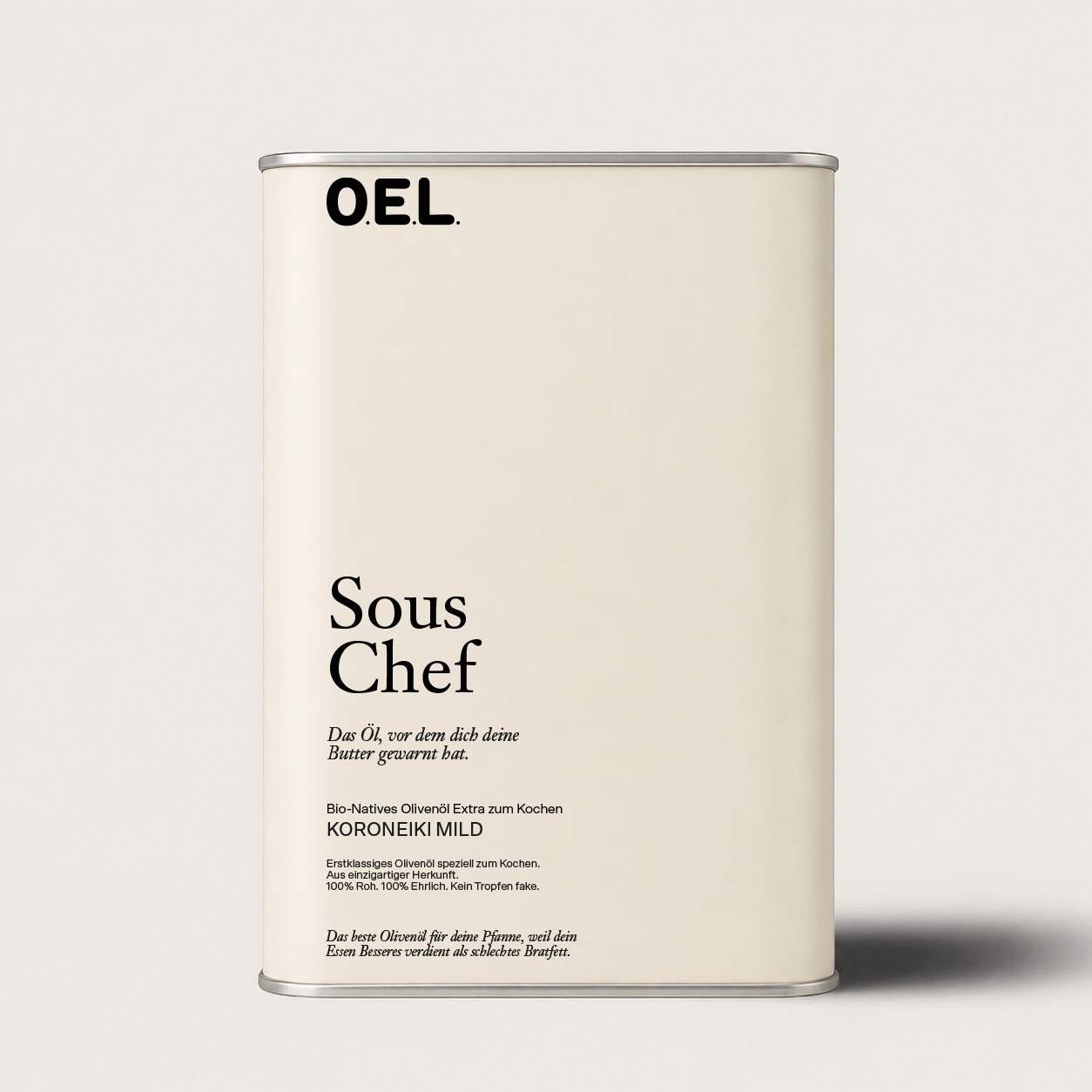
Large containers are not a disadvantage here, if they are used correctly. On the contrary: For daily needs, buy an economical refill size and only refill a smaller, clean bottle for the kitchen. The large container remains closed and thus better protected. The small bottle is regularly emptied, cleaned, and freshly refilled. This combines less packaging, a good price, and real freshness in everyday life.
Dosage is also important. A squeeze bottle or a clean pourer helps to work precisely without coating the rim of the bottle with oil residue. Sticky rims not only look unsightly. Oil comes into permanent contact with air there and can develop unpleasant odors over time.
Take heat seriously, but do not overdo it
Olive oil does not need to go in the refrigerator. A cool, dark storage cabinet is usually the better choice. Ideal are constant temperatures of around 14 to 18 degrees. In a normal apartment, this is not always realistic, and it does not have to be. What matters is avoiding strong and continuous heat.
The space next to the oven, heater, dishwasher, or stove is therefore unsuitable. There, the bottle experiences daily temperature fluctuations. The car, the balcony, or a sunny shelf are also bad storage places. Being temporarily warmer, for example on the way home, is no drama. Being stored for weeks at 25 degrees and above, yes.
In the refrigerator, olive oil can become cloudy or opaque. This is not an automatic sign of poor quality, but a natural reaction of individual fat components to cold. After warming up, it becomes clear again. Practical refrigerator storage is still rarely useful: The oil is harder to dose, and frequent removal creates unnecessary temperature fluctuations.
Work cleanly
Water, food residue, and dirty pourers do not belong in the bottle. Never dip a used brush, spoon, or herb sprig back into the oil. Anyone who makes flavored oil themselves should be particularly careful and only use suitable, hygienically prepared ingredients.
The same applies when refilling: Only refill when the smaller bottle is empty. Before that, it should be completely cleaned and, above all, dry. A swallow of old oil at the bottom plus fresh oil on top is not a clever mixture, but unnecessarily shortens the sensory freshness.
Buying decision: Freshness begins before your kitchen
The best storage cannot save an oil that is already old, has been transported for a long time, or was bottled under poor conditions. That is why it is worth looking at origin, harvest, and processing. A concrete harvest year is more meaningful than a best-before date as far away as possible. Even better: transparent information about the olive variety, the growing area, and the mill.
Extra virgin olive oil is not a flavor, but a legally protected quality category. But within this category, there are worlds. An oil from a traceable harvest and fast processing has a better starting position than a nameless blend whose olives, harvest times, and storage routes remain in the dark. Low acidity and laboratory values are relevant quality indicators, but they do not replace the sensory check. Does the oil smell and taste fresh, clear, and full of character? That remains the question that counts on the plate.
O.E.L. Berlin therefore relies on traceable Koroneiki olives from its own harvest and its own mill. This transparency is not a label detail. It makes quality verifiable and gives you a realistic basis to preserve freshness at home too.
How long does an opened bottle stay good?
It depends on the oil, packaging, temperature, and consumption. As a practical everyday guideline: An opened bottle should ideally be consumed within two to three months. In a dark, cool cabinet and with a cleanly closed cap, good oil often remains convincing longer. However, anyone who rarely uses olive oil is better off with smaller bottles.
For households that cook a lot, larger containers make sense - provided they are poured into a smaller kitchen bottle. Do not buy up for several years. Olive oil is not a wine that improves with long storage. It is a fresh food. The current harvest rarely just tastes better; it also gives you more of what makes good olive oil: aroma, tension, and origin in the mouth.
The quick freshness check before serving
If you are unsure, pour a small swallow into a glass, warm it briefly in your hand, and smell it. Fresh notes can be green, fruity, herbal, tomatoey, or almond-like. A slightly bitter taste and a peppery heat in the throat are often expressly desired in high-quality extra virgin olive oil.
If the oil smells of cardboard, crayons, old walnuts, candle wax, or stale deep fryer, it is probably oxidized. Then do not use it out of frugality for the special dinner. Good oil elevates simple ingredients. Bad oil brings them down.
Do not put your olive oil decoratively in the light today, but consciously in the cabinet. At the next plate of bread, warm vegetables, or simple pasta, you will notice why this small habit makes the difference.

Leave a comment
All comments are moderated before being published.
This site is protected by hCaptcha and the hCaptcha Privacy Policy and Terms of Service apply.