
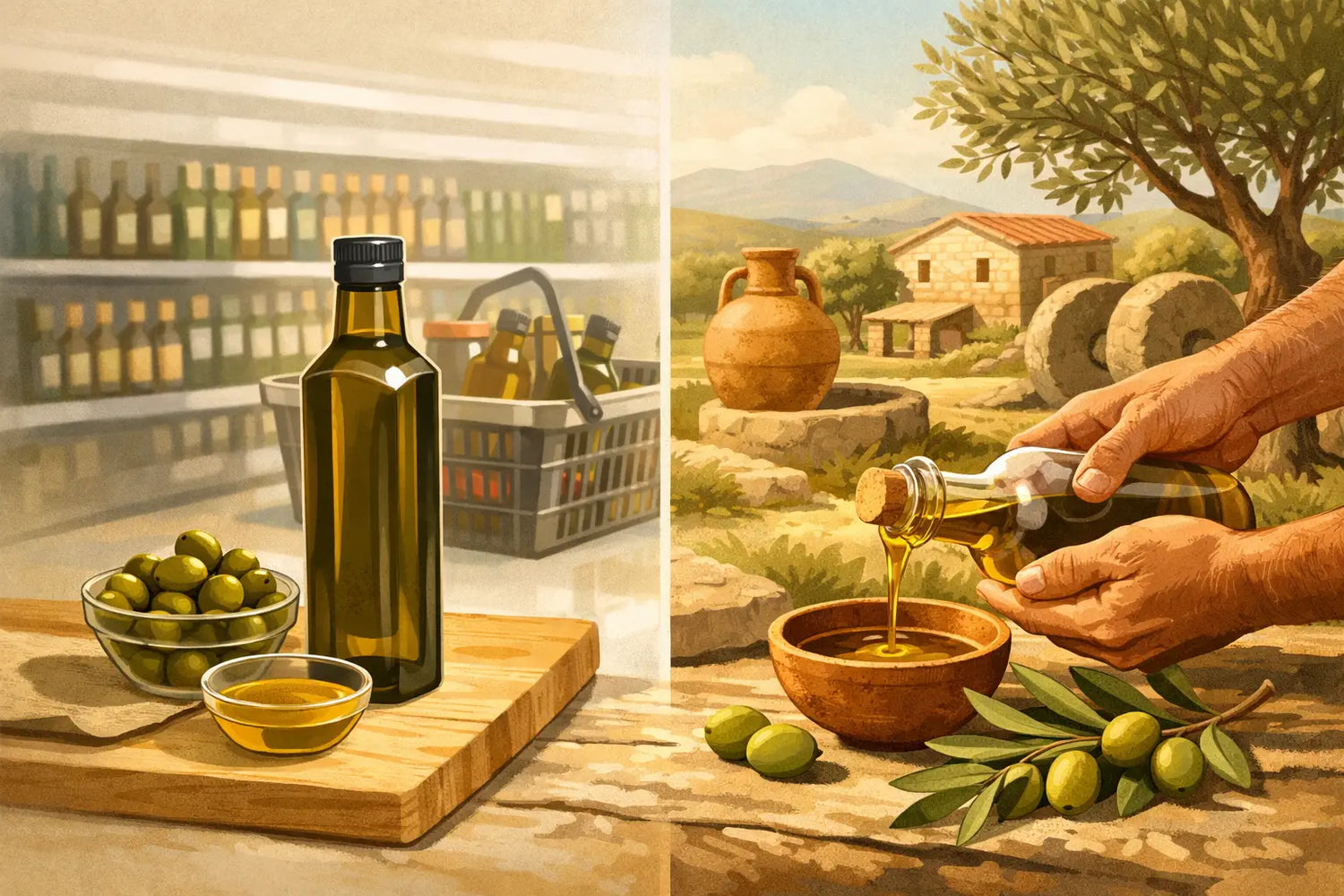
A dark glass bottle, a golden-green label, the words "nativ extra" and "cold-pressed" - on the shelf, many oils look strikingly similar. But when it comes to supermarket oil or producer oil, it's not the design that matters, but what's behind it: Who harvested the olives? Where were they processed? How fresh is the oil? And does it taste like olives - or just greasy?
Olive oil is not a neutral kitchen medium. A good oil brings bitterness, pepperiness, fresh grass, green tomato, or almond to the plate. It can make a simple vegetable dish more precise and give a piece of bread character. A generic oil, on the other hand, can technically meet all minimum requirements and still say nothing culinarily.
Supermarket oil or producer oil: The difference starts before the bottle
Supermarket oil is not a uniform quality class. There are certainly good products available in stores. The problem often lies in the anonymity and price pressure of the system. Large bottlers buy olive oil in changing batches, mix oils from different regions or countries, and bottle them under a brand name. The label then states, for example, "Olive oil from the European Union." Legally permissible. But for people who shop consciously, it's hardly informative.
A producer oil, on the other hand, makes the journey visible: It starts with the olive groves, the harvest, and the mill. Ideally, it is traceable from which region the olives come, which variety was processed, when they were harvested, and how quickly they were milled. This information is not decorative origin romanticism. It explains why an oil tastes the way it tastes.
Anyone who harvests their own olives and mills them themselves or works closely with a specific mill can not only purchase quality but also control it throughout the entire process. Ripeness, harvest time, transport of the fruits, temperature, and storage become real adjusting screws. With anonymous blends, it usually remains unclear who made these decisions - and by what standard.
"Extra virgin" is the beginning, not the quality judgment
"Extra virgin olive oil" is the highest legal category. Among other things, it requires a free fatty acid content of no more than 0.8 percent and demands sensory flawlessness. This is sensible but not a free pass for exceptional taste.
The category does not automatically tell you how fresh the oil is, how transparent its origin remains, or whether it tastes vibrant. An oil can meet the limits and still taste flat because the olives were harvested late, the storage time was long, or a blend is primarily designed for a low purchase price.
For producer oil, it's therefore worth looking beyond the category. Low acid values are a good sign, provided they have been verifiably measured. Polyphenols are also interesting: these natural plant compounds contribute to the bitterness and pungency of a fresh oil. However, a high value alone does not guarantee enjoyment. The decisive factor is the interplay of fruit, balance, freshness, and clean processing.
Freshness can be tasted - and it has a date
Olive oil is a fruit juice, not a wine that automatically improves with age. Immediately after harvesting, it usually has the most intense aroma. Oxygen, light, and heat gradually diminish this quality. Therefore, a specific harvest date is often more helpful than a distant best-before date.
A best-before date can reveal little about when the olives were actually processed, depending on the bottling time. Rather ask yourself: Which harvest is in this bottle? Is the batch named? Is the oil stored and packaged protected from light? Anyone who answers these questions clearly treats olive oil not as arbitrary goods.
What origin specifically changes
The olive variety shapes the character. Koroneiki olives from Greece, for example, can develop a concentrated, green-fruity profile with noticeable pungency. Other varieties are milder, more buttery, or nuttier. No style is inherently better. But it should be recognizable.
The harvest also makes a difference. Early-harvested, still green olives often yield less oil but a more intense aroma and more natural bitter and pungent compounds. Later-harvested fruits usually yield more and a milder oil. Industrial products are often geared towards availability, consistent taste, and calculation. A good producer oil, on the other hand, is allowed to show its vintage. Weather, harvest window, and fruit development are part of the product.
This is not a flaw, but honesty. Those who buy food with a clear origin do not expect every harvest to taste exactly the same. They expect it to be cleanly made and not have to hide its character behind a generic blend.
How to read an olive oil label without marketing fog
A few details quickly provide orientation. If only a broad country formulation is on the bottle, the supply chain often remains unclear. A specifically named region, a producer, an olive variety, or a batch creates more trust - provided the information is not just buzzwords.
Also, pay attention to the harvest year or harvest date. Check whether the supplier talks about the mill, processing, and storage. Laboratory values for acidity and polyphenols can be reliable proof if they are communicated batch-related and understandably. Terms such as "cold-pressed," "premium," or "traditional" are, however, not a proof of quality on their own.
Another point is the packaging. Dark glass, a light-proof tin, or a well-thought-out refill system protect the oil better than a transparent bottle that has stood under bright sales light for a long time. The same applies at home: seal well, store in a dark place, do not park next to the stove.
Price is a signal, not proof
High-quality producer oil costs more than a promotional product. This has real reasons: careful harvesting, small or clearly managed batches, quick processing, analyses, storage, and fair value creation for the local people. Those who harvest early also forgo a portion of the potential oil yield.
However, a high price does not guarantee anything. The decisive factor remains whether the supplier concretely proves its quality. Conversely, an extremely low price for supposedly particularly high-quality, freshly harvested oil is a reason to look more closely. Good olives, craftsmanship, and transparency cannot be endlessly optimized away.
For which cuisine is producer oil worthwhile?
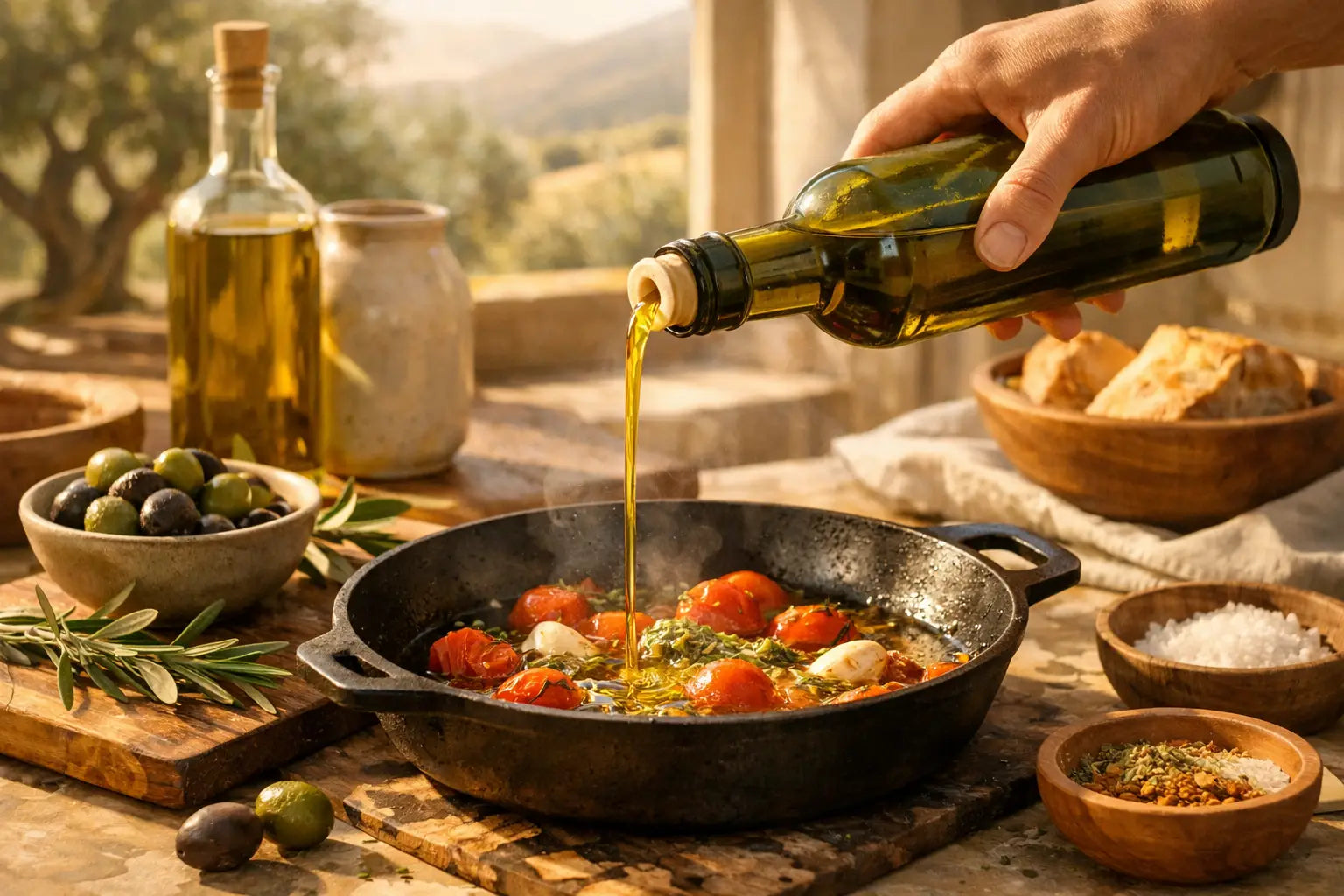
For dishes where olive oil is noticeably tasted, the difference is particularly clear: over tomatoes, beans, grilled vegetables, fish, yogurt, soups, or simply on toasted sourdough bread. Here, oil is not a background but an ingredient. A fresh, characterful producer oil brings excitement without additional acidity, sugar, or spice mixes having to conceal anything.
High-quality extra virgin olive oil is also well suited for everyday frying, as long as it is not continuously overheated to smoking point. For very high temperatures or large quantities, a cheaper, suitable oil may be more practical. Quality does not mean filling every pan with the most precious oil. Quality means consciously deciding when taste makes the difference.
O.E.L. Berlin therefore relies on traceable organic olive oil from Koroneiki olives, its own harvest, and its own mill. Not because origin would be a pretty story for the label, but because it is the prerequisite for control: from fruit to bottle.
The better question when shopping
Not every bottle from the supermarket is bad. Not every producer oil is automatically excellent. But the chances of real freshness, clear sensory perception, and traceable quality increase when a producer discloses what others hide behind general origin information.
Don't buy olive oil by color, advertising promises, or the loudest discount. Buy it like a food that ends up on your plate every day: with curiosity about the harvest, respect for the craftsmanship, and the demand that taste is allowed to have an origin.

Leave a comment
All comments are moderated before being published.
This site is protected by hCaptcha and the hCaptcha Privacy Policy and Terms of Service apply.