
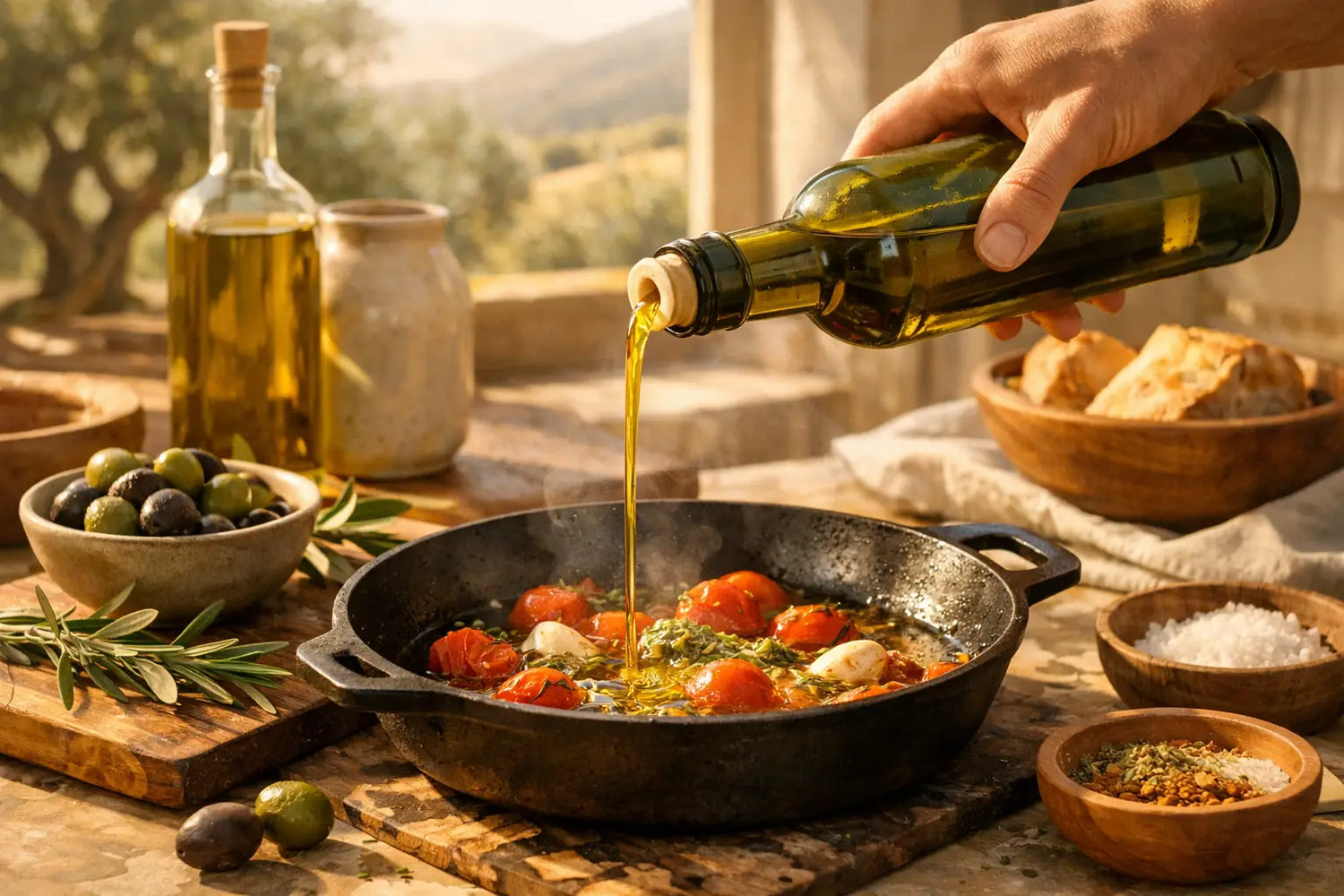
One sip too many, and the salad tastes heavy. One sip too few, and the pasta remains dry, even if the sauce is right. Dosing high-quality olive oil when cooking is not a question of stinginess, but of respect for the product and the dish. A fresh extra virgin olive oil brings fruitiness, bitterness, and pungency. Those who use it consciously will suddenly taste more of the vegetables, bread, fish, and good ingredients. Those who pour it in indiscriminately will overpower them.
Premium oil is not a neutral fat. It is an ingredient with character. Therefore, it does not always require larger quantities, but rather the right moment and a clear sense of portions.
Why quantity matters with high-quality olive oil
Olive oil from a fresh harvest, cleanly processed and directly from a traceable origin, is aromatically concentrated. Especially oils from Koroneiki olives often show green notes, are reminiscent of herbs or tomato leaves, and have a noticeable, pleasant pungency on the finish. This pungency is not a defect. It can be an indication of natural polyphenols.
The downside: a strong oil can dominate a delicate dish. For delicate white fish, burrata, or a fine leafy salad, a teaspoon per serving is often sufficient. For roasted pumpkin, lentils, or a tomato sauce, more may be used, because these ingredients can stand up to the oil.
The correct dose therefore depends not only on the size of the pan. It depends on the intensity of the oil, the quantity of ingredients, and the role the oil is intended to play: Is it meant to fry, bind, or be perceptible at the end? These are three different tasks.
Dosing high-quality olive oil when cooking: The basic quantities
Don't rely on free pouring from a large bottle. It rarely rewards precision. A tablespoon holds about 15 milliliters, a teaspoon about 5 milliliters. With these two sizes, almost any everyday dish can be safely managed.
For one serving of salad, 10 to 15 milliliters, or two to three teaspoons, are usually sufficient. For very delicate leaves like lamb's lettuce, it's better to start with two teaspoons and only add more after mixing. The oil should make the leaves glisten, not sit in a puddle at the bottom of the bowl.
For oven-roasted vegetables, 10 milliliters per person is a good starting point. First, sparingly distribute the oil, then season, and mix thoroughly with your hands or a spoon. This way, each piece gets a thin film. More oil does not automatically make oven vegetables crispier. Too much moisture on the surface can even hinder it.
With pasta, the ratio matters. For two servings, 15 to 20 milliliters are often enough for sautéing garlic or vegetables. After cooking, one to two teaspoons are added per plate as a finish. This oil is not hidden in the sauce, but carries its fragrance to the table.
In the pan: enough for contact, not for an oil bath
A pan with a diameter of 24 to 28 centimeters usually requires one tablespoon of olive oil for vegetables, eggs, or fish. The crucial thing is that the bottom is thinly and evenly coated after swirling. If dry spots remain, the food will stick. If the oil is visibly high, fried vegetables will quickly become soft instead of roasted.
For very absorbent ingredients like eggplant, the amount may initially seem alarming. Nevertheless, don't add everything at once. Start with one tablespoon, let the eggplant brown, and add more by the teaspoon if necessary. This way, you control texture and taste, instead of turning the pan into an oil reservoir.
Olive oil may get warm, but it should not smoke. As soon as it smokes, the temperature is too high and the delicate aroma is lost. For searing at extreme heat, another, more heat-stable fat may be advisable. For medium heat, gentle frying, and most everyday cooking, good extra virgin olive oil is, however, a convincing choice.
Cold use: first acid, then oil
For dressing, the order determines the dose. First, mix salt and acid - such as lemon juice or vinegar - in the bowl. Then slowly add the olive oil and taste. This way, you notice early on if the balance is right, instead of trying to save a bland vinaigrette with more and more oil.
As a simple guide, a ratio of one part acid to three parts oil works for many salads. However, this is not a law. A mild balsamic vinegar often requires less oil than an aggressive lemon. An intense, peppery oil can also work wonderfully with a little more acid. Tasting here is not an option, but the only honest measure.
As a finish: small amount, big impact
The oil at the end is where quality becomes visible without excuse. A teaspoon on a warm soup, over beans, on toasted bread, or over a portion of pasta is often perfectly sufficient. The warmth opens up the aroma without overcooking it.
If you finish a dish with high-quality olive oil, you should salt it more sparingly beforehand. Oil carries salt differently across the palate and rounds out flavors. First, add the finish, then try one last bite. Often, what's missing is not more oil, but a few salt crystals or a dash of acid.
The right tools prevent waste
A dark bottle protects oil from light, a small dispenser bottle protects against inaccurate quantities. A squeeze bottle is particularly practical: it doesn't release a gush, but a controlled stream. This makes a real difference when frying, garnishing, and quickly seasoning.
However, only transfer an amount that you will consume quickly. The main supply remains cool, dark, and well sealed. Heat, light, and oxygen make even the best oil dull faster. Large refill containers are useful if they reliably refill a smaller everyday bottle – not if they stand open next to the stove for months.
Even a tablespoon can become a habit again in a good kitchen. Not because cooking has to be sterilely measured, but because precision creates freedom. Those who know what 15 milliliters look like in their own pan can later work intuitively, without guessing every time.
Three common mistakes - and what works instead
The most common mistake is to treat oil as a repair agent. A dry couscous, a bland soup, or an overcooked plate rarely gets better with a large amount of oil. First check salt, acidity, temperature, and cooking time. Then use high-quality oil specifically as a final accent.
The second mistake: using the best oil exclusively for frying. When heated, it fulfills its purpose, but part of its aromatic finesse is inevitably lost. It's better to divide the amount. One part goes into the pan, a small part goes onto the plate after cooking. This not only tastes clearer, it also makes the quality truly tangible.
The third mistake is false economy. A drop-by-drop approach to an oil you love often leads to uninspired eating. Quality does not mean using as little as possible. Quality means using exactly the amount that a dish can bear. A tablespoon in a bowl of lentils for two people is not a luxury if it turns simple ingredients into a complete meal.
Read intensity instead of blanket dosing
Not every high-quality olive oil requires the same handling. A mild, ripe oil can be generously used over mozzarella or fish. An early harvested, grassy and peppery oil needs more restraint with raw dishes. Taste it neat with a piece of bread. If the pungency lingers in your throat, start with a smaller dose.
The dish also changes the equation. Bitter radicchio leaves go very well with fruity, strong oil. Sweet tomatoes benefit from pungency and a clear acidity. With artichokes, beans, potatoes, or grilled meat, oil should be visibly and tastefully present. With a fine pea soup or delicate asparagus, it should rather lie on top than disappear into it.
O.E.L. Berlin stands precisely for this attitude: origin and processing must be as clear as the taste in the dish. No anonymous blend hidden behind a neutral label. Those who know when and how an oil was harvested and milled cook more consciously with it - and dose not by habit, but by quality.
For your next meal, you don't need a complicated rule. Start with one less teaspoon, taste consciously, and only add more if necessary. Good olive oil shouldn't be loud just because it was expensive. It should deliver that crucial final taste that you remember.

Leave a comment
All comments are moderated before being published.
This site is protected by hCaptcha and the hCaptcha Privacy Policy and Terms of Service apply.