
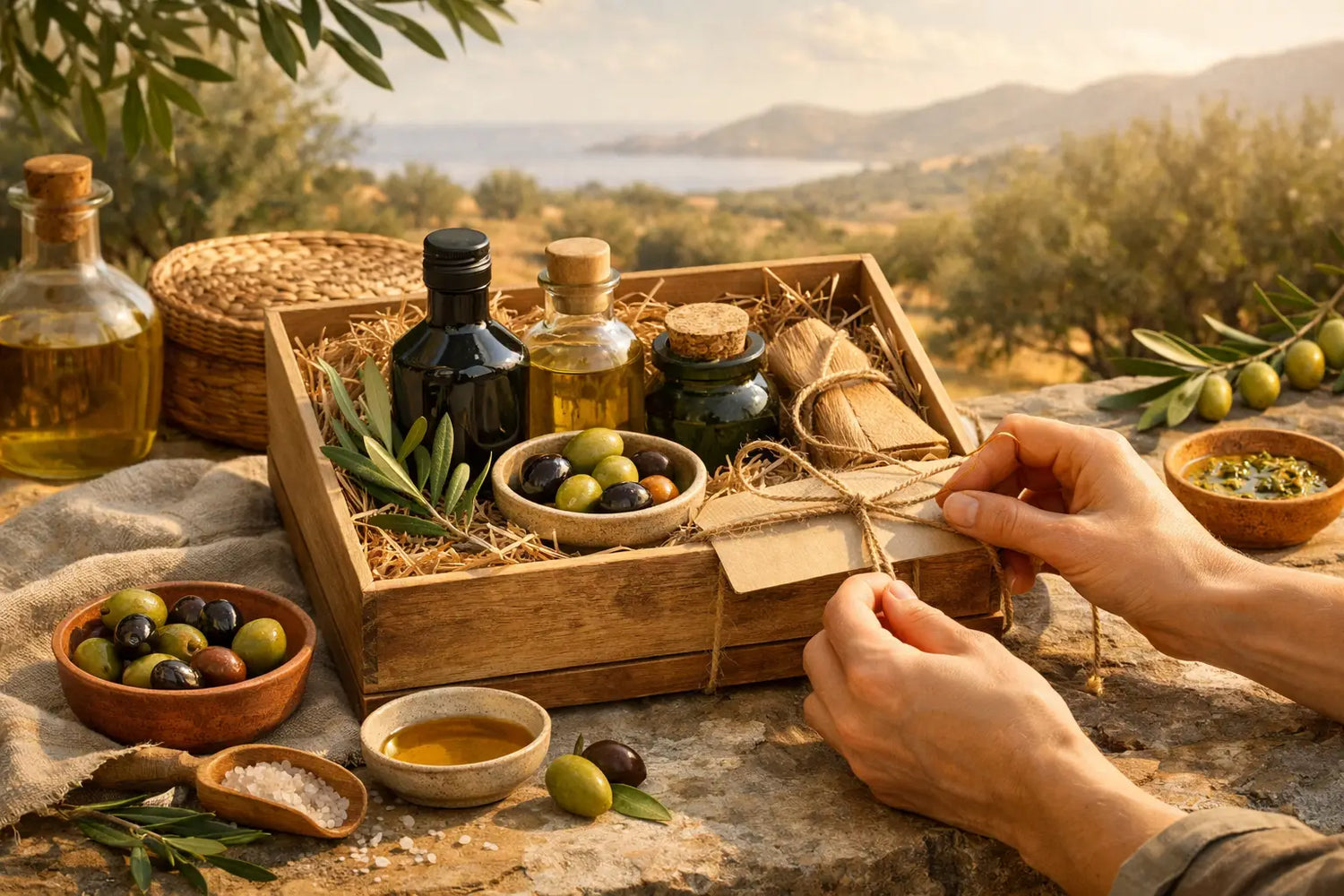
You don't just give away good olive oil. Anyone looking to buy an olive oil gift set is usually looking for more than just pretty packaging. It's about taste, attitude, and whether the gift really makes an impression or just looks good for a moment and then disappears into the cupboard.
Especially with delicacies, the wheat is quickly separated from the chaff here. Many sets appear high-quality because the cardboard is right, the bow is tied, and Mediterranean terms are on the label. However, what matters is not the appearance, but what is in the bottle - and whether the origin, harvest, processing, and freshness are traceable.
Buying an olive oil gift set means considering quality
An olive oil gift set is strong when it combines enjoyment and credibility. High-quality extra virgin olive oil has a clear sensory signature. It smells fresh, often like green grass, tomato leaf, herbs, or artichoke. In the mouth, it can be bitter and peppery. These are not flaws, but indications of fresh processing and valuable polyphenols.
Many buyers make the same mistake: they first look at the bottle size or the number of products in the set. This sounds reasonable but often leads to mediocre gifts. Three or four arbitrary delicatessen items do not make a good set. A strong gift set is curated. The products match in taste, tell a traceable origin, and have a real place in the kitchen.
Those who shop consciously quickly realize that different standards apply to olive oil than to many standard gifts. An oil from anonymous mass bottling can be elegantly packaged and still taste bland. An oil from one's own harvest and one's own mill, on the other hand, usually has character. You notice this not only when tasting it pure, but already with the first sip on bread, tomato, or warm vegetables.
How to recognize a good olive oil gift set
The most important point is transparency. A good set clearly states where the oil comes from, which olive variety was used, when it was harvested, and how it was processed. If this information is missing, caution is advised. Vague terms such as "Mediterranean selection" or "Premium Selection" sound good, but do not replace origin.
Freshness is equally important. Olive oil is not a decorative item, but a natural product. The fresher the harvest and the cleaner the processing, the livelier the aroma. When choosing a gift set, you should therefore not only look at the best-before date, but also at the harvest year and bottling. A fresh oil can carry a meal. An old oil can only make it greasy.
Then comes the sensory quality. Good producers speak openly about acidity levels, polyphenols, and flavor profile. Not to impress, but because this information helps to classify the product. Low acidity and high polyphenol values are strong signals of care. It is even better if the oil is described concretely in terms of taste instead of with empty superlatives.
And finally, the combination in the set counts. A high-quality oil, for example, harmonizes with good olives, olive flakes, mild vinegar, salt, or selected peppers. Such products enhance enjoyment. Cheap additions do the opposite. They only fill the carton.
The packaging can be beautiful - but never the main argument
Of course, a gift set can look good. Those who give want to hand over something that radiates value. But the packaging should support the product, not disguise it. If the box gets more attention than the oil, something is wrong.
Sets that are simple and clearly designed are particularly convincing. Less decoration, more statement. Those who can argue with origin, harvest, mill, and taste do not need over-staging. This often looks more elegant in the end than any gift wrap.
Who is it worth buying an olive oil gift set for?
Not every gift suits every occasion. An olive oil gift set works particularly well for people who enjoy cooking, eat consciously, or truly appreciate good food. For this target group, a strong oil is not a supporting actor, but a foundation. It refines salads, vegetables, fish, pasta, or simply a slice of sourdough bread.
As a host gift, it is often smarter than wine. It feels more personal, is suitable for everyday use, and doesn't just end up on the shelf for the next visit. Also for birthdays, invitations, Christmas, or as a thank you in a professional context, a good set can be just right - provided it doesn't seem arbitrary.
It's a different story if the recipient hardly cooks or views delicatessen more as a nice accessory. Then a small, clearly focused set might be more useful than a large gourmet box. More content doesn't automatically mean more joy. Sometimes an excellent bottle with one or two suitable accompaniments is the stronger gesture.
Buying an olive oil gift set: These are common mistakes
The most common mistake is to be blinded by the words "extra virgin" without looking deeper. This designation alone does not guarantee great taste. What is crucial is whether the producer works transparently and can also prove the quality.
The second mistake is the hunt for quantity. A set with many jars and bottles initially appears generous. But if no product really convinces, little remains of it. If you want to give quality, you should choose fewer products, but with clear origin and artisanal profile.
The third mistake is a lack of relevance to everyday life. A good gift set should work in a normal kitchen. The oil must not only be "special" but should also be used regularly. That is precisely where its value lies. Delicatessen becomes exciting when it doesn't treat enjoyment as a museum piece, but brings it into everyday life.
What makes a gift set with real character
A good set has a recognizable idea. Perhaps a single-variety organic olive oil is at the center, supplemented by olives and salt. Perhaps it leans more towards Mediterranean cuisine with vinegar and selected seasonings. The important thing is that everything contributes to the overall concept.
The whole thing becomes even stronger if the oil does not come from an anonymous blend, but from a clearly named region and from a producer who does not outsource responsibility. Own harvest, own mill, traceable batches - these are not secondary clauses. This is the difference between narrative and reality.
Precisely for this reason, gift sets from brands with a clear origin often work better than generic delicatessen boxes. They have more profile. At O.E.L. Berlin, for example, not just any oil is at the center, but a traceable organic olive oil from Koroneiki olives, with traceable production and sensory clarity. This makes a gift credible.
Price: expensive or appropriate?
With premium delicacies, the price is never just packaging and shopping cart value. It reflects harvest, processing, selection, storage, and transport. A high-quality olive oil is labor-intensive. Those who harvest early, press cleanly, and bottle fresh do not produce at discounter standards.
Therefore, a cheap gift set is not automatically a good offer. Often, you then pay for the staging instead of the content. Conversely, not every expensive set is automatically useful. An appropriate price is shown where quality is explained and proven. If origin and production remain in the dark, a high price remains only an assertion.
What contents in the set are really useful
The most convincing combinations are those that work culinarily. A fruity-green olive oil with a slight spiciness goes perfectly with natural olives, flaky salt, or a good vinegar for salads and marinades. Products such as olive flakes or selected peppers can also be useful if they are not merely filler material but continue a flavor profile.
Random mixtures are less useful. Sweet, savory, decorative items, and kitchen gadgets in one set often seem like a compromise, not an idea. Those who give pleasure should give clarity.
In the end, a simple truth remains: A good olive oil gift set shows respect - for the product, for the person who receives it, and for the food itself. When you buy an olive oil gift set, you are not just buying delicacies. You are deciding whether taste can be interchangeable or whether origin, freshness, and craftsmanship matter. That is what you remember later - not the ribbon.

Leave a comment
All comments are moderated before being published.
This site is protected by hCaptcha and the hCaptcha Privacy Policy and Terms of Service apply.