
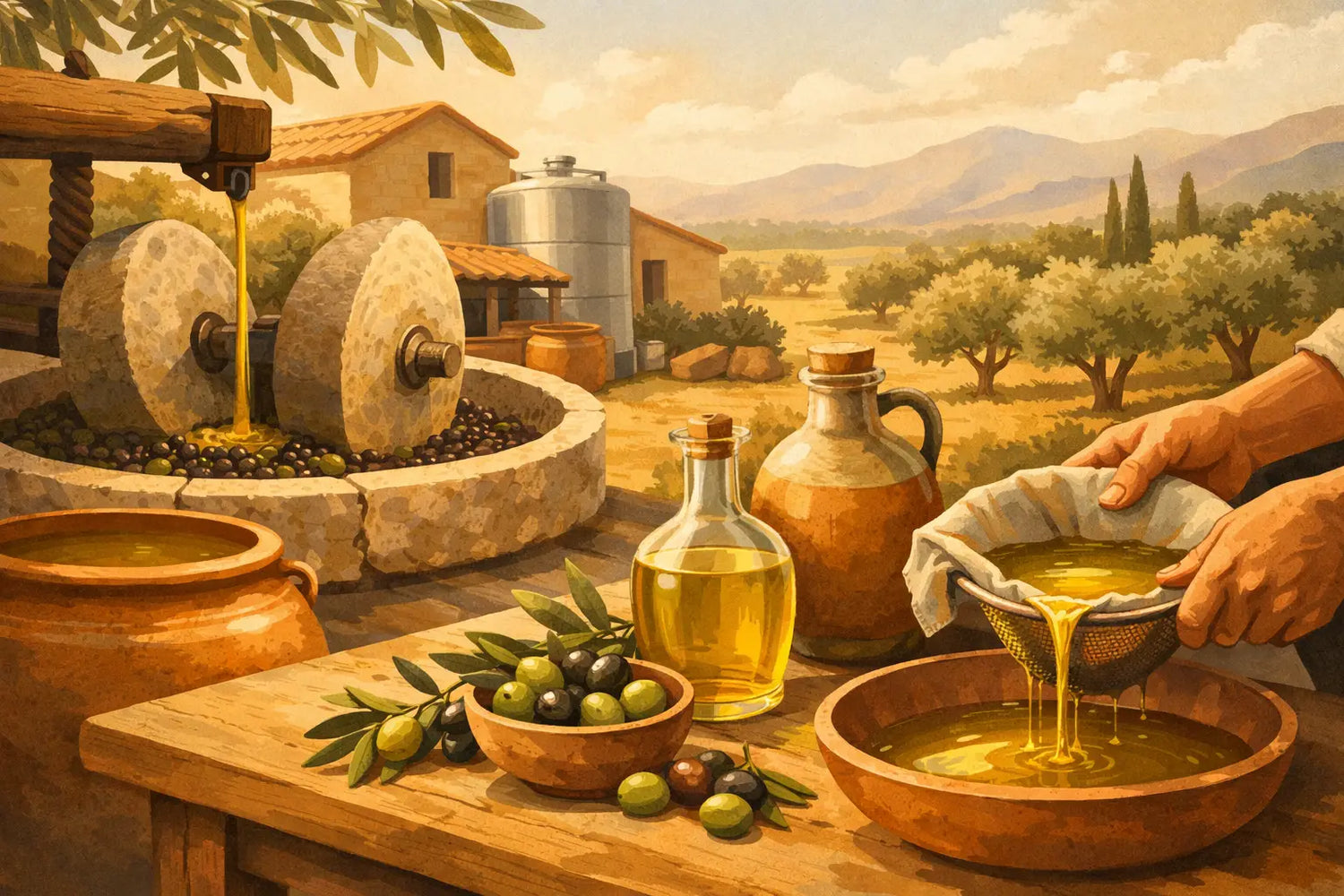
When you read the phrase "own mill olive oil" for olive oil, you're reading more than just a romantic origin story. It's about control. It's about minutes instead of days. It's about whether there's genuine care between the tree and the bottle – or just good marketing. Especially with extra virgin olive oil, this difference isn't minor; it's everything: in taste, freshness, polyphenols, and ultimately, in trust.
Many brands talk about tradition. Fewer speak precisely about processing. Yet, it's not the most beautiful grove that determines quality, but the chain in between. Who harvests? When is it milled? How warm is the process? Is it processed by variety or mixed with foreign goods? An own mill is therefore not a decorative detail. It can be a massive quality advantage – if used correctly.
Own Mill Olive Oil – Why it's More Than Just a Buzzword
Olive oil is not a static product. It begins to react immediately after harvest. The fruit continues to breathe, enzymatic processes occur, bruises become a problem, heat accelerates degradation. Operating your own mill or having direct access to it gives you the most valuable asset in the entire process: time.
This time saving isn't technically dry; it's sensorially palpable. Freshly processed olives more often yield oils with clear fruit, precise bitterness, and a lively pungency on the finish. These three elements are often misunderstood in everyday life. Many consider mild, flat oils to be particularly high-quality because they seem pleasing. In fact, bitterness and pungency are often signs that an oil is fresh, phenolic, and full of character.
An own mill also reduces friction losses in the process. There are no queues like at busy community mills, no unnecessary transport windows, less pressure to somehow fit goods in. This does not automatically mean that every external mill works worse. It just means: with your own mill, the crucial adjustments can be controlled more consistently.
What an Own Mill Specifically Changes in Olive Oil
The first big lever is timing. Olives harvested early and at the right stage of ripeness usually yield less, but add more vibrancy to the oil. More green aromas, more structure, often higher polyphenol values. Those who work for mass production tend to wait longer because the oil yield increases. Those who uncompromisingly pursue quality think differently. Fewer liters, more substance.
The second lever is the processing temperature. Cool extraction protects volatile aromas and helps keep the sensory profile clean. Too warm processing can increase yield but cost quality. This is precisely where craftsmanship differs from industry. Those who control their own mill don't have to choose between taste and convenience.
The third lever is the cleanliness of the line. In an own mill, machines, batches, and processes can be organized to minimize mixing. This is particularly relevant if you work with single varieties or want to precisely trace each batch. For discerning customers, this is not a side issue. Those who buy premium want to know what is in the bottle – and what is not.
Origin is Good. Control is Better.
Many labels mention a region, some even a village. That sounds concrete but says little about the actual quality level. Even in famous growing areas, there is mediocrity. The real question is: Who had control from the tree to bottling?
An own mill makes origin reliable. Not as folklore, but as a process. When harvesting, pressing, storage, and bottling are traceable, something rare enough in the olive oil market emerges: credibility. Precisely because the market is full of blends, unclear supply chains, and well-sounding terms that promise much and prove little.
Therefore, it's worth taking a closer look at every high-quality oil. Does it just say "from the EU" or "from selected groves"? Or are the variety, harvest time, mill, acidity, and sensory characteristics clearly named? Transparency is not an extra. It is the prerequisite for taking a premium price seriously at all.
Own Mill Does Not Automatically Mean Top Oil
Now for the important counterpoint: an own mill alone does not guarantee excellent olive oil. If you bring in poor or overripe fruit, harvest too late, work uncleanly, or store the oil incorrectly, you won't produce top quality even with your own facility.
Quality always arises from interaction. The grove must be well-maintained, the harvest careful, the mill technically on point, the storage inert and light-protected, the bottling professional. Those who merely advertise with the term "own mill" but otherwise remain vague present an incomplete picture.
That's precisely why one should not be swayed by simple narratives. Small is not automatically better. Tradition is not automatically more precise. And expensive is not automatically more honest. Good producers can explain their quality without evasion. They speak openly about harvest windows, extraction, analytical values, and taste. Everything else is cosmetic.
How to Recognize High-Quality Olive Oil from an Own Mill
A serious oil demonstrates integrity in the details. The label or product description should not just claim origin, but provide concrete information. Crucial are single-variety or clearly declared blends, a named harvest year, short distances between harvest and pressing, and clear data on acidity and sensory profile.
The packaging also reveals a lot. High-quality olive oil belongs in light-protected containers, not in decorative clear glass bottles for a windowsill. Those who take freshness and stability seriously protect the oil from light, heat, and oxygen. This may seem unspectacular, but it's precisely the kind of decision that reveals a commitment to quality.
In taste, a fresh extra virgin olive oil should appear lively, not tired. Depending on the variety and harvest time, it may smell of freshly cut grass, green banana, tomato leaf, artichoke, almond, or herbs. In the mouth, it can be bitter, and in the throat, mildly or distinctly pungent. This is not a defect. This is character.
For Whom Olive Oil from an Own Mill is Especially Worthwhile
If you use olive oil only occasionally and primarily for neutral frying, you won't always fully appreciate the difference. Then the temptation is great to stick to the price. But if you cook regularly, roast vegetables, accompany fish, legumes, salads, or good bread with oil, you'll quickly notice how much a truly fresh oil elevates a dish.
Especially in simple cooking, quality is most noticeable. A plate of white beans with lemon zest, a little salt, and a precise, fruity oil needs no compromises. The same applies to grilled vegetables, baked potatoes, yogurt with chili, ripe tomatoes, or a piece of toasted sourdough bread. If the oil is weak, the dish seems flat. If the oil is good, often not much else is needed.
Moreover, if you pay attention to health quality, there's another reason to look closely. Fresh, phenol-rich oils are not only culinarily more interesting but are also valued for their beneficial secondary plant compounds. However, these benefits do not remain stable forever. Olive oil is not wine, which improves with long aging. It thrives on freshness.
The Actual Buying Decision: Trust or Assertion
Ultimately, with "own mill olive oil," there's a simple but uncomfortable question: Are you buying a product or a story? Good producers don't mind if you dig deeper. On the contrary. They can explain where the olives come from, when they were harvested, how quickly they were processed, and why the oil tastes the way it does.
This is precisely the difference between interchangeable commercial goods and genuine origin. One sells a feeling. The other can reveal the path from tree to bottle. For a brand like O.E.L. Berlin, this transparency is not an accessory, but the core of what makes quality credible today.
Therefore, if you take olive oil seriously, you shouldn't just buy based on medals, bottle design, or origin romance. Ask about the mill, but don't stop there. Ask about harvest, time frame, temperature, storage, and analysis. A truly good oil can withstand these questions. And that's exactly what you'll taste on your plate later.
Next time you hold a bottle, don't look for big words first, but for reliable clues. Good food doesn't have to be loud. But it must be honest.

Leave a comment
All comments are moderated before being published.
This site is protected by hCaptcha and the hCaptcha Privacy Policy and Terms of Service apply.