
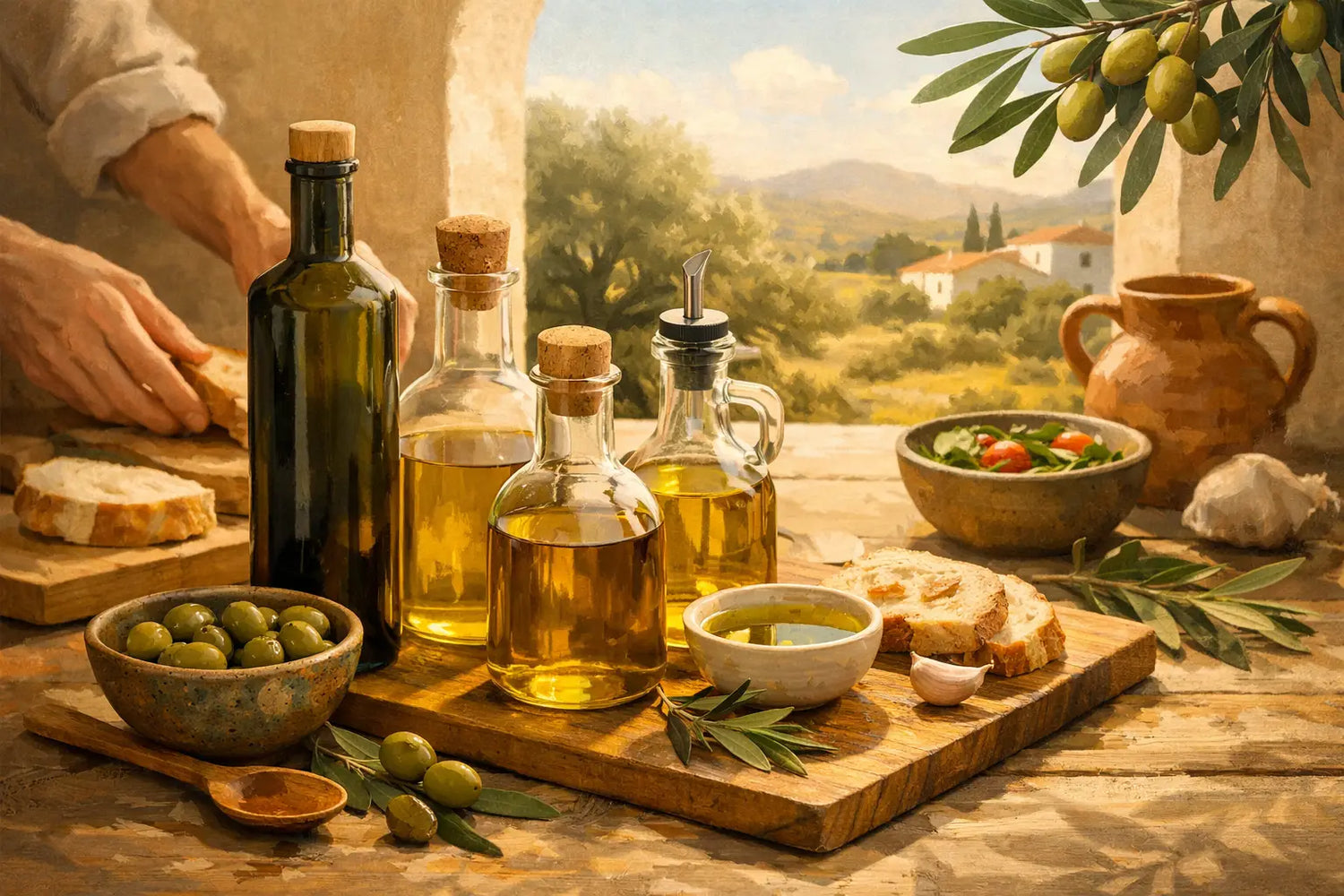
The pan is hot, the onions are waiting, the salad is already on the table. That's exactly when it becomes clear whether an oil just provides fat or if it's an ingredient. Organic olive oil for everyday cooking doesn't have to sit in the cupboard waiting for its grand entrance. It can go on toasted bread in the morning, into the pan at lunchtime, and over roasted vegetables in the evening. Provided it's fresh, well-made, and has a clear taste.
Organic is an important start. But organic alone doesn't say when the olives were harvested, who processed them, or what the oil tastes like. If you cook with olive oil every day, you should take a closer look. Not on principle. But because you'll notice the difference on your plate.
What good organic olive oil needs to achieve in everyday life
A good organic extra virgin olive oil brings three things together: It carries aromas, it connects ingredients, and it adds its own accent. In a tomato sauce, it makes the acidity rounder. On beans, lentils, or potatoes, it creates depth. With yogurt, lemon, and salt, it turns into a dressing in a minute that tastes like more than just routine.
For everyday use, therefore, you don't need a neutral, arbitrary oil. Neutrality is often mistaken for versatility. In fact, neutral fat lacks precisely what makes simple dishes interesting: fragrance, fruitiness, a fine bitterness, and a slight pungency in the finish. This pungency is not a defect. It can be an indication of natural antioxidant plant compounds like polyphenols.
This doesn't mean that every meal should taste of olive oil. For very delicate dishes, such as a light vanilla sauce, another fat is more suitable. But for vegetables, eggs, pasta, legumes, fish, meat, soups, and bread, a characterful olive oil is one of the easiest choices for more flavor.
Organic Olive Oil for Everyday Cooking: Organic Isn't Enough
The EU organic label stands for controlled organic farming and clear rules for agriculture. This is correct and relevant. However, it is not an automatic guarantee of freshness, artisanal processing, or complete traceability. Even organic olive oil can consist of large, anonymous blends from different regions and harvests.
Therefore, the chain behind the label is crucial. Which region do the olives come from? Is a variety named? Is there information about the harvest and the mill? Was it processed quickly after harvesting? And is it traceable who is responsible for the oil? The more specific these answers, the less room there is for marketing haze.
With high-quality oil, quality begins in the olive grove and doesn't end at the bottling plant. Earlier harvested, healthy olives often yield a more intense, greener profile with more bitterness and pepper. Later harvested fruits can taste milder and riper. Both can be good. The important thing is that the oil does not appear tired, flat, or rancid.
An oil from a clearly named variety like Koroneiki, for example, can be very lively, grassy, and peppery. This pairs excellently with grilled vegetables, feta, lemon dishes, and hearty salads. Those who prefer it milder can simply use the same quality in smaller doses or combine it with ingredients that absorb its freshness – such as potatoes, bread, or roasted pumpkin.
Reading the information on the bottle correctly
"Extra virgin" is the highest legal quality grade for olive oil. It is the basis, not the whole story. A low acidity value is a good sign of carefully processed olives, but on its own, it says little about aroma and taste. A lab value does not replace sensory quality.
Pay particular attention to a harvest year or harvest date. A best-before date is helpful, but less meaningful: it doesn't necessarily reveal how long the oil has been in transit or stored. Olive oil is not wine that gets better in the cellar. Freshness is a quality characteristic.
Packaging also matters. Light and heat are enemies of oil. Dark glass, a light-protected tin, or a good refill solution help preserve aroma and valuable ingredients longer. A transparent bottle on a brightly lit supermarket shelf is not an ideal home for a delicate natural product.
Another touchstone is the origin information. "Olive oil from the European Union" may be correct, but remains vague. Those who shop consciously can expect more: a specific country of origin, a region, ideally their own harvest and their own mill. O.E.L. Berlin relies precisely on this traceability instead of anonymous supermarket blends.
Can you fry with extra virgin olive oil?
Yes. Good extra virgin olive oil is suitable for daily pan-frying, sautéing, frying at medium to higher heat, and for oven vegetables. It brings flavor and remains stable during normal cooking. The claim that it should never be heated fundamentally does not hold up to normal kitchen practice.
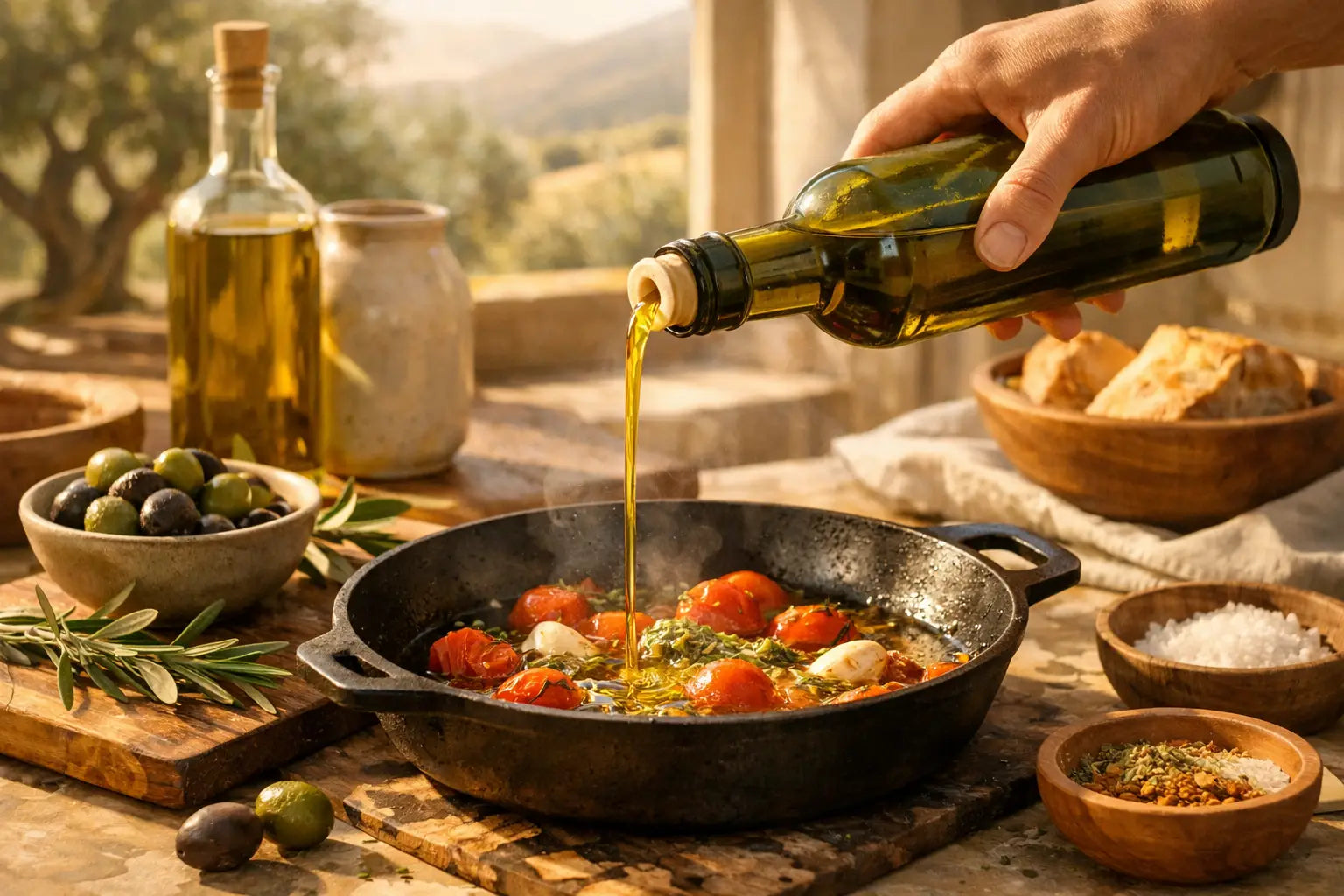
The difference lies in the temperature and the goal. Sautéing onions until translucent, stir-frying vegetables, frying a fried egg, or roasting eggplants: olive oil is an excellent choice for these. If the oil is smoking, the heat is too high – regardless of what oil is in the pan. Then the taste suffers, and the kitchen smells burnt instead of roasted.
For extreme, long-term deep-frying at very high temperatures, a dedicated oil may be more sensible. Not because olive oil would be inferior, but because its fine aroma would be wasted and the application has different requirements. Everyday usability does not mean forcing one product for everything. It means having the right oil on hand for most good meals.
This is what quality tastes like - even without a sensory seminar
You don't need specialized training to assess an oil. Pour a small sip into a glass, warm it briefly with your hand, and smell it. Fresh oil can evoke green grass, artichoke, tomato leaves, herbs, almonds, or green banana. In the mouth, it should be fruity, noticeably bitter, and slightly to distinctly peppery in the throat.
Rancid notes often present as waxy, musty, or old-nutty. An impression like cardboard, cellar, or stale peanuts does not belong. Many people consider such notes to be the normal olive oil taste because they haven't experienced it differently for a long time. This is not a personal fault. It merely shows how low the standard for mass-produced goods has often become.
Tasting is not a side issue. It helps you to better dose quantities. An intensely fruity oil might only need a small drizzle on a burrata. A milder oil can be more generously poured over roasted vegetables or into a cake. Quality does not mean maximum pungency. Quality means balance, clarity, and a taste that matches the dish.
One oil, many daily decisions
Don't just put the oil on the table for serving. Use it at the beginning of cooking for garlic and onions, during cooking for a quick marinade, and at the end as a finishing touch. It's precisely this last small amount that makes a difference: over a lentil soup, on rice with herbs, with fried fish, or on a slice of sourdough bread, it brings back freshness that heat and long cooking times may have diminished.
Those who cook frequently benefit from a larger container and refill a smaller bottle for the countertop. This reduces packaging and prevents a large bottle from constantly sitting next to the stove. The reserve belongs in a cool, dark, and well-sealed place in the cupboard. Not in the refrigerator: there, the oil can become cloudy without necessarily being bad, but handling becomes unnecessarily cumbersome.
In the end, good organic olive oil is not an ingredient for special days. It is a daily decision against interchangeability. Don't buy the oil that just happens to be there. Buy one whose origin you understand, whose freshness you can taste, and that makes you want to turn a simple meal into something you truly look forward to.


Leave a comment
All comments are moderated before being published.
This site is protected by hCaptcha and the hCaptcha Privacy Policy and Terms of Service apply.