
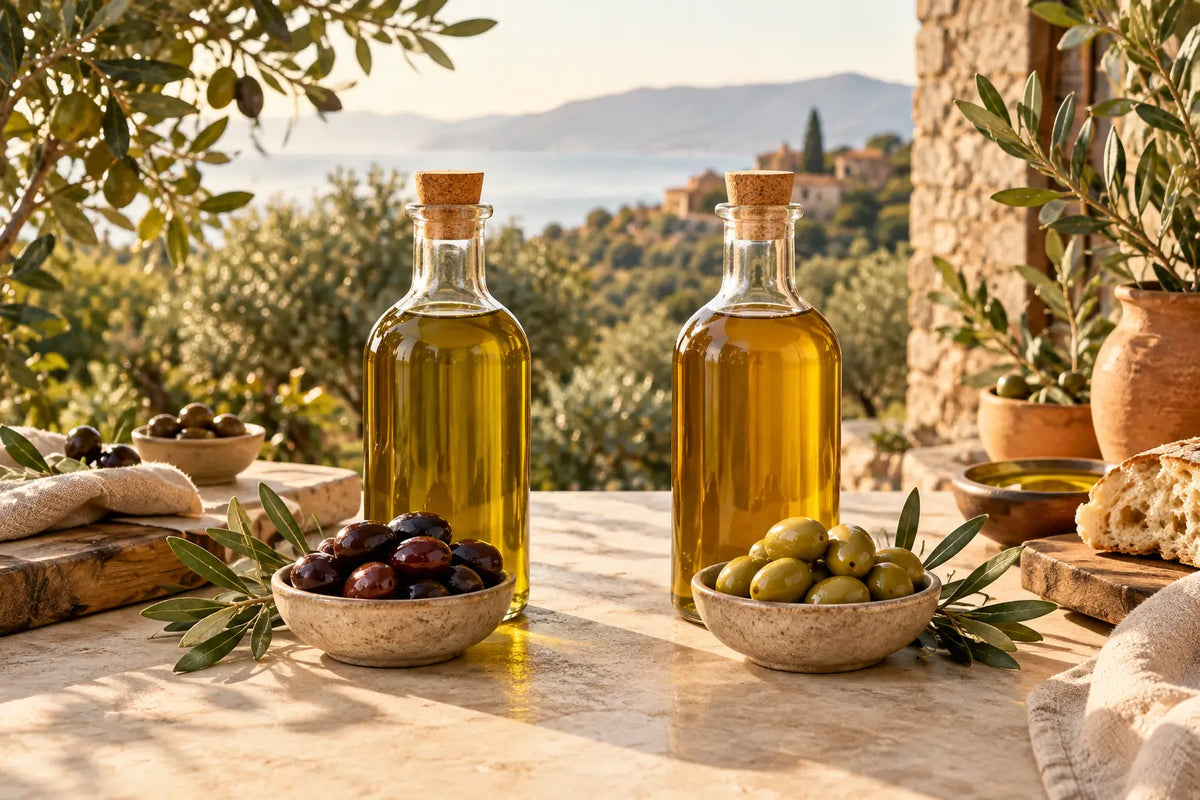
If you feel a scratch in your throat the first time you try a fresh olive oil, you haven't made a mistake. At best, you are experiencing quality: fresh olives, cleanly processed, full of natural plant compounds. This is exactly where the question of Koroneiki or Arbequina olive oil becomes interesting. Both varieties can be excellent. But they do not taste the same, grow under different conditions, and require a look beyond the pretty label.
The variety is a good starting point. But it is not the whole truth. Harvest time, freshness, the mill, storage, and transparency ultimately determine whether an oil tastes lively or merely greasy.
Koroneiki or Arbequina olive oil: the difference in the glass
Koroneiki is Greece's defining olive variety. It is small, hardy, and often produces oils with a clear green aromatic profile when harvested early: freshly cut grass, wild herbs, tomato leaf, artichoke, and sometimes green apple or almond. On the palate, it shows structure. On the finish, it may be bitter and noticeably peppery.
Arbequina originally comes from Catalonia and is now particularly widespread in Spain. Its profile is usually softer and rounder: ripe almond, banana, apple, and sometimes butter or mild herbs. Good Arbequina oils can be wonderfully elegant. Those who have only known neutral supermarket oil until now may find it easier to get into than a uncompromisingly fresh Koroneiki.
This is not a ranking. It is a question of style. Koroneiki makes an aromatic statement. Arbequina accompanies more discreetly. Anyone who understands olive oil not merely as frying fat, but as an ingredient with its own voice, will immediately notice this difference.
Taste is not a coincidence, but a harvest decision
The variety provides the potential. How the olives are treated determines the result. If they are harvested early, while still green, and processed quickly, the result is often more intense, fresher-tasting oils with more bitterness and sharpness. With a later harvest, the aromas continue to mature: the oil becomes milder, softer, and often yellower in expression. This applies to Koroneiki just as much as to Arbequina.
This is why the statement "Koroneiki is always sharp" is too simplistic. A late-harvested or long-stored Koroneiki can taste surprisingly mild. Conversely, an early-harvested Arbequina can have significantly more bite than its reputation suggests.
The time between harvest and pressing is also crucial. Olives are fruit. If they lie too long in crates or sacks, quality begins to deteriorate before the mill even starts. Freshness, short transport routes, and controlled processing are not romantic details. They make the difference between clear aromas and dull heaviness.
What bitterness and sharpness really mean
Many people have learned that good oil must be as mild as possible. This is a convenient industry narrative. A high-quality extra virgin olive oil may be bitter and peppery, especially when harvested early. Both can indicate a high content of polyphenols, which are natural antioxidants from the olive.
Balance is what matters. An oil should not taste scratchy, dull, or aggressive. It should smell fresh and have a clean finish. The sharpness often only appears when swallowing. This brief cough is not a flaw, but in young, polyphenol-rich oils, it is often part of the sensory profile.
Arbequina is milder on average, Koroneiki more expressive on average. Anyone specifically looking for an oil with green freshness, a peppery finish, and noticeable presence will often end up with Koroneiki. Anyone who prefers creamy, nutty mildness or does not want to overpower very delicate ingredients may be right with Arbequina.
Which variety suits which cuisine?
Koroneiki shows its strength when a dish can handle contrast. Over roasted vegetables, white beans, lentils, oven-baked potatoes, or a thick slice of sourdough bread, it brings tension. It pairs with tomatoes, lemon, feta, grilled fish, and robust salads. Drizzling a fresh, peppery oil over pasta at the end changes the dish more than another pinch of salt.
Arbequina is strong when restraint is required. It harmonizes with delicate fish, mozzarella, mild leafy greens, mayonnaise, cake, or desserts with citrus fruits. It is also often a pleasant introduction for people who are just beginning to explore high-quality olive oil.
When frying, both varieties are generally suitable, as long as it is a good extra virgin olive oil and the pan is not needlessly overheated until it smokes. But it would be a shame to let a distinctive, early-harvest oil disappear exclusively in a hot pan. The finest aromas belong where you can taste them: in the finished food.
Origin before variety name
Seeing "Arbequina" or "Koroneiki" on the label is not yet proof of quality. The variety may be clearly stated, while origin, harvest, and processing remain shrouded in mystery. Especially with anonymous commercial oils, price, availability, and a consistently uniform taste often count. For this, oils from different years, regions, and qualities are blended. Practical for calculation. Boring on the plate.
Anyone who buys consciously should look more closely: Is the place of harvest clearly stated? Is there a specific harvest year or window? Do you know where it was pressed? Is the acidity stated as a value below the legal maximum or transparently categorized? Are there laboratory values for polyphenols? And above all: Is it traceable who takes responsibility for the oil?
Low acidity alone does not make a great oil. But it is a sensible building block, because it can indicate healthy, carefully processed raw material. In combination with sensory freshness, transparent origin, and clean storage, this creates a reliable picture of quality.
This is why Koroneiki from our own harvest and our own mill is at the heart of O.E.L. Berlin. Not because other varieties are fundamentally worse. But because origin only becomes credible when you can show it from the olive to the bottle. No anonymous blends. No stories without proof.
The most common misconception: mild means high quality
Mild can be great. But mild can also simply mean old, flat, or over-filtered. Over time, many oils lose the green notes that make them lively. What remains is fat without character. This is not automatically spoiled, but it is also no argument for quality.
Therefore, do not look at the best-before date as a purchasing incentive, but as an indicator of freshness. The further into the future it is, the more likely the oil comes from a more recent bottling. Even better: a clearly stated harvest date. Store the bottle in a dark, cool place and keep it tightly sealed. Light, heat, and oxygen are the enemies of a good oil, regardless of the variety.
Do I need both varieties at home?
Not necessarily. Anyone who likes cooking Mediterranean dishes with plenty of vegetables, legumes, tomatoes, and bread can get very far with a distinctive Koroneiki. It gives everyday dishes depth without having to cook more complicatedly.
Two oils make sense if you consciously want to work with contrasts: a green, peppery Koroneiki for the final touch and a mild Arbequina for delicate ingredients or sweet applications. The size of the collection is not what matters. What matters is that every bottle is fresh, used openly, and not forgotten for months next to the stove.
The better question when buying
Do not ask only: Koroneiki or Arbequina? Ask: When were the olives harvested, how quickly were they pressed, how transparent is the origin, and does the oil taste like fresh fruit? Only then does a variety decision become a good purchasing decision.
A truly good olive oil should not impress in the cupboard. It should stand out on the plate—over warm vegetables, in a simple vinaigrette, on bread that was really just bread. Choose the variety that you enjoy using generously. Quality that you skimp on remains merely a promise.

Leave a comment
All comments are moderated before being published.
This site is protected by hCaptcha and the hCaptcha Privacy Policy and Terms of Service apply.