
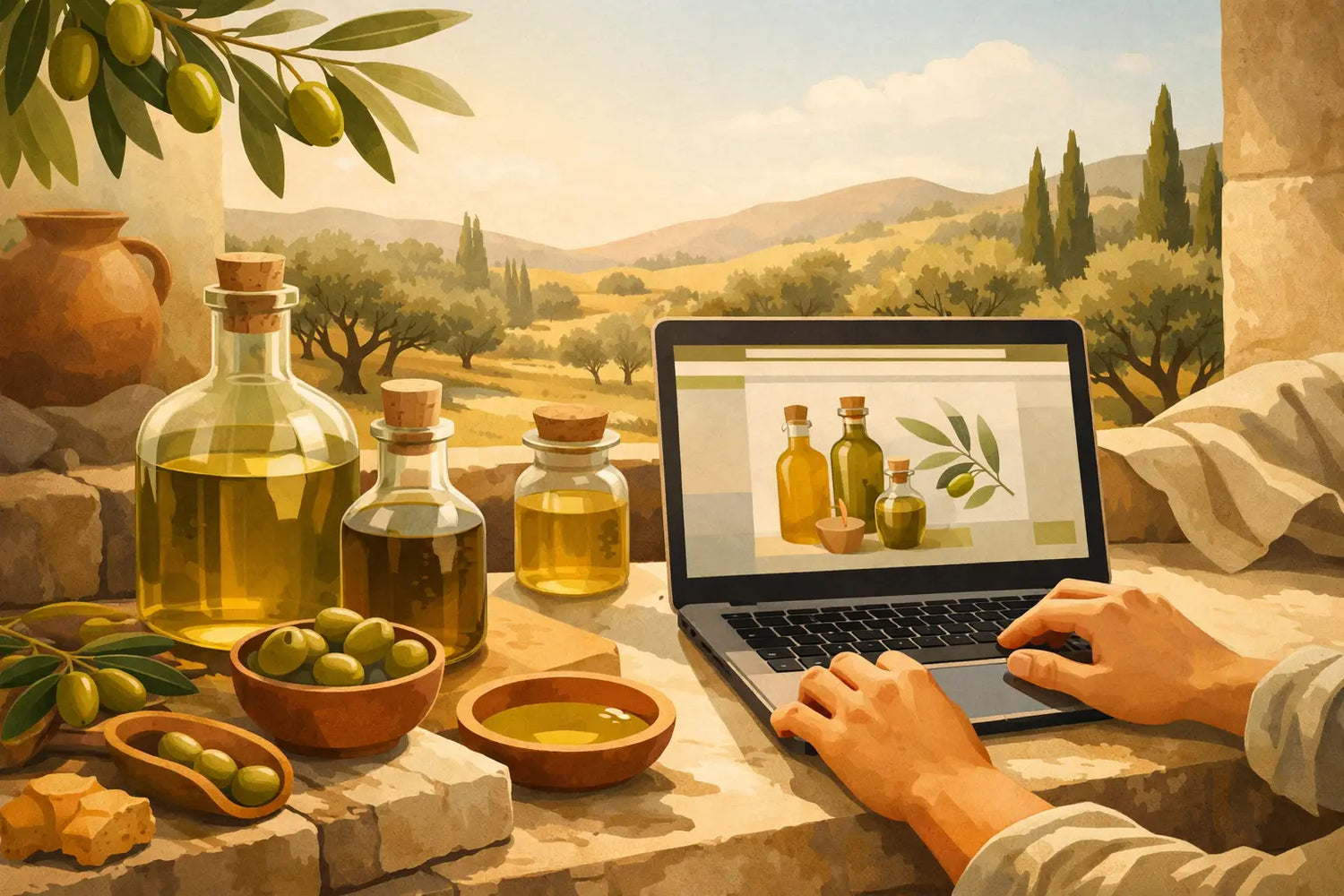
Anyone looking to buy olive oil online will first and foremost see beautiful bottles, Mediterranean images, and grand promises. That’s precisely where the problem begins. Because good olive oil is not recognized by romantic labels, but by its origin, harvest, processing, and whether a provider is willing to clearly disclose these points.
Online, the selection is larger than in stores. This is an advantage – and a trap. There are worlds between genuine extra virgin olive oil from a traceable harvest and interchangeable commercial goods. In terms of taste, health, and even culture. If an oil only sounds like "Southern Europe" but doesn't say from which grove, which mill, or which harvest it comes, often only marketing remains in the end.
Buying olive oil online means checking for trust
In a physical store, you can pick up a bottle. You can't do that online. That's why something else is all the more important: verifiable information. A reputable provider does not hide behind bland formulations like "best quality" or "traditionally made." They specify the variety, origin, harvest time, ideally even the mill, analytical values, and sensory profile.
Anyone who sells truly good olive oil can explain why it is good. Not vaguely, but concretely. Which olive was processed? Was it harvested early or late? How quickly did the olives reach the mill after harvesting? How low is the acidity? Are there details on polyphenols or at least indications of fruitiness, bitterness, and pungency? Exactly these details separate artisanal quality from anonymous mass-produced goods.
When buying online, transparency replaces tasting. If it's missing, that's not a minor shortcoming, but a warning sign.
How to recognize real Extra Virgin Olive Oil
Extra virgin olive oil is not a lifestyle term, but a clearly defined quality grade. Nevertheless, it is found today on products that taste sensorially flat, old, or simply insignificant. Legally, an oil can meet the minimum requirements and still be culinarily disappointing. Therefore, it's worth taking a second look.
A high-quality oil feels alive. It smells fresh, green, sometimes of tomato leaf, artichoke, herbs, or green almond. In the mouth, it should be fruity, often bitter and peppery. Many consumers initially mistake this pungency for a flaw. In fact, it is usually a good sign in fresh, polyphenol-rich oils.
Mild is not automatically better. Very mild oils certainly suit some dishes, but if an oil fundamentally says nothing, that is rarely a sign of quality. Character is not created by arbitrariness, but by variety, terroir, and fresh processing.
Origin is more than a country on the label
"From Greece", "from Italy" or "from Spain" is not enough information. These countries produce outstanding oils - and huge quantities of average ones. What matters is the specific origin. Region, producer, olive variety, and ideally the connection between harvest and mill make the difference.
It becomes particularly exciting when a provider not only bottles but truly knows the olive's journey. Own harvest, own mill, or long-standing, direct partnerships are not minor details. They create control over freshness and quality. This is precisely what is missing in many blends, which are put together from various batches, regions, or even countries, until ultimately a pleasant, standardized oil is produced.
Freshness beats folklore
Olive oil is not wine. It usually does not improve with storage. A fresh oil is often more aromatic, precise, and vital. The harvest date is therefore more important than any nostalgic story on the label.
If no harvest year is given, one should be skeptical. The best-before date alone is of little help, as it can be derived from the bottling date or the sales date. An oil from a fresh harvest tastes different - clearer, greener, more exciting. When buying online, one should therefore specifically look for current harvest information.
Buying olive oil online: What information should not be missing
A good shop does not have to appear complicated. But it should answer the relevant questions before they even need to be asked. This includes variety, origin, harvest year, quality grade, and a realistic flavor profile. Equally important are container sizes, storage instructions, and honest statements about what the oil is intended for.
Not every high-quality oil is automatically the right one for every household. Those who cook daily need different formats than someone who only occasionally enhances a salad. Small bottles are useful if you want to try different oils or quickly use up a particularly intense oil. Larger containers are worthwhile for families, frequent cooks, and anyone who sees oil not as decoration, but as a basic ingredient. Refill solutions are not only practical, but often fresher and more economical than constantly buying new small bottles.
Another point is the packaging. Dark glass or light-protected containers are mandatory, not optional. Light, heat, and oxygen are the natural enemies of aroma. Anyone who promises premium quality and sells oil in problematic packaging is saving at the wrong end.
Price: expensive, cheap or just unclear?
Good olive oil costs money. Not because it should sound luxurious, but because true quality in agriculture is expensive. Careful harvesting, quick processing, low yields, clean mill work, sensory control, and sensible packaging do not produce a cheap price.
This doesn't mean that the most expensive oil is automatically the best. However, it does mean that extremely cheap offers usually have a catch. Either it's industrial mass production, old goods, an arbitrary blend, or a product where more has been invested in branding than in the content.
When comparing prices, one should therefore not only look at the price per liter, but at the value for money. A fresh, single-varietal, traceable oil with a clear origin and distinctive flavor is often the better everyday choice than a cheap oil, of which one needs more and which still brings less joy.
Taste is personal - quality is not arbitrary
Some like green, pungent oils. Others prefer a rounder, softer style. Both are legitimate. Personal taste begins where quality is assured. What should not be negotiable is freshness, cleanliness, and transparency.
That's why good product descriptions are so important online. They not only help with the purchase, but also prevent disappointment. A peppery oil for fish carpaccio, a balanced oil for vegetables and legumes, a strong one for bitter notes in winter salads - that's not snobbery, but kitchen logic.
A provider who takes taste seriously doesn't just describe how "super delicious" their oil is. They specify its aroma and application. This shows respect for the product and for the people who cook with it.
The typical trap when buying online
Many shops sell olive oil like a gift item. Lots of design, little substance. That works until you open the bottle. Then it's not the branding that decides, but the aroma.
If a shop talks more about packaging, lifestyle, and holiday moments than about harvest, variety, and processing, one should be attentive. The same applies to exaggerated health promises without reliable information. Polyphenols, acidity, and sensory freshness are relevant topics. But they deserve precision instead of buzzwords.
This is precisely where honest trade separates itself from decorative marketing. No industry. No tricks. No compromises. This is not a pose if the facts behind it are visible.
Why direct purchasing is often the better choice
Buying directly from a specialized brand or a transparently operating producer has a simple advantage: The path between harvest, bottling, storage, and shipping is usually clearer. The oil does not lie for months in opaque trade stages, but reaches the customer in a more controlled manner.
For buyers who take origin seriously, this is more than convenience. It is a question of the product's integrity. If it is traceable where the olives come from, when they were harvested, and how they were processed, an interchangeable cooking oil becomes a food with identity.
Precisely for this reason, an approach like that of O.E.L. Berlin is convincing: not with vague origin images, but with traceable quality, clear principles, and an oil that truly makes a difference in food.
Ultimately, what happens in the kitchen matters
Buying olive oil online is worthwhile if you don't fall for pretty promises, but pay attention to clear origin and fresh quality. The right oil gives roasted vegetables more depth, a simple salad more excitement, and a piece of bread a real moment. Those who choose consciously will taste the difference not only at the first tasting, but every day at the stove.

Leave a comment
All comments are moderated before being published.
This site is protected by hCaptcha and the hCaptcha Privacy Policy and Terms of Service apply.