
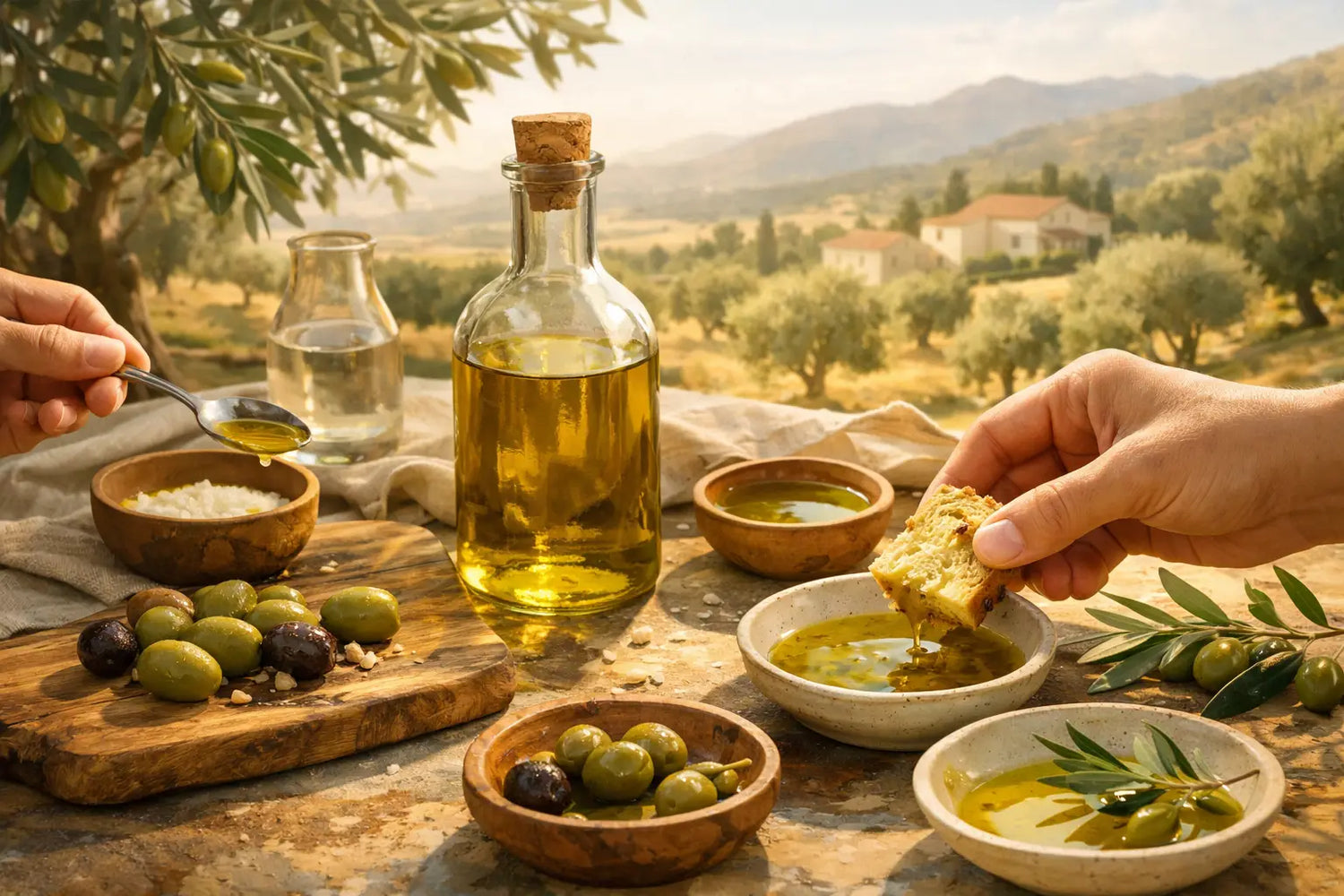
If you only think of olive oil as "mild," "fruity," or "Italian," you probably haven't tasted truly good oil. Because the question of what high-quality olive oil tastes like reliably separates two worlds: anonymous supermarket oil on one side, fresh, cleanly produced extra virgin olive oil on the other. The difference is not small. It is immediately apparent in the mouth.
High-quality olive oil tastes vibrant. It has fruitiness, often bitterness, and a noticeable pungency in the throat. This is precisely what irritates many people when they first try it, because they have been accustomed to bland, old, or technically smoothed oils for years. What many perceive as "too intense" is often, in reality, a sign of freshness, healthy olives, and careful processing.
What does high-quality olive oil taste like in direct comparison?
When you taste good olive oil neat, a clear fruitiness usually comes first. This can be reminiscent of freshly cut grass, green tomatoes, artichoke, almond leaf, herbs, or unripe banana. Some oils appear greener and firmer, others riper, rounder, and softer. What matters is not that an oil always tastes the same. What matters is that it tastes clear, clean, and precise.
Then often comes the bitterness. Yes, bitterness. Not as a flaw, but as a quality. Especially fresh oils from early-harvested olives bring this tart, elegant note. It primarily sits on the tongue and, depending on the variety, is reminiscent of chicory, arugula, or green walnut. Those who only know stale mass-produced goods quickly confuse bitterness with harshness. In fact, it often shows that there is still a lot of life in the olives.
Finally, the pungency follows. It often appears in the throat, sometimes only after one or two seconds. A slight to distinct scratchiness or cough is not a defect. It is an indication of polyphenols, those natural plant compounds that not only add depth of flavor but are also crucial for the stability and character of an oil. A truly fresh oil should have exactly that.
The three characteristics: fruity, bitter, pungent
Extra virgin olive oil is professionally tasted based on three positive fundamental characteristics: fruitiness, bitterness, and pungency. These three form the sensory backbone. If all of these are missing, the oil is usually simply insignificant. If one of them is extremely unbalanced, harmony is often lacking.
Fruitiness does not mean sweetness. It describes the aromas of healthy, fresh olives. A high-quality oil can appear green-fruity, reminiscent of herbs, leaves, and unripe vegetables. But it can also be more yellow-fruity, with notes of ripe banana, almond, or apple. Both can be good, as long as the aroma profile remains clean.
Bitterness is more pronounced, especially in early-harvested olives. It is intentional. Especially in varieties with a lot of character, it is part of it. Pungency, in turn, is the sensory echo of freshness. An oil that starts gently and has a distinctly peppery finish in the throat often has much more to say than one that disappears immediately.
This does not mean that every good oil has to be brutally intense. There are elegant, softer oils with a fine structure and still high quality. But a high-quality olive oil should never taste completely neutral, dull, or greasy.
What high-quality olive oil should NOT taste like
The better question is often not just: What does high-quality olive oil taste like? But also: What does it not taste like?
It should not taste rancid. So, not like old nuts, wax, cardboard, or stale fat. It should also not appear musty, moldy, winey-vinegary, or dull. Such notes are not flavors, but flaws. They arise from bad fruit, too long storage, unclean processing, or improper transport.
Also problematic is an oil that seems "mild" but is, in reality, simply empty. Many consumers have been trained to confuse neutrality with quality. However, a bland oil is often just one thing: old, filtered to the point of characterlessness, or made from blends that are primarily intended not to offend anyone. No edges, no corners, no statement. Practical for industry. Boring for the kitchen.
Why good olive oil often tastes more intense
Intensity is not a marketing effect, but the result of many decisions. Which olive variety was used, when it was harvested, how quickly it was milled after harvest, how cleanly the mill operates, and how the oil is stored - you taste all of this later in the dish.
Early-harvested olives usually yield less, but have more character. The oil is greener, more bitter, more pungent, and aromatically more complex. Later-harvested olives often yield more quantity and a milder taste. Both can be sensible. However, those looking for maximum freshness, high polyphenol values, and clear sensory tension will almost always be closer to early harvest than to industrial late harvest.
Time is also crucial. Ideally, only a few hours should pass between harvesting and processing. Fresh fruits oxidize, damaged fruits even faster. Those who take origin seriously and do not work with anonymous mass-produced goods can talk about exactly that: Which olive? Which harvest? Which mill? Which vintage? That's where trust begins.
What does high-quality olive oil taste like with food?
Tasted neat, good oil reveals its truth. In the kitchen, it shows its value. On warm sourdough bread, a fresh oil suddenly becomes magnificent. Peppery pungency, green notes, slight bitterness - everything becomes clearer. Added over tomatoes, beans, fish, or simple mashed potatoes, it makes the difference between "quite good" and "just one more spoon."
A characterful oil is not a neutral frying fat substitute. It is an ingredient with attitude. With burrata, it can be grassy and peppery. With grilled vegetables, it can be more bitter and herbaceous. With vanilla ice cream or lemon cake, some oils with almondy, soft tones work surprisingly well. What matters is not to use the same oil for everything, but to understand what tone the oil sets.
Precisely for this reason, the old habit of only " saving good olive oil for salad" is short-sighted. A clean, fresh extra virgin olive oil elevates simple everyday dishes. It makes lentils, pasta, eggs, or oven-roasted vegetables not more complicated, but better.
How to taste olive oil correctly
You don't need a sensory seminar. A small glass is enough. Put some oil in it, warm it slightly with your hand, and smell it first. Do fresh, vegetal, clear aromas come towards you? Or rather nothing at all?
Then take a small sip and spread the oil in your mouth. Pay attention to the order. What happens first on your tongue? Does it become bitter? Is there pungency in the back of your throat? Does something fresh, green, or almondy remain? A good oil develops. A weak oil collapses immediately.
If you want to compare, try two or three oils side by side. Only then will it become obvious how big the gap between fresh quality and arbitrary commercial goods really is. This is often where one's perspective on olive oil permanently changes.
Why taste is also a matter of origin
Olive oil is not a standardized industrial product, even if trade likes to make it seem that way. Variety, climate, soil, harvest time, and processing strongly influence the taste, similar to wine - only more directly. A Koroneiki from Greece typically brings different accents than a Picual from Spain or a Taggiasca from Italy.
Documenting origin cleanly not only creates transparency but also taste expectation. This is not a detail for label enthusiasts, but for everyone who wants to know why an oil tastes the way it tastes. If harvest, mill, and batch are traceable, quality becomes verifiable. And that is precisely what is missing in many blends that only work with Mediterranean longing images.
O.E.L. Berlin starts precisely there: no anonymous mixture, no stories without proof, but traceable origin, own harvest, own mill, and a taste that is not bred for complacency.
Does high-quality olive oil have to appeal to everyone immediately?
No. And that is perhaps the most honest answer. Those who have only had bland, old, or degreened oils for years sometimes need two or three samples to correctly classify the bitterness and pungency. Taste is habit, but quality remains quality nonetheless.
It also depends on what you are looking for. For some dishes, you want a green, peppery oil with a kick. For others, one with a softer profile. Not every intense oil is automatically better, and not every mild oil is automatically bad. But a high-quality oil always has precision, freshness, and a clear character. It never tastes arbitrary.
Once you understand what high-quality olive oil really tastes like, you shop differently. Not for romantic notions of origin, not for golden color, not for the softest advertising promise. But for freshness, transparency, and sensory truth. That's when olive oil changes from an interchangeable ingredient to what it should be: a food with origin, craftsmanship, and character.
Next time you taste, don't look for "mild." Look for life in the glass.


Leave a comment
All comments are moderated before being published.
This site is protected by hCaptcha and the hCaptcha Privacy Policy and Terms of Service apply.